

World Liberty Financial Proposes WLFI Staking to Boost Community Governance
- World Liberty Financial has introduced a new governance proposal that seeks to enable staking for WLFI holders to incentivize them to participate in community governance.
- It targets a 2% APR, but unlike in other PoS networks where yield is paid from fees and new tokens minted, WLF treasury will directly pay stakers.
World Liberty Financial has published a new proposal detailing a plan to introduce staking to the network to incetivize WLFI holders to participate in governance.
The proposal by the WLFI team notes that staking would enhance security, technological operations and confidence in the network. Stakers will be rewarded with a targeted return of 2% APR, but to qualify, they must stake the tokens for a minimum of 180 days and vote on at least two proposals in that time.
World Liberty Financial is a DeFi project deployed on Ethereum, with WLFI and its sister token, USD1, both issued on Ethereum as ERC-20 tokens. While they rely on the Ethereum PoS consensus mechanism for transaction validation and security, the WLFI team now wants its own community to take control over the network’s governance.
Currently, any user who holds WLFI can vote on governance proposals. So far, there have been five proposals, which have all passed. This includes one to test the network’s airdrop functionality by distributing USD1 to all WLFI token holders, which Binance has participated in, as CNF reported.
The proposal changes this and requires users to stake their tokens before voting on any proposal.
“This ensures that voting power is held by participants with long-term alignment to the protocol who elect to participate in the governance consensus mechanism, not short-term holders or speculators,” it says.
World Liberty to Pay Stakers Directly from Treasury
Under the new system, minimum lockup period is 180 days, and the governance power will be determined by the staking amount and the lock-up duration. Unlike in other staking environments where voting power can be delegated, governance rights on World Liberty Financial will be non-transferrable. The platform is targeting a 2% APR return on staking. To receive yield, stakers must vote at least twice.
One key difference with the staking is that the yield will not be generated from the transaction fees or new tokens generated, as happens with PoS networks like Solana and Ethereum. Rather, it will be paid directly by World Liberty Financial from its treasury, “based on what it determines will incentivize governance participation and other factors.”
This centralizes control over the staking, with the staking returns structured like company dividends. In the long run, World Liberty can decide to make changes unchecked, such as lowering the return rate. If the number of tokens staked surges, the treasury could shrink quickly, leaving no more tokens to pay out as yield.
This model is also detrimental to the network as it is not tied to network usage. With networks like Solana, the higher the usage, the higher the revenue generated, creating an ecosystem of sustainable rewards.
The proposal also provides for the creation of nodes and supernodes. However, these are structured around their capital committed and will not take part in any validation.
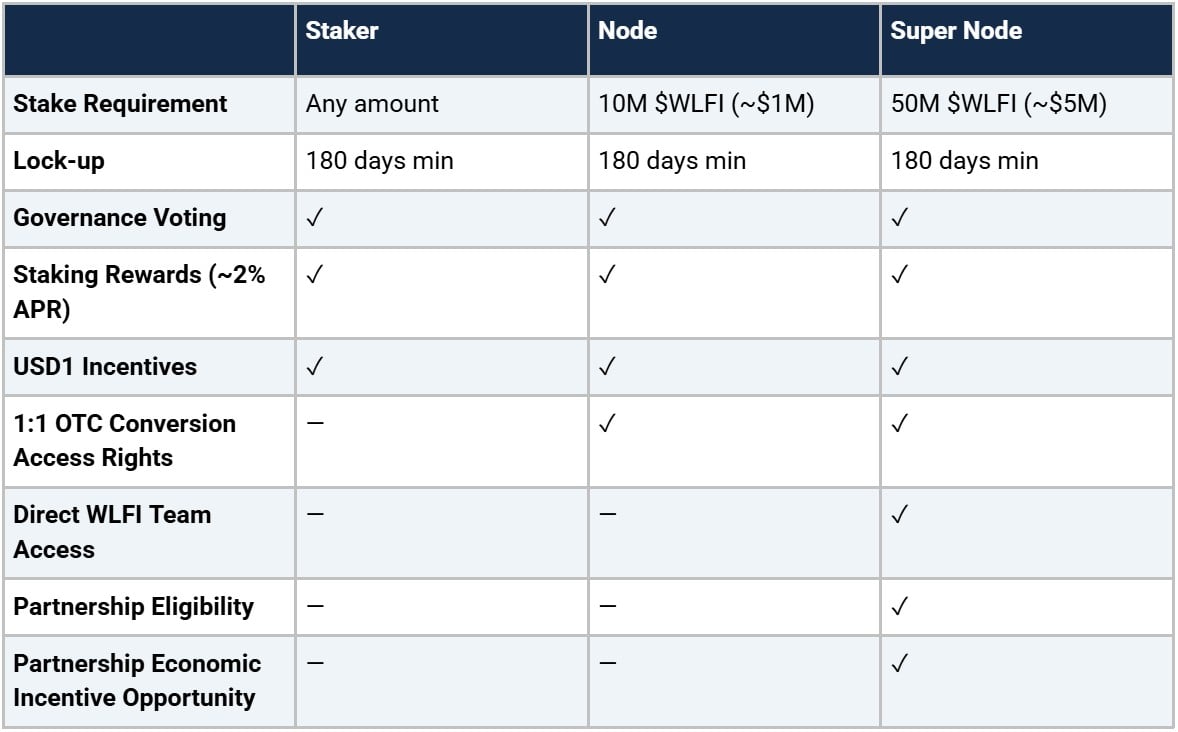 Image courtesy of WLFI.
Nodes must commit at least 10 million WLFI tokens (worth $1.17 million at current rates) and would benefit from direct connection to third-party market makers. They would also get direct mint-redeem access for USD1, capturing some of the value that has been previously going to the open market.
Super nodes must stake 50 million WLFI, valued at $5.8 million at current prices, and would get all the ‘node’ benefits, as well as direct coordination access with the World Liberty team and potential commercial partnerships.
This node structure has little to do with infrastructure. Rather, the World Liberty team is seeking to attract institutional capital in a private club tier system by offering them economic privileges at the expense of the rest of the market.
WLFI trades at $0.11177 at press time, gaining 2.59% at press time. USD1 has regained its peg after a brief depeg following the hack of its founders’ social media accounts, as we reported.
]]>

You May Also Like

AEVIS VICTORIA Shareholders Approve All Proposals at 2025 AGM

Mike Johnson 'fed up' with Trump as he ditches White House for first time: insiders

How to Spot a South African Cyber-Scam Before You Click “Pay”



