

Gate Gains Malta Payments License, Expands EU Fiat & Stablecoins
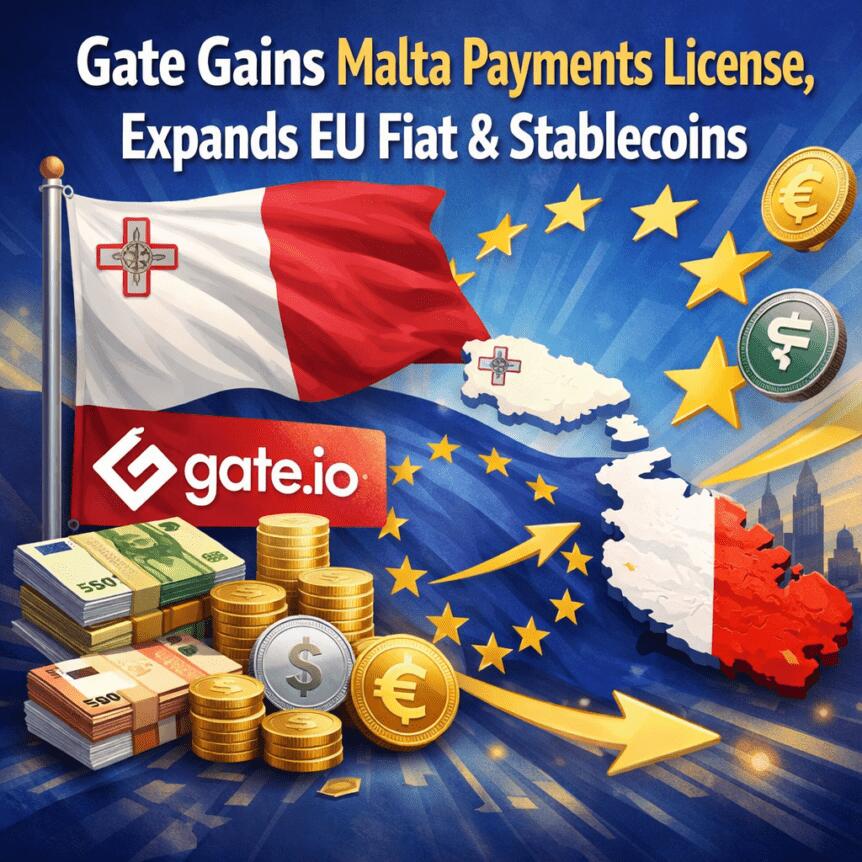
Gate, the crypto exchange behind a platform that serves millions of users worldwide, has cleared another regulatory milestone in Europe. The Malta-based group received a Payment Institution license from the Malta Financial Services Authority (MFSA), authorizing Gate Technology to provide regulated payment services across the European Union under the PSD2 framework. The move broadens Gate’s EU footprint beyond trading and custody into fiat and stablecoin payment rails within the bloc, reinforcing its strategy to fuse traditional payments infrastructure with Web3 capabilities in Europe. Gate notes that its global user base surpasses 49 million, underscoring the potential reach of an EU-wide payments platform. This latest authorization complements Gate’s prior MiCA license achievement, which granted cross-border exchange and custody capabilities across member states starting in 2025.
Key takeaways
- Gate Technology received a PSD2-based Payment Institution license from MFSA, enabling regulated payment services across the EU.
- The license expands Gate’s EU operations from crypto trading and custody into fiat and stablecoin payment infrastructure with passporting across member states.
- The development builds on Gate’s prior MiCA authorization, announced on Oct. 1, 2025, which allowed exchange and custody services throughout the EU.
- The MFSA listing confirms the authorization covers payment accounts and related operations, signaling a broadening of Gate’s regulated activities beyond crypto custody.
- The move reflects a broader industry trend, with other exchanges like OKX also securing Malta payment licenses to support euro-denominated payments within regulated rails.
Tickers mentioned:
Market context: The industry is increasingly aligning crypto services with traditional payments regulation in the European Union, particularly under MiCA and PSD2, to enable regulated, cross-border flows for crypto-related payments and stablecoins.
Sentiment: Neutral
Price impact: Neutral. The licensing news signals regulatory alignment and potential product expansion, but does not by itself indicate immediate price moves.
Trading idea (Not Financial Advice): Hold. As Gate expands its EU payments capabilities, strategic execution and regulatory milestones will influence momentum, but investors should watch timelines and product launches for concrete impact.
Market context: The Maltese authorization sits within a broader EU push to regulate crypto-enabled payments. With MiCA shaping governance of crypto-asset providers and PSD2 guiding payment services, exchanges are increasingly obtaining cross-border licenses to deliver euro-denominated, regulated payments alongside crypto trading.
Why it matters
The MFSA’s decision to grant Gate Technology a PSD2-based Payment Institution license elevates Gate’s position from a crypto-trading platform to a dual-rails provider that can handle both digital assets and fiat payments within Europe. This is not merely a compliance tick-box; it expands the company’s ability to offer payment services that connect traditional financial rails with Web3 applications. For users, this could translate into streamlined on- and off-ramps, simpler fiat-to-crypto exchanges, and potentially cost-efficient mechanisms for transferring value across borders within the bloc.
From a strategic perspective, Gate’s move aligns with a growing trend among major crypto firms seeking to embed themselves more deeply in regulated payment ecosystems. By leveraging PSD2, Gate can passport payment services across EU member states, a capability that complements its MiCA authorization which already opened the door to cross-border exchange and custody. In practice, this means Gate aims to provide a more seamless experience for institutions and retail customers who rely on both crypto services and conventional payment rails—for example, funding accounts with cash or withdrawing funds into traditional bank accounts, all within a tightly regulated framework.
While the public benefits are clear, several questions remain. Gate did not specify which payment products it intends to launch first or the exact rollout timeline across EU markets. Industry observers will be watching for details on whether Gate will introduce fiat-to-crypto gateways, card-based payments, or stablecoin-enabled transfers tied to EU payment rails. The MFSA listing confirms that payment accounts and related operations are within Gate’s scope, but product-level specifics will determine how quickly end users experience tangible advantages.
In this environment, Gate’s competitors are also pursuing similar regulatory paths. OKX, for instance, obtained a Malta Payment Institution license to support products such as OKX Pay and the OKX Card, illustrating a coordinated push among exchanges to secure regulated access to euro-denominated payment channels. Under MiCA, providers that integrate stablecoin payments into regulated rails must stay aligned with EU payments law, which makes these licensing steps an increasingly common prerequisite for exchanges seeking broader European reach. As such, Gate’s PSD2 authorization is best understood as part of a wider shift toward regulated, interoperable crypto-financial services in Europe.
What to watch next
- Clarified product roadmap: Gate should reveal which payment services will launch first (fiat on/off ramps, card integration, or stablecoin payments) and the expected rollout timeline across EU member states.
- Regulatory cadence: Any MFSA-guided milestones or updates to Gate’s obligations under PSD2 and MiCA, including governance, reporting, or consumer protection enhancements.
- Merchant and institution adoption: Partnerships with banks, merchants, or fintechs that can leverage Gate’s regulated payment rails, potentially accelerating euro-denominated payment flows for crypto users.
- Cross-border usage: Practical tests of passporting capabilities across multiple EU jurisdictions and any friction points in onboarding or KYC processes for EU customers.
Sources & verification
- Gate Technology’s Malta PSD2 license grant announced by Gate via its public announcements.
- The MFSA public authorization catalogue listing Gate Technology as a licensed Payment Institution under Malta’s Financial Institutions Act.
- Gate’s earlier MiCA authorization announcement, confirming cross-border exchange and custody permissions across EU member states.
- OKX Malta Payment Institution license announcement as part of the broader EU compliance trend among major exchanges.
Gate expands EU payments with PSD2 license in Malta
Gate has openly described its Malta MFSA authorization as a strategic bridge between established payment infrastructure and emerging Web3 services across the European Union. The Maltese license is a formal recognition that Gate Technology can perform a spectrum of regulated payment activities, including initiating transfer operations, maintaining payment accounts, and enabling funds movement that originates from or terminates in the EU. In practical terms, Gate can, under PSD2, facilitate the kinds of payments that users expect when interacting with crypto platforms—cash-in and cash-out flows, transfers between wallets and bank accounts, and perhaps merchant-enabled payments that bridge crypto and fiat rails—without stepping outside regulatory boundaries.
The MFSA’s listing also underscores Gate’s ambition to deliver a fully compliant suite of services that integrate traditional financial rails with digital-asset tools. While the company has not named specific products for immediate launch, the authorization confirms a regulatory green light for operations that handle customer payments in a way that mirrors conventional financial institutions. This is particularly relevant for entities dealing with stablecoins, where staying within the ambit of regulated payment and electronic-money frameworks can facilitate smoother operations across borders while preserving consumer protections and compliance standards.
Market observers will be watching how Gate leverages this license to grow its European footprint, especially given the substantial scale of its user base. Gate reports a global user count exceeding 49 million, a figure that, if translated into EU activity, could significantly boost demand for euro-denominated payment solutions tied to crypto services. Yet the company’s reluctance to disclose a detailed EU user composition or a concrete product launch schedule hints at a cautious approach as it integrates new regulatory capabilities with its existing product lineup. In a sector where regulatory clarity is a competitive differentiator, Gate’s PSD2 license is a meaningful step toward a more seamless, compliant, and enterprise-friendly crypto ecosystem in Europe.
This article was originally published as Gate Gains Malta Payments License, Expands EU Fiat & Stablecoins on Crypto Breaking News – your trusted source for crypto news, Bitcoin news, and blockchain updates.


You May Also Like

Whale ‘1011’ Pours Another $9M USDC Into Hyperliquid After $230M Liquidation

Strong Hands, Strong Network: How Pi Network Is Building a Resilient Web3 Ecosystem

Pound Holds Ground as UK Business Activity Slips to One-Year Low



