Charles Hoskinson says Cardano is now on a defined, accelerated path to its most ambitious performance leap yet. In an August 31 AMA, the Cardano founder highlighted an open-for-review Cardano Improvement Proposal (CIP) for Leios—a staged implementation plan that, in its first iteration, targets a 30× to 65× throughput increase while preserving Cardano’s determinism and […]Charles Hoskinson says Cardano is now on a defined, accelerated path to its most ambitious performance leap yet. In an August 31 AMA, the Cardano founder highlighted an open-for-review Cardano Improvement Proposal (CIP) for Leios—a staged implementation plan that, in its first iteration, targets a 30× to 65× throughput increase while preserving Cardano’s determinism and […]

Cardano Founder: Leios To Deliver 65x Scaling Within 12–18 Months

Charles Hoskinson says Cardano is now on a defined, accelerated path to its most ambitious performance leap yet. In an August 31 AMA, the Cardano founder highlighted an open-for-review Cardano Improvement Proposal (CIP) for Leios—a staged implementation plan that, in its first iteration, targets a 30× to 65× throughput increase while preserving Cardano’s determinism and UTXO model. “The throughput increases if Leios is implemented 30 to 65x,” Hoskinson said, adding that time-to-market is “about 1 to 1.5 years,” a compressed window he contrasted with a two-and-a-half to three-year timeline for a full, unsimplified build.

Cardano’s Biggest Scaling Milestone Yet

Hoskinson framed Leios as the anchor of a long-arc scaling agenda designed to push Cardano from consensus-bound ceilings toward network-bound ceilings. “The goal is to get a one-minus-delta protocol where you’re no longer consensus constrained but rather you’re network constrained,” he said. The initial design intentionally trims complexity relative to the research blueprint so client teams can co-develop and ship something “that massively improves the state of affairs” and can be upgraded iteratively thereafter.

The trade-offs of the first step are explicit. Hoskinson said transaction-inclusion latency would rise from roughly 20 seconds to around 40–60 seconds, a cost he presented as acceptable when measured against headline throughput gains and mitigable through parallel workstreams. “There’s always trade-offs in these things,” he noted, pointing to Hydra as one mitigation avenue today and to a joint evolution with Paris—Cardano’s fast-finality effort—for future confirmation times. He also emphasized that the hardware footprint remains modest: “Four-core machines,” he said, “which means that Raspberry Pis can run it,” alongside a cryptographic key-registration step.

As reported last week by Bitcoinist, the specification is not yet approved and is open for review by the broader ecosystem. It includes acceptance criteria, versioning and an implementation plan intended to align multiple independent node teams. “Next we need our partners like TXPipe and Blink Labs and all these others to read through it, comment on it… then the hope is to get to a final CIP and get it on the official implementation agenda,” he said. One outcome of implementation, he added, is a standardized test suite to ensure interoperability “between all of the different nodes… the Haskell node, the Rust [node], the Go node.”

The execution model is as noteworthy as the technical plan. Hoskinson said Input Output has already begun provisioning a ‘follow-the-sun’ development cadence so “development occurs 24 hours a day, 7 days a week,” with AI-assisted hand-offs to “massively improve developer velocity and also code quality.” That process focus is meant to compress the 12–18 month delivery window without sacrificing reliability.

Architecturally, Hoskinson positioned Leios as a drop-in operating mode that cooperates with the current Ouroboros stack rather than replacing it wholesale. “It knows how to plug into our goals with Paris for fast finality. It knows how to plug into fee markets. It knows how to plug into Chronos, which will come later for timekeeping. It knows how to plug into the partner-chains ecosystem. It knows how to plug into Hydra,” he said. Importantly, if the new mode encounters problems, the network can fail back to the existing consensus path, preserving liveness: “When Leios fails, it fails back to Praos… Praos becomes the emergency mode of the network and Leios becomes the operating mode of the network.”

Hoskinson stressed that Cardano’s core execution model remains intact. “What’s nice is we didn’t have to change UTXO. We didn’t have to change any of the fundamental assumptions of the system,” he said. “For the most part, all intents and purposes, transaction determinism is preserved.” By avoiding a wholesale ledger redesign, the team expects to minimize disruption for builders while still unlocking headroom for demand.

Beyond the first release, Hoskinson described a multi-year upgrade path already under prototyping, with a next wave “ready to go for 2027–2028.” That roadmap includes deeper overhauls to Cardano’s network stack, adding more flexibility and data-availability components. Each layer, he argued, ratchets Cardano closer to “unlimited scale.”

For now, the message is focus and speed. “This is the hardest thing we’ve ever done as an ecosystem,” Hoskinson said, “but it puts us in a really good position.” The priority is to finalize the specification with client teams and ship the first step on an aggressive clock. “We’ve never moved this fast in the history of Cardano,” he said. “We basically want to write code on the weekends… during the night… during the day.” And the end-state remains unambiguous: “We’re very convinced that the Leios program as it evolves over time will basically keep the Cardano network relevant forever.”

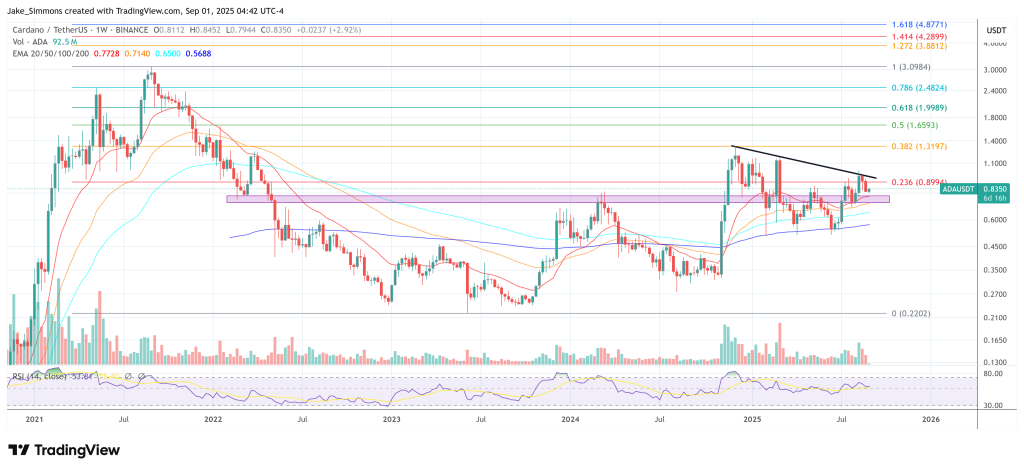
At press time, ADA traded at $0.83.
Cardano price
Market Opportunity
Nowchain Logo
Nowchain Price(NOW)
$0.00077
$0.00077$0.00077
-4.93%
USD
Nowchain (NOW) Live Price Chart
Disclaimer: The articles reposted on this site are sourced from public platforms and are provided for informational purposes only. They do not necessarily reflect the views of MEXC. All rights remain with the original authors. If you believe any content infringes on third-party rights, please contact [email protected] for removal. MEXC makes no guarantees regarding the accuracy, completeness, or timeliness of the content and is not responsible for any actions taken based on the information provided. The content does not constitute financial, legal, or other professional advice, nor should it be considered a recommendation or endorsement by MEXC.

You May Also Like

Over $145M Evaporates In Brutal Long Squeeze

Over $145M Evaporates In Brutal Long Squeeze

The post Over $145M Evaporates In Brutal Long Squeeze appeared on BitcoinEthereumNews.com. Crypto Futures Liquidations: Over $145M Evaporates In Brutal Long Squeeze
Share
BitcoinEthereumNews2026/01/16 11:35
Vitalik Buterin Reveals Ethereum’s Bold Plan to Stay Quantum-Secure and Simple!

Vitalik Buterin Reveals Ethereum’s Bold Plan to Stay Quantum-Secure and Simple!

Buterin unveils Ethereum’s strategy to tackle quantum security challenges ahead. Ethereum focuses on simplifying architecture while boosting security for users. Ethereum’s market stability grows as Buterin’s roadmap gains investor confidence. Ethereum founder Vitalik Buterin has unveiled his long-term vision for the blockchain, focusing on making Ethereum quantum-secure while maintaining its simplicity for users. Buterin presented his roadmap at the Japanese Developer Conference, and splits the future of Ethereum into three phases: short-term, mid-term, and long-term. Buterin’s most ambitious goal for Ethereum is to safeguard the blockchain against the threats posed by quantum computing.  The danger of such future developments is that the future may call into question the cryptographic security of most blockchain systems, and Ethereum will be able to remain ahead thanks to more sophisticated mathematical techniques to ensure the safety and integrity of its protocols. Buterin is committed to ensuring that Ethereum evolves in a way that not only meets today’s security challenges but also prepares for the unknowns of tomorrow. Also Read: Ethereum Giant The Ether Machine Takes Major Step Toward Going Public! However, in spite of such high ambitions, Buterin insisted that Ethereum also needed to simplify its architecture. An important aspect of this vision is to remove unnecessary complexity and make Ethereum more accessible and maintainable without losing its strong security capabilities. Security and simplicity form the core of Buterin’s strategy, as they guarantee that the users of Ethereum experience both security and smooth processes. Focus on Speed and Efficiency in the Short-Term In the short term, Buterin aims to enhance Ethereum’s transaction efficiency, a crucial step toward improving scalability and reducing transaction costs. These advantages are attributed to the fact that, within the mid-term, Ethereum is planning to enhance the speed of transactions in layer-2 networks. According to Butterin, this is part of Ethereum’s expansion, particularly because there is still more need to use blockchain technology to date. The other important aspect of Ethereum’s development is the layer-2 solutions. Buterin supports an approach in which the layer-2 networks are dependent on layer-1 to perform some essential tasks like data security, proof, and censorship resistance. This will enable the layer-2 systems of Ethereum to be concerned with verifying and sequencing transactions, which will improve the overall speed and efficiency of the network. Ethereum’s Market Stability Reflects Confidence in Long-Term Strategy Ethereum’s market performance has remained solid, with the cryptocurrency holding steady above $4,000. Currently priced at $4,492.15, Ethereum has experienced a slight 0.93% increase over the last 24 hours, while its trading volume surged by 8.72%, reaching $34.14 billion. These figures point to growing investor confidence in Ethereum’s long-term vision. The crypto community remains optimistic about Ethereum’s future, with many predicting the price could rise to $5,500 by mid-October. Buterin’s clear, forward-thinking strategy continues to build trust in Ethereum as one of the most secure and scalable blockchain platforms in the market. Also Read: Whales Dump 200 Million XRP in Just 2 Weeks – Is XRP’s Price on the Verge of Collapse? The post Vitalik Buterin Reveals Ethereum’s Bold Plan to Stay Quantum-Secure and Simple! appeared first on 36Crypto.
Share
Coinstats2025/09/18 01:22
Non-Opioid Painkillers Have Struggled–Cannabis Drugs Might Be The Solution

Non-Opioid Painkillers Have Struggled–Cannabis Drugs Might Be The Solution

The post Non-Opioid Painkillers Have Struggled–Cannabis Drugs Might Be The Solution appeared on BitcoinEthereumNews.com. In this week’s edition of InnovationRx, we look at possible pain treatments from cannabis, risks of new vaccine restrictions, virtual clinical trials at the Mayo Clinic, GSK’s $30 billion U.S. manufacturing commitment, and more. To get it in your inbox, subscribe here. Despite their addictive nature, opioids continue to be a major treatment for pain due to a lack of effective alternatives. In an effort to boost new drugs, the FDA released new guidelines for non-opioid painkillers last week. But making these drugs hasn’t been easy. Vertex Pharmaceuticals received FDA approval for its non-opioid Journavx in January, then abandoned a next generation drug after a failed clinical trial earlier this summer. Acadia similarly abandoned a promising candidate after a failed trial in 2022. One possible basis for non-opioids might be cannabis. Earlier this year, researchers at Washington University at St. Louis and Stanford published a study showing that a cannabis-derived compound successfully eased pain in mice with minimal side effects. Munich-based pharmaceutical company Vertanical is perhaps the furthest along in this quest. It is developing a cannabinoid-based extract to treat chronic pain it hopes will soon become an approved medicine, first in the European Union and eventually in the United States. The drug, currently called Ver-01, packs enough low levels of cannabinoids (including THC) to relieve pain, but not so much that patients get high. Founder Clemens Fischer, a 50-year-old medical doctor and serial pharmaceutical and supplement entrepreneur, hopes it will become the first cannabis-based painkiller prescribed by physicians and covered by insurance. Fischer founded Vertanical, with his business partner Madlena Hohlefelder, in 2017, and has invested more than $250 million of his own money in it. With a cannabis cultivation site and drug manufacturing plant in Denmark, Vertanical has successfully passed phase III clinical trials in Germany and expects…
Share
BitcoinEthereumNews2025/09/18 05:26