

Bitcoin Mirrors Gold Pattern as Institution Sells XAUT: Is Gold-BTC Rotation Next?
Key Insights
- Gold leads every other sector in 2026, while risk assets like Bitcoin continue to bleed.
- Antalpha Global sent 1,000 XAUT worth $5.16 million to Bybit, likely to sell.
- Gold and Bitcoin price action charts showed intriguing similarities.
Since the tokenization of gold, whales and institutions have been actively trading the asset in a manner similar to cryptocurrencies. Gold trading has grown because it’s relatively more stable than Bitcoin (BTC), an old-world reserve asset.
Despite Bitcoin’s institutional adoption, the cryptocurrency still ranked lower than gold by preference in the hierarchy of risk assets. This is because traders were moving their crypto gains into gold for long-term custody.
However, price action analysis and recent activity by a particular institution could be a signal that we were about to see capital rotation. Will capital rotate from gold to Bitcoin as the latter mirrors the former?
Gold Outperforms All Risk Assets in 2026
The data from Artemis indicated that gold outperformed every other sector in 2026. As of February 26th, gold was up by about 20%. Others were in the red except S&P 500 ETF Trust (SPY) and Invesco QQQ Trust (QQQ).
SPY had only gained 1.8%, indicating weakness in the top 500 companies in the United States. For QQQ, which tracks the Nasdaq 100 Index, it was up by a mere 0.42% for the Year-to-Date (YTD).
Getting to the losers, Coinbase Global Inc. (COIN) declined by 19.4% despite surging up to mid-August last year. Bitcoin, Ethereum (ETH), and Robinhood (HOOD) were down by 23.3%, 31.1%, and 31.9%, respectively.
 Index performance benchmark | Source: Artemis
But looking at the performance charts, the declining assets had started to tilt upwards as gold remained stagnant. Actually, gold had lost about 3% from its January 23rd peak, while the other assets bottomed on this day.
This was probably the reason the institution moved its gold holdings.
Antalpha Global Selling Gold: Is Capital Rotating to BTC?
Global institutions were taking profits from their gold positions, according to on-chain data. According to Onchain Lens, Antalpha Global transferred about 1K XAUT, worth about $5 million, to Bitget, potentially for sale.
 Institutional activity on gold | Source: Onchain Lens/X
Over the past three days, the institution had been moving gold from its custodial wallet. This deposit on Bitget followed a peak in gold prices. The firm seemed to be using the investment adage: “Be fearful when the masses are greedy.” The masses tend to buy when prices are high, just like now for XAUT.
Based on the aforementioned chart of returns movement, the institution could position itself to rotate capital into risk assets that were beginning to rise. Among them, Bitcoin seemed closest to gold in terms of technical setup.
Similarities in Gold and Bitcoin Price Action Charts
A comparison chart of both gold and Bitcoin showed intriguing similarities. BTC was aping gold’s price movement, which had hit a peak value of around $5,700 after the breakout.
For Bitcoin, it remained below a similar resistance level that had previously held gold. Bitcoin was trading around the same zone that propelled gold to this peak value.
A similar projection for BTC would see the crypto reach around $700K. However, this projection seemed more long-term than short-term.
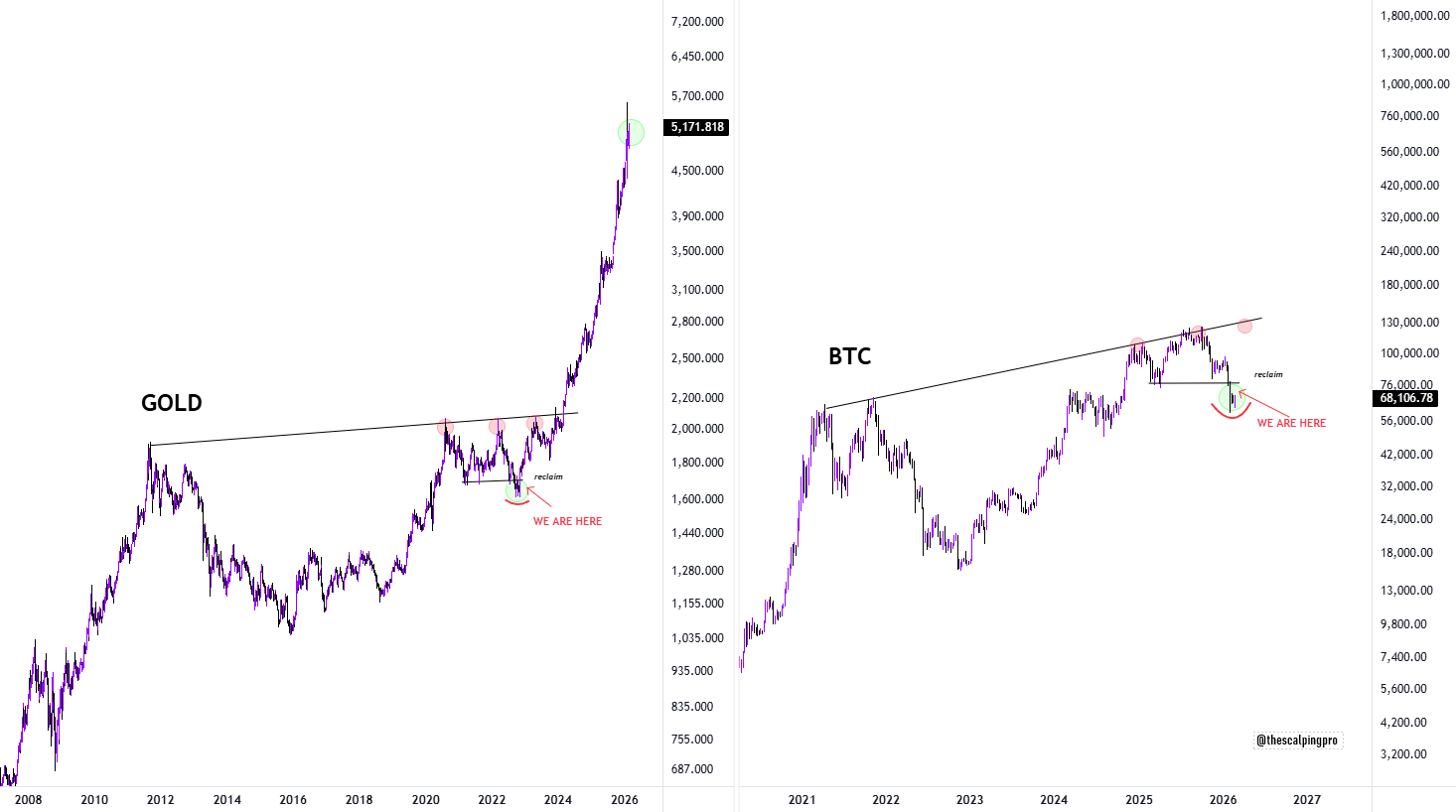 Gold vs. Bitcoin price charts | Source: TradingView
Such price-action similarity put Bitcoin in an advantageous position.
ge, as capital could rotate from the asset to the cryptocurrency. This is especially true during gold’s bear season, which has yet to be confirmed.
Altogether, the data showed gold was outperforming the entire risk asset market, but its peak value of $5,700 could divert capital. In that case, Bitcoin was best positioned, unlike other Wall Street risk assets like SPY, QQQ, COIN, and HOOD.
The post Bitcoin Mirrors Gold Pattern as Institution Sells XAUT: Is Gold-BTC Rotation Next? appeared first on The Market Periodical.


You May Also Like
US Dollar Carry Trade Appeal Persists as High Yields Attract Investors: MUFG

Trump torn apart for cheering loss of American jobs with Colbert cancellation

Missing Republican racked up travel expenses — despite going AWOL for months of votes



