According to recent metrics, bitcoin miners sustained solid earnings results in August, capturing revenue nearly on par with July’s tally, or marginally above, with earnings ranging from $1.633 billion to $1.66 billion. Bitcoin Fees Inch Higher While Miners’ Locked in $1.63B–$1.66B Last Month At the time of writing, data from mempool.space and Johoe’s mempool tracker […]According to recent metrics, bitcoin miners sustained solid earnings results in August, capturing revenue nearly on par with July’s tally, or marginally above, with earnings ranging from $1.633 billion to $1.66 billion. Bitcoin Fees Inch Higher While Miners’ Locked in $1.63B–$1.66B Last Month At the time of writing, data from mempool.space and Johoe’s mempool tracker […]

Bitcoin Miners Post August Haul Near July as Fees Tick Up

According to recent metrics, bitcoin miners sustained solid earnings results in August, capturing revenue nearly on par with July’s tally, or marginally above, with earnings ranging from $1.633 billion to $1.66 billion.

Bitcoin Fees Inch Higher While Miners’ Locked in $1.63B–$1.66B Last Month

At the time of writing, data from mempool.space and Johoe’s mempool tracker indicate a queue of approximately 85,000 to 93,000 unconfirmed transactions. This points to a spurt of heightened onchain activity alongside increased fees. On Sept. 1, the average cost of a BTC transaction reached 0.000016 BTC, or 8.7 satoshis per byte, equivalent to $1.75 per transfer.
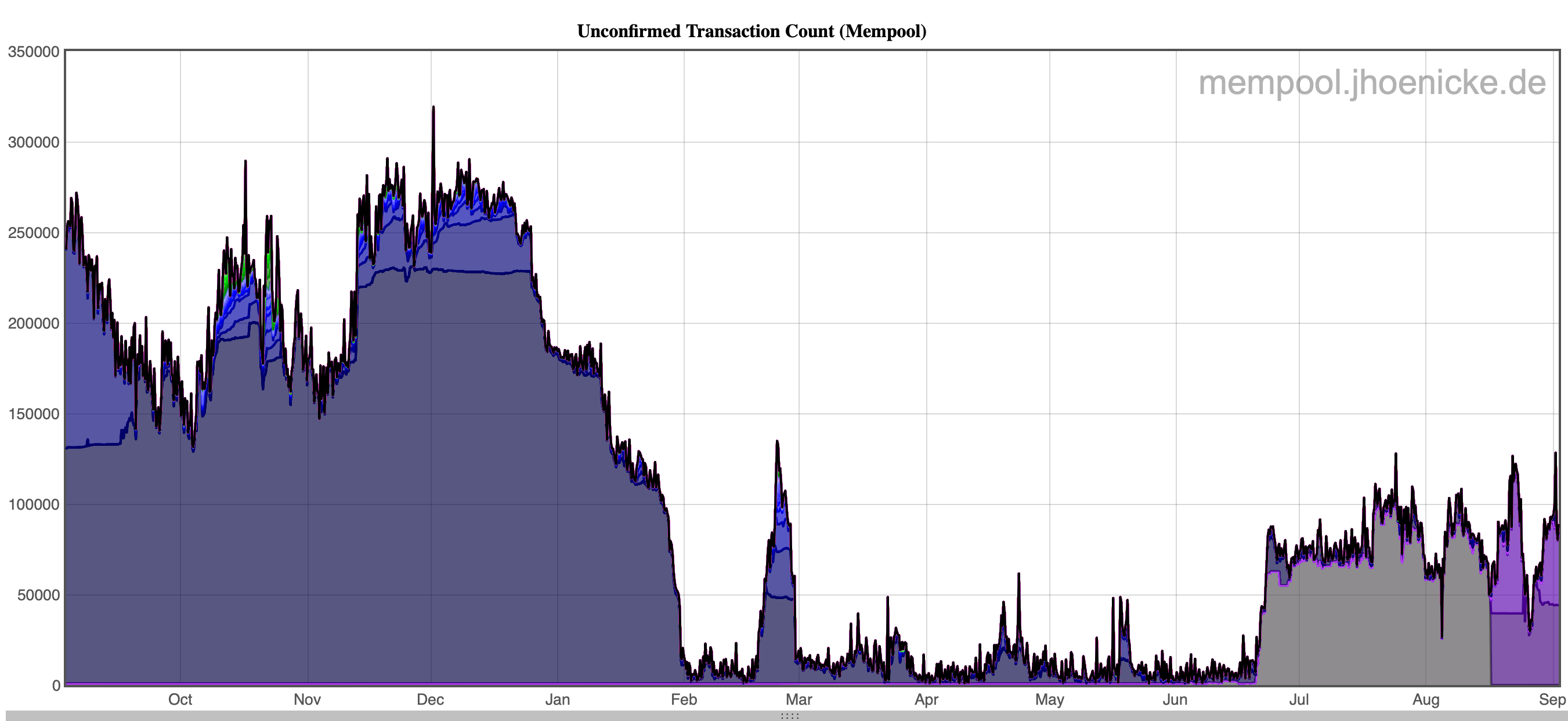
Bitcoin Miners Post August Haul Near July as Fees Tick UpJohoe’s mempool tracker shows a bump in pending transfers since the end of June.

Not long ago, transaction fees made up less than 1% of the overall block reward. Archived data from Sept. 2 shows that during the past day, fees represented 1.89% of the total reward. Since the end of June, a steady buildup of unconfirmed transfers has persisted, with daily backlogs ranging from 50,000 to 139,000. This stands in contrast to earlier periods of record-low onchain activity, when blocks were at times not fully utilized.

Despite the steady transfer activity, fees have remained relatively stable, averaging $1.30–$1.40 per transaction over the past three months. Most values fall between a $1.00 and $1.50 average, with only occasional spikes into the $2.00–$3.00 range, which remain outliers. By late August, the average slipped closer to $0.80–$1.00, followed by a slight uptick at the start of September.

Miners fared well in August, securing revenue nearly identical to the prior month’s earnings, which marked the strongest haul since the April 2024 halving. Data from theblock.co records miner rewards at exactly $1.65 billion from the subsidy alone, rising to $1.66 billion when fees are included. Same as July. Figures compiled by newhedge.io offer a more granular view, placing the subsidy at $1.62 billion and the combined total at $1.633 billion, and above July’s $1.61 billion aggregate.
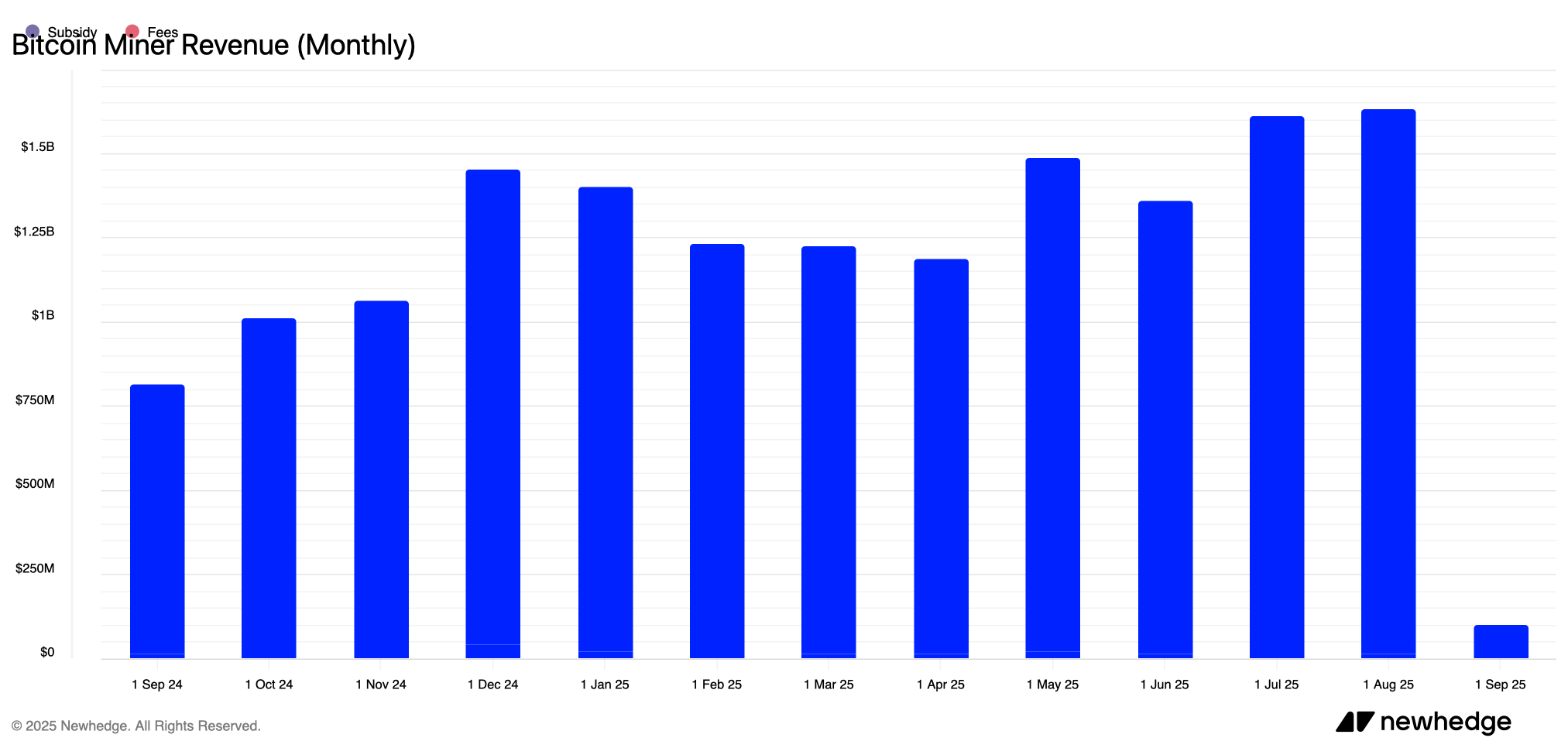
Bitcoin Miners Post August Haul Near July as Fees Tick Up Bitcoin miner monthly revenue from newhedge.io.

​​Taken together, steady queues, modestly firmer fees, and earnings holding near July levels suggest miners enter September with resilient cash flow. Subsidy remains the backbone, while onchain demand offers a small but growing tailwind. If activity persists, revenue should stay supported; if congestion eases, efficiency and energy costs will decide margins until the next catalyst reshapes block economics once more.


Market Opportunity
NEAR Logo
NEAR Price(NEAR)
$1.54
$1.54$1.54
-1.21%
USD
NEAR (NEAR) Live Price Chart
Disclaimer: The articles reposted on this site are sourced from public platforms and are provided for informational purposes only. They do not necessarily reflect the views of MEXC. All rights remain with the original authors. If you believe any content infringes on third-party rights, please contact [email protected] for removal. MEXC makes no guarantees regarding the accuracy, completeness, or timeliness of the content and is not responsible for any actions taken based on the information provided. The content does not constitute financial, legal, or other professional advice, nor should it be considered a recommendation or endorsement by MEXC.

You May Also Like

Visa Expands USDC Stablecoin Settlement For US Banks

Visa Expands USDC Stablecoin Settlement For US Banks

The post Visa Expands USDC Stablecoin Settlement For US Banks appeared on BitcoinEthereumNews.com. Visa Expands USDC Stablecoin Settlement For US Banks
Share
BitcoinEthereumNews2025/12/17 15:23
Nasdaq Company Adds 7,500 BTC in Bold Treasury Move

Nasdaq Company Adds 7,500 BTC in Bold Treasury Move

The live-streaming and e-commerce company has struck a deal to acquire 7,500 BTC, instantly becoming one of the largest public […] The post Nasdaq Company Adds 7,500 BTC in Bold Treasury Move appeared first on Coindoo.
Share
Coindoo2025/09/18 02:15
Curve Finance votes on revenue-sharing model for CRV holders

Curve Finance votes on revenue-sharing model for CRV holders

The post Curve Finance votes on revenue-sharing model for CRV holders appeared on BitcoinEthereumNews.com. Curve Finance has proposed a new protocol called Yield Basis that would share revenue directly with CRV holders, marking a shift from one-off incentives to sustainable income. Summary Curve Finance has put forward a revenue-sharing protocol to give CRV holders sustainable income beyond emissions and fees. The plan would mint $60M in crvUSD to seed three Bitcoin liquidity pools (WBTC, cbBTC, tBTC), with 35–65% of revenue distributed to veCRV stakers. The DAO vote runs from up to Sept. 24, with the proposal seen as a major step to strengthen CRV tokenomics after past liquidity and governance challenges. Curve Finance founder Michael Egorov has introduced a proposal to give CRV token holders a more direct way to earn income, launching a system called Yield Basis that aims to turn the governance token into a sustainable, yield-bearing asset.  The proposal has been published on the Curve DAO (CRV) governance forum, with voting open until Sept. 24. A new model for CRV rewards Yield Basis is designed to distribute transparent and consistent returns to CRV holders who lock their tokens for veCRV governance rights. Unlike past incentive programs, which relied heavily on airdrops and emissions, the protocol channels income from Bitcoin-focused liquidity pools directly back to token holders. To start, Curve would mint $60 million worth of crvUSD, its over-collateralized stablecoin, with proceeds allocated across three pools — WBTC, cbBTC, and tBTC — each capped at $10 million. 25% of Yield Basis tokens would be reserved for the Curve ecosystem, and between 35% and 65% of Yield Basis’s revenue would be given to veCRV holders. By emphasizing Bitcoin (BTC) liquidity and offering yields without the short-term loss risks associated with automated market makers, the protocol hopes to draw in professional traders and institutions. Context and potential impact on Curve Finance The proposal comes as Curve continues to modify…
Share
BitcoinEthereumNews2025/09/18 14:37

