

Ethereum (ETH) Price: Six Red Months and Counting – What Has to Change for ETH to Turn Around?
TLDR
- Ethereum has recorded six consecutive months of losses, its second-longest losing streak since 2018.
- ETH is trading just above its 2018 price peak, currently below $2,000.
- Pressure comes from whale selling, derivatives activity, L2 cannibalization, and ETF outflows.
- Vitalik Buterin says AI could speed up Ethereum’s development roadmap and improve security.
- Analysts at Standard Chartered and VanEck have long-term price targets of $7,500 and $10,000 respectively.
Ethereum has now closed in the red for six months in a row, marking its second-longest losing streak since 2018.
According to data from CoinGlass, the last time ETH came close to a streak like this was during the 2018 bear market, when the price crashed below $85.
That crash was driven by the collapse of the ICO bubble, as hundreds of projects had raised funds by issuing ERC-20 tokens on the Ethereum network.
The current slump is being driven by a different set of factors.
Analysts point to whale distribution, heavy derivatives selling, macroeconomic uncertainty, outflows from spot ETH ETFs, and competition from Ethereum’s own Layer 2 networks eating into its fee revenue.
ETH is currently trading slightly above its 2018 price peak, a level that was once seen as a major milestone.
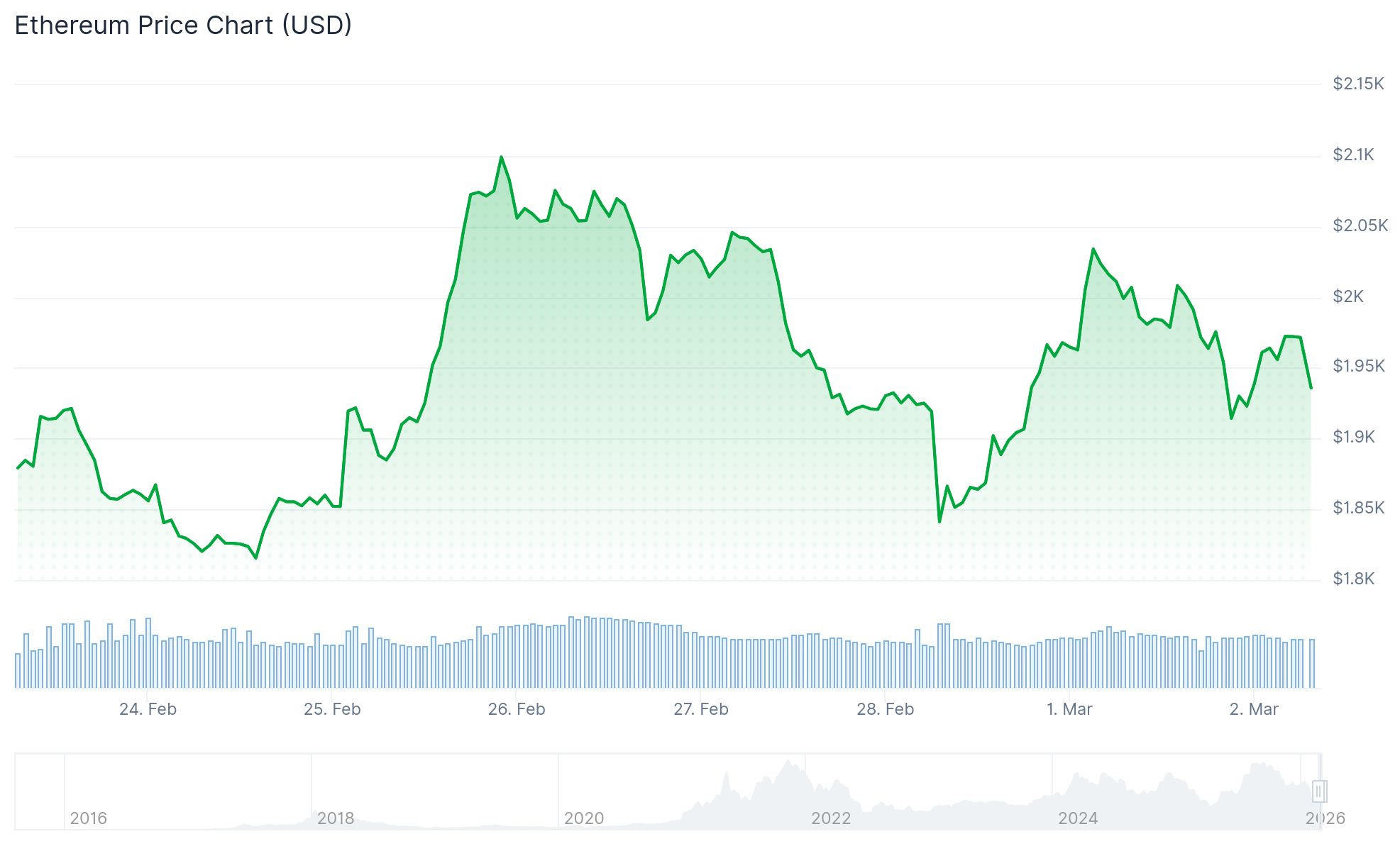 Ethereum (ETH) Price
The price recently dipped below $2,000 after briefly reaching a high of $2,054. It is now trading below the 100-hourly Simple Moving Average.
Key Price Levels to Watch
Immediate resistance sits at $2,000, with the next major levels at $2,120 and $2,155.
If ETH breaks above $2,155, the next targets would be $2,220 and $2,250.
On the downside, support sits at $1,920, then $1,880. A drop below $1,880 could push the price toward $1,840 or $1,800, with $1,740 as a deeper support level.
Vitalik Weighs In on AI and Ethereum’s Future
Ethereum co-founder Vitalik Buterin has said that artificial intelligence could accelerate the network’s development roadmap.
He made the comments after someone used AI to prototype Ethereum’s entire 2030 roadmap within weeks.
Buterin tested AI coding himself, building a version of his blog software in about an hour on his laptop.
He suggested that half of the speed gains from AI should go toward security improvements, including more test cases and formal verification of code.
He also noted that bug-free code, once considered unrealistic, could become a standard expectation in crypto development.
Standard Chartered has a long-term price target of $7,500 for ETH, based on its role in stablecoins, DeFi, and tokenization.
VanEck has set a target of $10,000, citing the upcoming Pectra and Glamsterdam upgrades, which could unlock 100,000 transactions per second.
ETH is currently holding above the $1,900 support level after its latest pullback from $2,054.
The post Ethereum (ETH) Price: Six Red Months and Counting – What Has to Change for ETH to Turn Around? appeared first on CoinCentral.


You May Also Like

Glassnode Warns Nearly 30% Of Bitcoin Supply Could Face Future Quantum Risks
Bitcoin Price News: BTC at Risk of Falling to $70K as Crypto Veteran Calls for 50‑60K in Coming Months

Photographer catches Marco Rubio writing mantra to himself during cabinet meeting



