TLDR Ethereum’s staking entry queue reached its highest level since September 2023, with 860,369 ETH ($3.7 billion) waiting to be staked Whale activity shows purchases of approximately 260,000 ETH in a 24-hour period ETH is trading at around $4,321-$4,381 after retreating 12.4% from its August 24 all-time high Institutional interest in staking has increased, showing [...] The post Ethereum (ETH) Price: Technical Patterns Point to $8,500-$22,000 Range After Recent Pullback appeared first on Blockonomi.TLDR Ethereum’s staking entry queue reached its highest level since September 2023, with 860,369 ETH ($3.7 billion) waiting to be staked Whale activity shows purchases of approximately 260,000 ETH in a 24-hour period ETH is trading at around $4,321-$4,381 after retreating 12.4% from its August 24 all-time high Institutional interest in staking has increased, showing [...] The post Ethereum (ETH) Price: Technical Patterns Point to $8,500-$22,000 Range After Recent Pullback appeared first on Blockonomi.

Ethereum (ETH) Price: Technical Patterns Point to $8,500-$22,000 Range After Recent Pullback

TLDR

  • Ethereum’s staking entry queue reached its highest level since September 2023, with 860,369 ETH ($3.7 billion) waiting to be staked
  • Whale activity shows purchases of approximately 260,000 ETH in a 24-hour period
  • ETH is trading at around $4,321-$4,381 after retreating 12.4% from its August 24 all-time high
  • Institutional interest in staking has increased, showing growing confidence in Ethereum’s long-term value
  • Technical analysts project potential upside targets ranging from $8,500 to $22,000 based on breakout patterns

Ethereum is experiencing a surge in staking interest as institutional investors and crypto treasury firms look to earn rewards on their holdings. The Ethereum staking entry queue has reached its highest point since September 2023, with on-chain data showing 860,369 ETH worth approximately $3.7 billion waiting to be staked.

This level of staking queue hasn’t been seen since 2023 when the Shanghai upgrade enabled withdrawals. The growth in validator queue stems from several factors, including increased network confidence.

More people and institutions are showing trust in Ethereum’s long-term value and want to participate in securing the network. Current market conditions are also favorable as rising Ether prices and historically low gas fees make staking more attractive and accessible for users.

Institutional interest has grown considerably. More companies and funds are entering Ethereum staking, bringing larger amounts of capital into the ecosystem.

The surge in the staking entry queue helps alleviate recent concerns about a potential sell-off. Earlier fears emerged when the staking exit queue hit an all-time high of just over 1 million ETH on August 29.

Since then, the exit queue has dropped 20%, indicating a slowdown in unstaking activities. The staking entry and exit queues almost reached parity for the first time since July.

Whale Activity Signals Market Interest

Recent whale movements have caught market attention. According to crypto analyst Ali Martinez, whales purchased around 260,000 ETH in the past 24 hours. These large-scale purchases suggest rising demand from major investors.

Currently, Ethereum is trading at approximately $4,321-$4,381, representing a 12.4% decline from its all-time high on August 24. This pullback appears to be driven by profit-taking from retail traders.
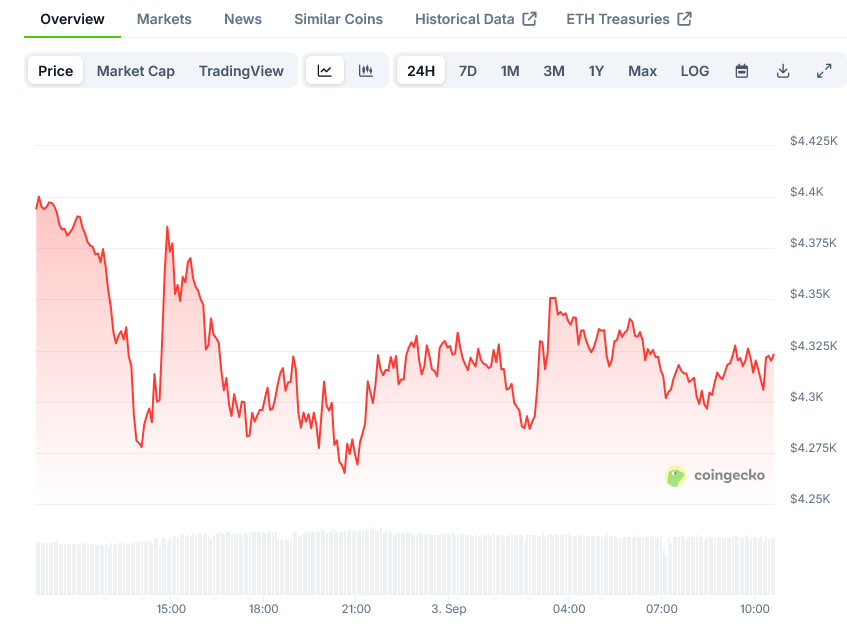
Ethereum Price on CoinGeckoEthereum Price on CoinGecko

Despite the recent price dip, Ethereum’s technical indicators show mixed signals. The Relative Strength Index (RSI) stands at 52.69, with the signal line at 56.81, positioning ETH in a neutral zone where neither intense buying nor selling pressure dominates.

The MACD indicator shows some bearish momentum with the blue line at 153.55 and the orange signal line higher at 205.51. The negative histogram at -51.95 suggests fading momentum, though the narrowing gap could indicate a potential reversal if buying volume increases.

Technical Analysis Points to Potential Breakout

Technical analysts are projecting ambitious upside targets for Ethereum. According to analyst EGRAG CRYPTO, ETH could reach $8,500, $15,250, or even $22,000 if it breaks out from an ascending triangle formation.


The analyst outlines Fibonacci-based cycle targets that could validate these projected price movements. These technical patterns form a “confluence factor” that supports the potential for major upward price action.

Logarithmic analysis points to a potential $22,000 price target, while non-logarithmic calculations suggest $8,500. Averaging these levels gives a mid-range target of $15,250.

Blockchain data shows that 35.7 million ETH is currently staked, worth approximately $162 billion and representing 31% of the total supply. Corporate treasury funds continue to grow, with a total of 4.7 million ETH (almost 4% of the entire supply) worth around $20.4 billion already purchased by more than 70 participants.

The majority of these entities have staked or plan to stake the asset for additional yields, which has contributed to the growing entry queue in recent weeks.

Ethereum’s next price movements are being closely monitored due to these whale activities and technical indicators pointing to a potential rally that could influence broader market trends in the coming weeks.

The post Ethereum (ETH) Price: Technical Patterns Point to $8,500-$22,000 Range After Recent Pullback appeared first on Blockonomi.


Market Opportunity
Ethereum Logo
Ethereum Price(ETH)
$3,290.97
$3,290.97$3,290.97
+0.81%
USD
Ethereum (ETH) Live Price Chart
Disclaimer: The articles reposted on this site are sourced from public platforms and are provided for informational purposes only. They do not necessarily reflect the views of MEXC. All rights remain with the original authors. If you believe any content infringes on third-party rights, please contact [email protected] for removal. MEXC makes no guarantees regarding the accuracy, completeness, or timeliness of the content and is not responsible for any actions taken based on the information provided. The content does not constitute financial, legal, or other professional advice, nor should it be considered a recommendation or endorsement by MEXC.

You May Also Like

Sui Mainnet Recovers After 6-Hour Network Stall: No Funds at Risk

Sui Mainnet Recovers After 6-Hour Network Stall: No Funds at Risk

On January 14, 2026, Sui Mainnet faced a significant disruption, leaving the network stalled for roughly six hours. The incident was caused by an internal divergence
Share
Tronweekly2026/01/17 09:30
Will There Be A ’28 Years Later 3’ After ‘The Bone Temple’? Here’s The Good News

Will There Be A ’28 Years Later 3’ After ‘The Bone Temple’? Here’s The Good News

The post Will There Be A ’28 Years Later 3’ After ‘The Bone Temple’? Here’s The Good News appeared on BitcoinEthereumNews.com. Chi Lewis-Parry and Ralph Fiennes
Share
BitcoinEthereumNews2026/01/17 09:21
Urgent: Coinbase CEO Pushes for Crucial Crypto Market Structure Bill

Urgent: Coinbase CEO Pushes for Crucial Crypto Market Structure Bill

BitcoinWorld Urgent: Coinbase CEO Pushes for Crucial Crypto Market Structure Bill The cryptocurrency world is buzzing with significant developments as Coinbase CEO Brian Armstrong recently took to Washington, D.C., advocating passionately for a clearer regulatory path. His mission? To champion the passage of a vital crypto market structure bill, specifically the Digital Asset Market Clarity (CLARITY) Act. This legislative push is not just about policy; it’s about safeguarding investor rights and fostering innovation in the digital asset space. Why a Clear Crypto Market Structure Bill is Essential Brian Armstrong’s visit underscores a growing sentiment within the crypto industry: the urgent need for regulatory clarity. Without clear guidelines, the market operates in a gray area, leaving both innovators and investors vulnerable. The proposed crypto market structure bill aims to bring much-needed definition to this dynamic sector. Armstrong explicitly stated on X that this legislation is crucial to prevent a recurrence of actions that infringe on investor rights, citing past issues with former U.S. Securities and Exchange Commission (SEC) Chair Gary Gensler. This proactive approach seeks to establish a stable and predictable environment for digital assets. Understanding the CLARITY Act: A Blueprint for Digital Assets The Digital Asset Market Clarity (CLARITY) Act is designed to establish a robust regulatory framework for the cryptocurrency industry. It seeks to delineate the responsibilities of key regulatory bodies, primarily the SEC and the Commodity Futures Trading Commission (CFTC). Here are some key provisions: Clear Jurisdiction: The bill aims to specify which digital assets fall under the purview of the SEC as securities and which are considered commodities under the CFTC. Investor Protection: By defining these roles, the act intends to provide clearer rules for market participants, thereby enhancing investor protection. Exemption Conditions: A significant aspect of the bill would exempt certain cryptocurrencies from the stringent registration requirements of the Securities Act of 1933, provided they meet specific criteria. This could reduce regulatory burdens for legitimate projects. This comprehensive approach promises to bring structure to a rapidly evolving market. The Urgency Behind the Crypto Market Structure Bill The call for a dedicated crypto market structure bill is not new, but Armstrong’s direct engagement highlights the increasing pressure for legislative action. The lack of a clear framework has led to regulatory uncertainty, stifling innovation and sometimes leading to enforcement actions that many in the industry view as arbitrary. Passing this legislation would: Foster Innovation: Provide a clear roadmap for developers and entrepreneurs, encouraging new projects and technologies. Boost Investor Confidence: Offer greater certainty and protection for individuals investing in digital assets. Prevent Future Conflicts: Reduce the likelihood of disputes between regulatory bodies and crypto firms, creating a more harmonious ecosystem. The industry believes that a well-defined regulatory landscape is essential for the long-term health and growth of the digital economy. What a Passed Crypto Market Structure Bill Could Mean for You If the CLARITY Act or a similar crypto market structure bill passes, its impact could be profound for everyone involved in the crypto space. For investors, it could mean a more secure and transparent market. For businesses, it offers a predictable environment to build and scale. Conversely, continued regulatory ambiguity could: Stifle Growth: Drive innovation overseas and deter new entrants. Increase Risks: Leave investors exposed to unregulated practices. Create Uncertainty: Lead to ongoing legal battles and market instability. The stakes are incredibly high, making the advocacy efforts of leaders like Brian Armstrong all the more critical. The push for a clear crypto market structure bill is a pivotal moment for the digital asset industry. Coinbase CEO Brian Armstrong’s efforts in Washington, D.C., reflect a widespread desire for regulatory clarity that protects investors, fosters innovation, and ensures the long-term viability of cryptocurrencies. The CLARITY Act offers a potential blueprint for this future, aiming to define jurisdictional boundaries and streamline regulatory requirements. Its passage could unlock significant growth and stability, cementing the U.S. as a leader in the global digital economy. Frequently Asked Questions (FAQs) What is the Digital Asset Market Clarity (CLARITY) Act? The CLARITY Act is a proposed crypto market structure bill aimed at establishing a clear regulatory framework for digital assets in the U.S. It seeks to define the roles of the SEC and CFTC and exempt certain cryptocurrencies from securities registration requirements under specific conditions. Why is Coinbase CEO Brian Armstrong advocating for this bill? Brian Armstrong is advocating for the CLARITY Act to bring regulatory certainty to the crypto industry, protect investor rights from unclear enforcement actions, and foster innovation within the digital asset space. He believes it’s crucial for the industry’s sustainable growth. How would this bill impact crypto investors? For crypto investors, the passage of this crypto market structure bill would mean greater clarity on which assets are regulated by whom, potentially leading to enhanced consumer protections, reduced market uncertainty, and a more stable investment environment. What are the primary roles of the SEC and CFTC concerning this bill? The bill aims to delineate the responsibilities of the SEC (Securities and Exchange Commission) and the CFTC (Commodity Futures Trading Commission) regarding digital assets. It seeks to clarify which assets fall under securities regulation and which are considered commodities, reducing jurisdictional ambiguity. What could happen if a crypto market structure bill like CLARITY Act does not pass? If a clear crypto market structure bill does not pass, the industry may continue to face regulatory uncertainty, potentially leading to stifled innovation, increased legal challenges for crypto companies, and a less secure environment for investors due to inconsistent enforcement and unclear rules. Did you find this article insightful? Share it with your network to help spread awareness about the crucial discussions shaping the future of digital assets! To learn more about the latest crypto market trends, explore our article on key developments shaping crypto regulation and institutional adoption. This post Urgent: Coinbase CEO Pushes for Crucial Crypto Market Structure Bill first appeared on BitcoinWorld.
Share
Coinstats2025/09/18 20:35





