

Maritime Shares Rally as Hormuz Crisis Triggers Route Changes and Rate Increases
TLDR
-
Maritime transport equities advanced following vessel disruptions at Strait of Hormuz
-
Shares of Maersk and Hapag-Lloyd surged over 4% in trading
-
Leading shipping companies halted operations through the strait
-
Energy commodity prices rallied in tandem with transport stocks
-
Industry experts suggest effects will be concentrated in regional container markets
Maritime transport equities experienced upward momentum Monday following disruptions near the Strait of Hormuz that compelled leading carriers to redirect their operations. Stock values across container shipping and tanker sectors advanced as markets responded to reduced shipping availability and climbing energy costs.
European maritime companies spearheaded early session gains as news of route adjustments circulated throughout the industry. Major container line operators saw share prices increase by more than 4% during opening hours as financial markets digested supply chain modifications.
Multiple carriers placed vessel transits through the Strait of Hormuz on hold citing security considerations. Shipping companies announced they would redirect their fleets away from the affected area pending further developments.
Maersk, Hapag-Lloyd, and CMA CGM initiated service diversions around the African continent to circumvent impacted shipping lanes. These operational adjustments decreased accessible capacity on certain international maritime corridors.
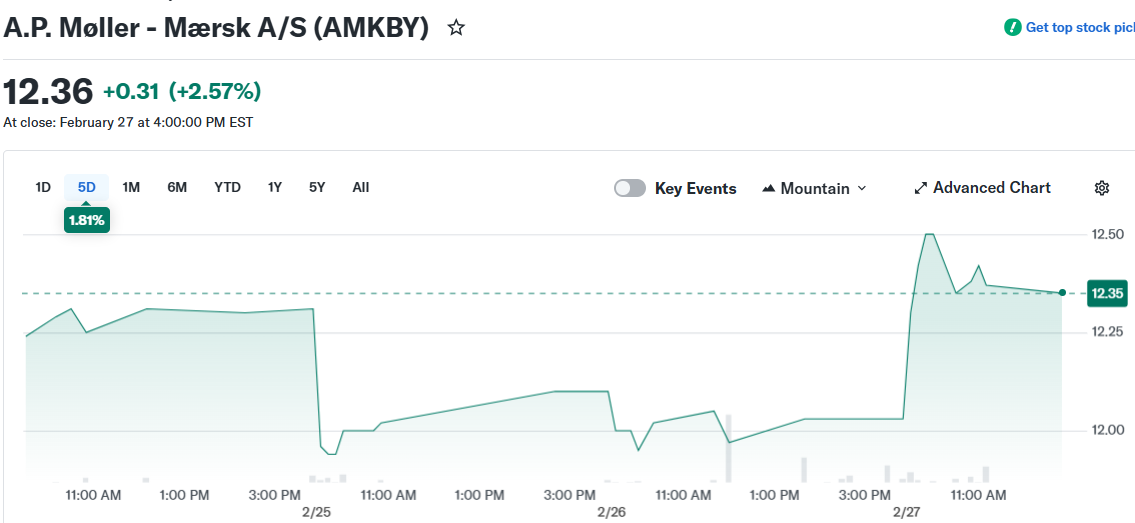 A.P. Møller – Mærsk A/S (AMKBY)
Commodity markets experienced parallel upward pressure following the disruptions. Brent crude alongside U.S. crude contracts advanced beyond 7%, with natural gas quotations climbing above 4%.
Maritime Corridors Undergo Strategic Realignment
Shipping operators redirected their networks following heightened regional tensions and documented incidents in the waterway. The Strait of Hormuz functions as a critical passage for worldwide energy transport and regional commerce.
Certain carriers additionally redirected vessels from the Suez Canal and adjacent passages. Route modification activity constrained shipping availability across multiple international corridors.
Investment firms indicated that reduced capacity might provide support for freight pricing in coming weeks. Logistics and tanker enterprises similarly experienced equity value increases as transport sector stocks climbed.
Scandinavian tanker companies and vehicle transport operators registered advances alongside container shipping enterprises. The wider transport industry mirrored increases in energy valuations and shipping requirements.
Dubai’s Jebel Ali port processed approximately 15.5 million TEU during 2024, accounting for roughly 8% of worldwide container volume. Despite its significant size, the facility operates outside the primary Asia-Europe container pathway.
Industry Experts Evaluate Market Effects
Market analysts indicated that Hormuz disruptions carry significance but primarily affect regional container operations. In contrast, disturbances at the Suez Canal typically generate broader worldwide consequences for container distribution networks.
Prior to the Red Sea situation, the Suez Canal managed approximately 22% of worldwide container movements. Present disruptions near Hormuz are anticipated to influence regional shipping dynamics more specifically.
Several investment firms maintained reserved perspectives regarding container shipping fundamentals. Excess capacity within the sector continues to pressure freight rate projections notwithstanding temporary disruptions.
Projections indicate container fleet expansion may exceed demand through 2026. Industry analysts noted capacity growth remains a critical element shaping rate trajectories.
Shipping and logistics equities sustained higher valuations in early sessions as carriers proceeded with vessel redirections and tracked developments surrounding the Strait of Hormuz. Financial markets continue observing whether maritime traffic returns to standard patterns throughout the region.
The post Maritime Shares Rally as Hormuz Crisis Triggers Route Changes and Rate Increases appeared first on Blockonomi.


You May Also Like

Scotland Predicted Lineup vs Haiti: Starting XI, Team News & Tactical Analysis

Binance TR’s Pizza-Themed Social Media Event: Opportunity to Win a Domino’s Gift Voucher Worth 800 TL

Türkiye Predicted Lineup vs Australia: Starting XI, Team News & Tactical Analysis



