A friend once asked me how old he was in days. That random question led me to build a free age calculator — and I quickly discovered it wasn’t as simple as subtracting two years. In the process, I learned about tricky coding challenges, why people love small tools, and how even a side project can spark surprising human reactions.A friend once asked me how old he was in days. That random question led me to build a free age calculator — and I quickly discovered it wasn’t as simple as subtracting two years. In the process, I learned about tricky coding challenges, why people love small tools, and how even a side project can spark surprising human reactions.

What Building a Simple Age Calculator Taught Me About Time, Technology, and Small Tools

⏳ A Friend’s Question That Sparked an Idea

One evening, a friend casually asked me: \n “Can you tell me exactly how old I am — in days?”

I laughed, but then realized something funny: I didn’t actually know. I could tell him his age in years, sure. But days? Weeks? Hours? Even heartbeats? I had no clue.

That single question got stuck in my head. As a developer, I enjoy problems that look simple on the surface but hide a lot of complexity underneath. So I decided to build a free Online Age Calculator for my site.
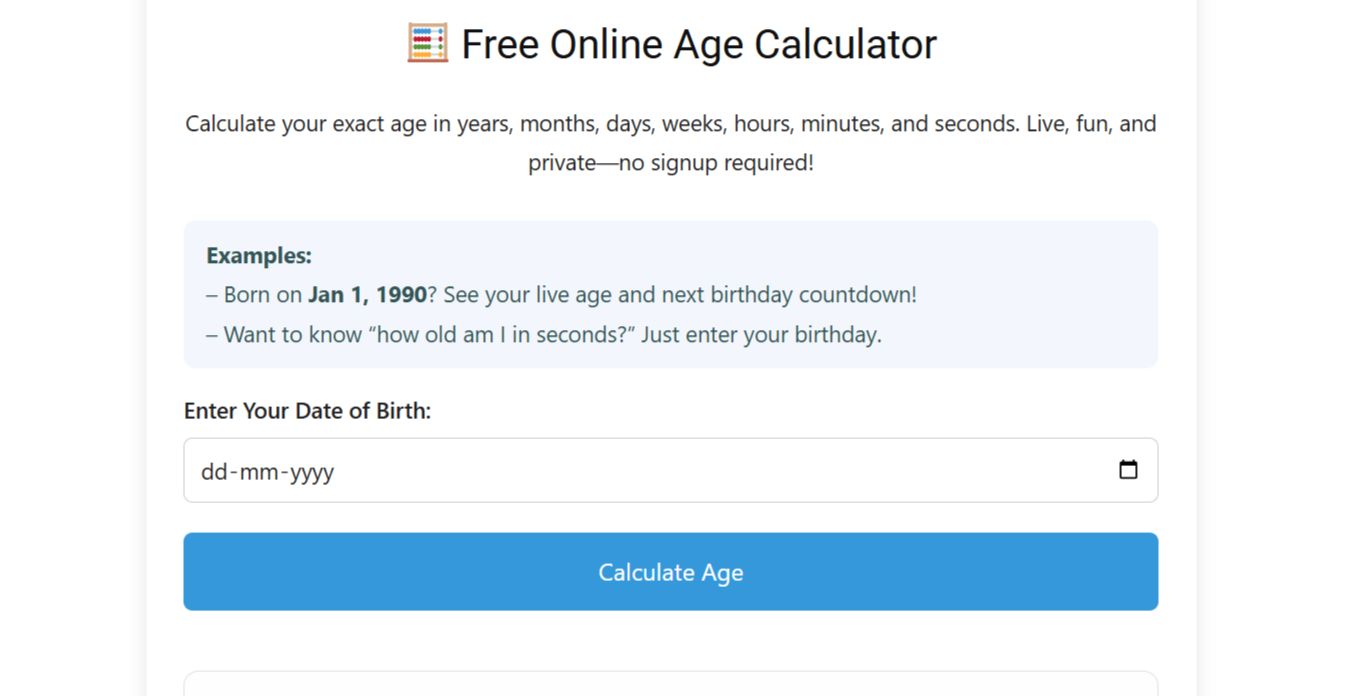
The starting point: enter your date of birth.

I figured it would be a quick weekend project. Instead, it turned into something much bigger — a little side project that ended up teaching me about tricky coding problems, why people love small tools, and even how we think about time itself.


🧮 The Hidden Math of Time

At first, I thought calculating age would be trivial: \n Current year – birth year = age. Done.

But time doesn’t play that nicely.

  • Leap years sneak in an extra day.
  • Months vary (28, 29, 30, or 31 days).
  • If your birthday hasn’t happened yet this year, you subtract one.

Suddenly, what looked like a middle-school math problem became a puzzle full of edge cases. I leaned on JavaScript’s Date() object, but even that wasn’t enough — I had to carefully adjust for months, days, and special cases like February 29 birthdays.

When I finally got it working, it felt less like writing a calculator and more like uncovering the hidden rules of time itself.


🌍 Why Exact Age Matters More Than You Think

At first I assumed people would only use the calculator out of curiosity. But the more feedback I got, the more I realized how practical it actually was.

  • A student told me they used it to fill out an admission form.
  • Someone in finance said they checked pension eligibility with it.
  • A coach said the birthday countdown became a fun motivator for their team.

It turns out, age precision matters in more places than I’d ever thought:

  • Legal documents — Birth certificates, passports, IDs.
  • Banking and pensions — Eligibility often depends on exact dates.
  • Sports — Age cutoffs can be strict to the very day.
  • Healthcare — Vaccines, screenings, and treatments tied to exact age.
  • Education — Admissions and exams with strict limits.

In all of these, “I’m about 30” isn’t good enough. Precision matters.


🎯 What Makes This Tool Different
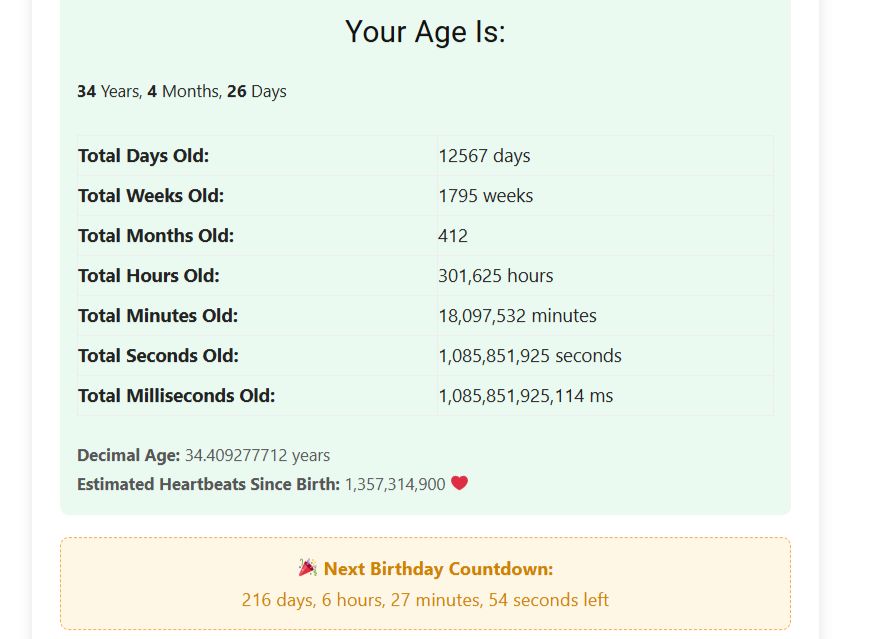
Example results: more than just years — days, heartbeats, and even a birthday countdown.

The first version only returned years. Useful, but honestly, boring. So I started adding extra stats — partly out of curiosity, partly because it was fun to see what else I could calculate.

  • Total Days Lived → Staring at a five-digit number is surreal.
  • Weeks & Months Old → Neat milestones most people never think about.
  • Hours, Minutes, Seconds, Milliseconds → Every tick of your life, counted.
  • Decimal Age → Not just “34 years,” but 34.40 years.
  • Estimated Heartbeats ❤️ → Billions of beats, which suddenly makes you think about health.
  • Next Birthday Countdown 🎉 → Exact days, hours, minutes until the next cake.

When I tested it on myself, I was stunned: \n Over 12,000 days lived, 1.3 billion heartbeats, and still counting.

It was the first time I’d looked at my life in those numbers, and it somehow made time feel both longer and shorter at the same moment.


📊 Why People Love Simple Tools

I kept wondering: why was this little calculator getting so much attention? So I started digging into user behavior and UX psychology.

The answer was simple:

  • People love tools that do one thing well.
  • They love instant results without logins, ads, or distractions.
  • And they love fun facts they can share.

One student wrote to me saying they’d shown their “days lived” number to their whole class. Another person told me they used the heartbeat counter as an icebreaker in a workshop. That’s when I realized: these weren’t just stats. They were conversation starters.

The internet is full of massive apps and platforms, but sometimes the magic is in doing one small thing in a way that feels fresh, personal, and fun.


🛠️ Lessons I Learned as a Developer

This project wasn’t about chasing some big idea. But it ended up reshaping how I think about side projects:

  • Small doesn’t mean trivial. Even a calculator can touch law, finance, health, and daily life.
  • Edge cases are everything. Leap years, negative days, decimal precision — the details are where trust is won.
  • Users surprise you. I never thought the heartbeat counter would be popular, but it turned out to be the feature people loved most.

💬 Final Thoughts

When my friend asked me how old he was in days, I thought it was a silly question. Now I see it was the spark for one of the most interesting side projects I’ve ever worked on.

Watching him laugh at his “1.3 billion heartbeats” stat reminded me that even the tiniest tools can create real, human moments. And that, to me, is more valuable than any flashy app or framework.

👉 If you’re curious, you can try the tool here: Free Online Age Calculator.

And if you’re a developer: don’t underestimate the small stuff. Sometimes, it’s those simple little projects that end up leaving the biggest impact.


Market Opportunity
Threshold Logo
Threshold Price(T)
$0.010085
$0.010085$0.010085
+2.65%
USD
Threshold (T) Live Price Chart
Disclaimer: The articles reposted on this site are sourced from public platforms and are provided for informational purposes only. They do not necessarily reflect the views of MEXC. All rights remain with the original authors. If you believe any content infringes on third-party rights, please contact [email protected] for removal. MEXC makes no guarantees regarding the accuracy, completeness, or timeliness of the content and is not responsible for any actions taken based on the information provided. The content does not constitute financial, legal, or other professional advice, nor should it be considered a recommendation or endorsement by MEXC.

You May Also Like

Sui Mainnet Recovers After 6-Hour Network Stall: No Funds at Risk

Sui Mainnet Recovers After 6-Hour Network Stall: No Funds at Risk

On January 14, 2026, Sui Mainnet faced a significant disruption, leaving the network stalled for roughly six hours. The incident was caused by an internal divergence
Share
Tronweekly2026/01/17 09:30
Will There Be A ’28 Years Later 3’ After ‘The Bone Temple’? Here’s The Good News

Will There Be A ’28 Years Later 3’ After ‘The Bone Temple’? Here’s The Good News

The post Will There Be A ’28 Years Later 3’ After ‘The Bone Temple’? Here’s The Good News appeared on BitcoinEthereumNews.com. Chi Lewis-Parry and Ralph Fiennes
Share
BitcoinEthereumNews2026/01/17 09:21
Urgent: Coinbase CEO Pushes for Crucial Crypto Market Structure Bill

Urgent: Coinbase CEO Pushes for Crucial Crypto Market Structure Bill

BitcoinWorld Urgent: Coinbase CEO Pushes for Crucial Crypto Market Structure Bill The cryptocurrency world is buzzing with significant developments as Coinbase CEO Brian Armstrong recently took to Washington, D.C., advocating passionately for a clearer regulatory path. His mission? To champion the passage of a vital crypto market structure bill, specifically the Digital Asset Market Clarity (CLARITY) Act. This legislative push is not just about policy; it’s about safeguarding investor rights and fostering innovation in the digital asset space. Why a Clear Crypto Market Structure Bill is Essential Brian Armstrong’s visit underscores a growing sentiment within the crypto industry: the urgent need for regulatory clarity. Without clear guidelines, the market operates in a gray area, leaving both innovators and investors vulnerable. The proposed crypto market structure bill aims to bring much-needed definition to this dynamic sector. Armstrong explicitly stated on X that this legislation is crucial to prevent a recurrence of actions that infringe on investor rights, citing past issues with former U.S. Securities and Exchange Commission (SEC) Chair Gary Gensler. This proactive approach seeks to establish a stable and predictable environment for digital assets. Understanding the CLARITY Act: A Blueprint for Digital Assets The Digital Asset Market Clarity (CLARITY) Act is designed to establish a robust regulatory framework for the cryptocurrency industry. It seeks to delineate the responsibilities of key regulatory bodies, primarily the SEC and the Commodity Futures Trading Commission (CFTC). Here are some key provisions: Clear Jurisdiction: The bill aims to specify which digital assets fall under the purview of the SEC as securities and which are considered commodities under the CFTC. Investor Protection: By defining these roles, the act intends to provide clearer rules for market participants, thereby enhancing investor protection. Exemption Conditions: A significant aspect of the bill would exempt certain cryptocurrencies from the stringent registration requirements of the Securities Act of 1933, provided they meet specific criteria. This could reduce regulatory burdens for legitimate projects. This comprehensive approach promises to bring structure to a rapidly evolving market. The Urgency Behind the Crypto Market Structure Bill The call for a dedicated crypto market structure bill is not new, but Armstrong’s direct engagement highlights the increasing pressure for legislative action. The lack of a clear framework has led to regulatory uncertainty, stifling innovation and sometimes leading to enforcement actions that many in the industry view as arbitrary. Passing this legislation would: Foster Innovation: Provide a clear roadmap for developers and entrepreneurs, encouraging new projects and technologies. Boost Investor Confidence: Offer greater certainty and protection for individuals investing in digital assets. Prevent Future Conflicts: Reduce the likelihood of disputes between regulatory bodies and crypto firms, creating a more harmonious ecosystem. The industry believes that a well-defined regulatory landscape is essential for the long-term health and growth of the digital economy. What a Passed Crypto Market Structure Bill Could Mean for You If the CLARITY Act or a similar crypto market structure bill passes, its impact could be profound for everyone involved in the crypto space. For investors, it could mean a more secure and transparent market. For businesses, it offers a predictable environment to build and scale. Conversely, continued regulatory ambiguity could: Stifle Growth: Drive innovation overseas and deter new entrants. Increase Risks: Leave investors exposed to unregulated practices. Create Uncertainty: Lead to ongoing legal battles and market instability. The stakes are incredibly high, making the advocacy efforts of leaders like Brian Armstrong all the more critical. The push for a clear crypto market structure bill is a pivotal moment for the digital asset industry. Coinbase CEO Brian Armstrong’s efforts in Washington, D.C., reflect a widespread desire for regulatory clarity that protects investors, fosters innovation, and ensures the long-term viability of cryptocurrencies. The CLARITY Act offers a potential blueprint for this future, aiming to define jurisdictional boundaries and streamline regulatory requirements. Its passage could unlock significant growth and stability, cementing the U.S. as a leader in the global digital economy. Frequently Asked Questions (FAQs) What is the Digital Asset Market Clarity (CLARITY) Act? The CLARITY Act is a proposed crypto market structure bill aimed at establishing a clear regulatory framework for digital assets in the U.S. It seeks to define the roles of the SEC and CFTC and exempt certain cryptocurrencies from securities registration requirements under specific conditions. Why is Coinbase CEO Brian Armstrong advocating for this bill? Brian Armstrong is advocating for the CLARITY Act to bring regulatory certainty to the crypto industry, protect investor rights from unclear enforcement actions, and foster innovation within the digital asset space. He believes it’s crucial for the industry’s sustainable growth. How would this bill impact crypto investors? For crypto investors, the passage of this crypto market structure bill would mean greater clarity on which assets are regulated by whom, potentially leading to enhanced consumer protections, reduced market uncertainty, and a more stable investment environment. What are the primary roles of the SEC and CFTC concerning this bill? The bill aims to delineate the responsibilities of the SEC (Securities and Exchange Commission) and the CFTC (Commodity Futures Trading Commission) regarding digital assets. It seeks to clarify which assets fall under securities regulation and which are considered commodities, reducing jurisdictional ambiguity. What could happen if a crypto market structure bill like CLARITY Act does not pass? If a clear crypto market structure bill does not pass, the industry may continue to face regulatory uncertainty, potentially leading to stifled innovation, increased legal challenges for crypto companies, and a less secure environment for investors due to inconsistent enforcement and unclear rules. Did you find this article insightful? Share it with your network to help spread awareness about the crucial discussions shaping the future of digital assets! To learn more about the latest crypto market trends, explore our article on key developments shaping crypto regulation and institutional adoption. This post Urgent: Coinbase CEO Pushes for Crucial Crypto Market Structure Bill first appeared on BitcoinWorld.
Share
Coinstats2025/09/18 20:35