

Inflation Statistics 2026: Latest Trends, Comparisons, and Economic Impacts
Inflation is more than a number on the news; it’s a factor shaping decisions at the grocery store, affecting our travel budgets, and influencing policy decisions from Washington, D.C., to cities around the globe. With price increases impacting essentials like food, housing, and fuel, understanding inflation helps us navigate these changes. This article dives deep into the latest inflation statistics today, offering a closer look at global inflation, key trends, and how these changes influence our daily lives.
Editor’s Choice
- Global inflation is projected to average around 3.1% in 2026, with core inflation expected to stabilize near 2.8%.
- U.S. headline inflation has eased to about 2.5%, while core inflation stands at roughly 2.5% as of early 2026.
- Euro Area inflation is forecast to dip to about 1.9%, with the broader EU average hovering near 2.0% in 2026.
- Global goods‑price inflation is expected to moderate to around 2.8%, reflecting fading post‑pandemic supply pressures.
- Brent crude oil is projected to average about $58 per barrel in 2026, down from roughly $69 per barrel in 2025.
- Global food‑price inflation is expected to settle in the range of 4–6%, lower than 2025’s broad spikes.
Recent Developments
- The Federal Reserve holds its policy rate steady at 3.5%–3.75%, judging inflation still above its 2% target.
- Global oil prices are projected to average about $58–59 per barrel for Brent crude in 2026, down from roughly $69 per barrel in 2025.
- The IMF forecasts global economic growth of 3.3% in 2026, slightly above its earlier estimates.
- The World Bank projects global GDP growth of about 2.6% in 2026, reflecting weak but resilient demand.
- U.S. GDP growth is expected to reach 2.2% in 2026, up from 2.1% in 2025.
- Investment in domestic semiconductor production has risen to around $350 billion annually worldwide, driven by supply‑chain resilience policies.
Global Food Inflation Forecast
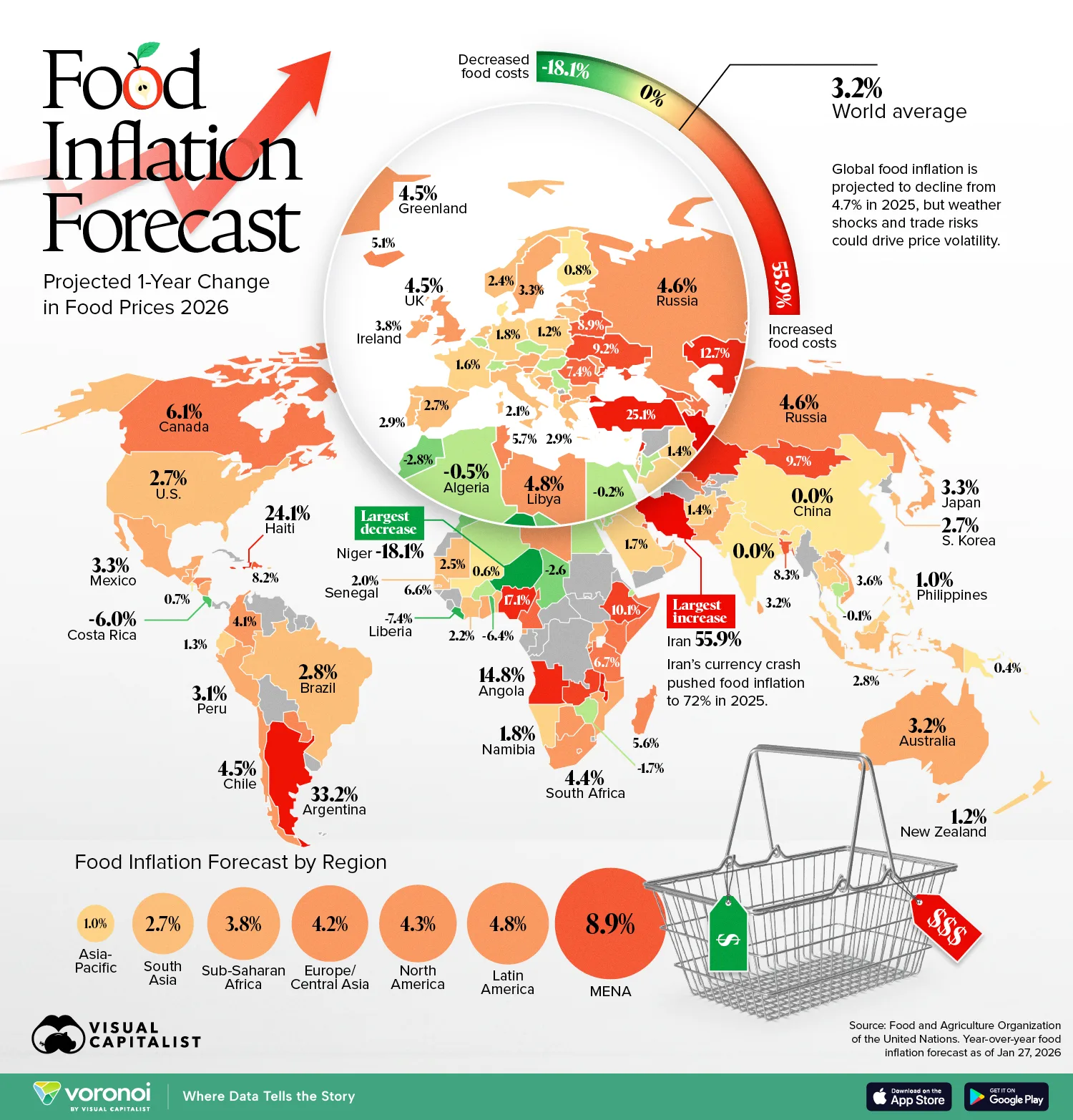
- The global average food inflation for 2026 stands at 3.2%.
- Around 55.9% of countries will see higher food prices this year.
- The MENA region records the highest regional rate at 8.9%.
- Latin America follows at 4.8%, while North America reaches 4.3%.
- Europe and Central Asia are projected at 4.2%.
- Sub-Saharan Africa posts 3.8%, and South Asia shows 2.7%.
- Asia-Pacific remains the lowest region at 1.0%.
- Iran leads globally with a sharp rise of 55.9%.
- Argentina records 33.2%, and Turkey reaches 25.1%.
- Haiti posts 24.1%, while Ghana stands at 17.1%.
- Angola reports 14.8%, and Ethiopia reaches 10.1%.
- Canada shows 6.1%, while the United States records 2.7%.
- Russia and Chile both report around 4.5% to 4.6%.
- China shows stable prices at 0.0%.
- Niger records the largest drop at -18.1%, while Liberia falls by -7.4%.
- Costa Rica reports -6.0%, and the UAE shows a slight decline of -0.2%.
- Australia stands at 3.2%, and New Zealand records 1.2%.
 (Reference: Visual Capitalist)
The Different Methods of Measuring Inflation: PCE versus CPI
- U.S. CPI inflation is running at about 2.4% year‑over‑year as of early 2026.
- The PCE price index is rising at roughly 2.3%, holding close to the Federal Reserve’s target band.
- Core PCE, excluding food and energy, is at approximately 2.5%, indicating sticky underlying price pressures.
- CPI’s fixed‑basket methodology tends to overstate inflation by about 0.2–0.3% points relative to PCE.
- PCE’s chain‑weighting and substitution effect lower its measured inflation by around 0.1–0.2% points versus CPI.
- Healthcare costs account for roughly 17% of the PCE basket, compared with about 8% in CPI.
- Housing‑related items make up close to 42% of CPI but only about 33% of PCE.
- About 90% of Federal Open Market Committee communications reference core PCE as the primary inflation gauge.
- CPI now captures regional inflation differences in about 12 major metro areas with at least 1.5–2.0% points divergence from the national average.
Annual CPI Inflation Breakdown
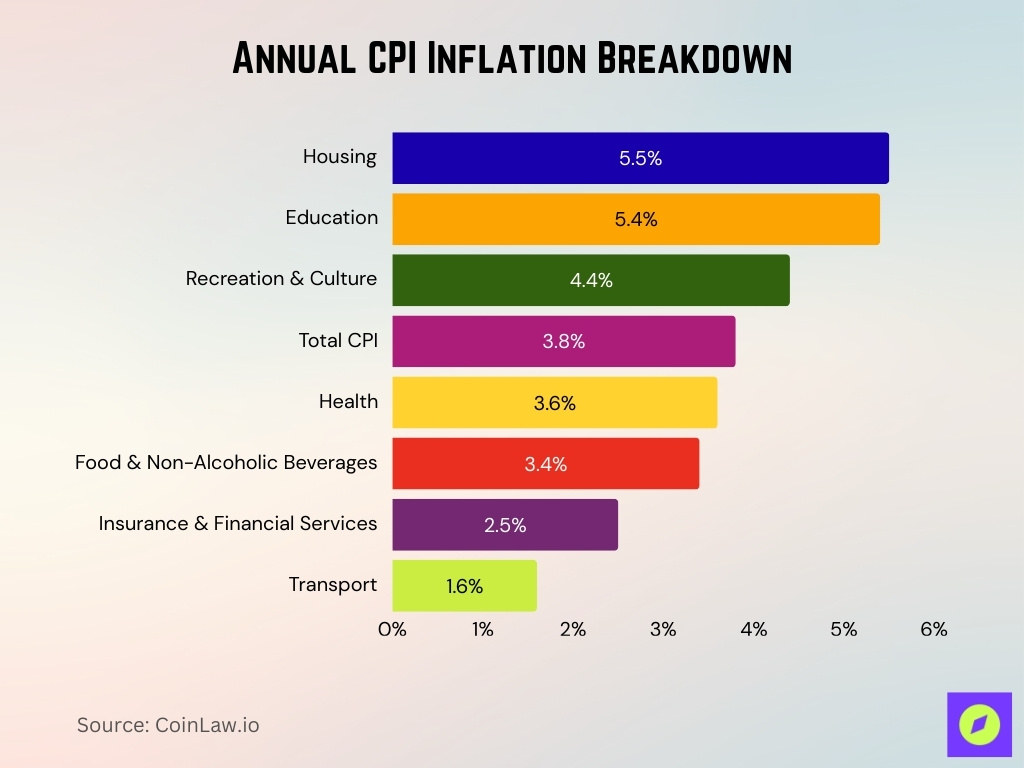
- Housing leads inflation with a strong rise of 5.5%, making it the biggest cost pressure.
- Education follows closely at 5.4%, showing steady price growth.
- Recreation & culture records an increase of 4.4%.
- The overall Total CPI stands at 3.8%, reflecting broad price growth across the economy.
- Health costs rise by 3.6%, adding to household expenses.
- Food & non-alcoholic beverages increase by 3.4%, affecting daily spending.
- Insurance & financial services grow by 2.5%, showing moderate inflation.
- Transport records the lowest rise at 1.6%, easing some cost pressure.
 (Reference: flintgroup.au)
Factors Driving Inflation
- U.S. headline inflation is forecast to average about 2.7% in 2026, with tariffs alone adding roughly 0.1–0.2% points to the rate.
- Healthcare‑sector wages are rising at around 4.5%, faster than the overall labor‑cost growth of about 3.8%.
- Residential electricity prices are expected to climb another 4% in 2026, more than double the headline inflation rate.
- Global food prices are projected to dip slightly but remain volatile, with World Bank scenarios suggesting a baseline easing of about 2% versus 2025 levels.
- New or expanded tariffs are estimated to raise import‑price inflation by nearly 10% in affected sectors, with businesses passing about 60–70% of those costs to consumers by 2026.
- The federal funds rate is expected to sit around 3.4% by late 2026, affecting mortgage and auto‑loan affordability.
- Geopolitical disruptions are adding roughly 0.5–1.0% points of extra volatility to energy and raw‑material prices in 2026.
- Cybersecurity and data‑center costs are pushing annual tech‑infrastructure spending up by about 6–10% for many firms, feeding into service‑sector pricing.
Policy Responses to Inflation
- The Federal Reserve has lowered its policy rate to 3.5%–3.75%, signaling a cautious easing path as inflation stabilizes near 2.4%.
- European central banks are holding benchmark rates around 2.5–3.0%, targeting inflation near 2.0% in 2026.
- Emerging‑market central banks such as Brazil and India have kept policy rates in the 8–10% band to anchor local inflation near 4–6%.
- Governments have committed over $150 billion globally to supply‑chain and domestic manufacturing programs like the CHIPS Act by 2026.
- The EU’s clean‑energy package is set to raise annual green‑investment flows to about 600 billion euros, aiming to cut long‑term energy‑cost inflation.
- Price‑monitoring and transparency programs now scrutinize over 40% of major consumer‑goods categories in G7 economies.
Top 15 Worst Inflation Rates in Asia
- Iran tops the Asia list with an inflation rate of roughly 48.6% as of late 2025 and early 2026.
- Myanmar follows with inflation near 33%, reflecting persistent currency and supply‑side pressures.
- Yemen records inflation of around 31%, hampered by conflict‑driven supply disruptions.
- Kazakhstan is at about 10.1%, driven by food and energy‑price volatility.
- Mongolia posts inflation near 7.5–10%, depending on the latest monthly print.
- Bangladesh shows inflation of approximately 8.4%, above its target band.
- Uzbekistan faces inflation of around 7.3–8%, affected by imported‑price pressures.
- Turkmenistan’s inflation is near 5.5–8%, depending on the data source.
- Laos reports inflation of about 5.1–7.5%, reflecting food‑price swings.
- Pakistan’s inflation settles near 5.6–6.5%, down from much higher peaks but still elevated.
Latest Numbers and News Releases
- U.S. CPI inflation has eased to 2.4% year‑over‑year in early 2026, down from 2.7% in mid‑2025.
- Euro area inflation stands at about 1.9%, slightly below the ECB’s 2.0% target.
- UK inflation has fallen to roughly 2.8%, with food‑price inflation still above 5%.
- U.S. core PCE inflation is at approximately 2.5%, reflecting slower underlying price pressures.
- Housing‑related inflation, especially rent, remains elevated at about 5.5–6% in major U.S. metro areas.
- Advanced‑economy inflation averages 2.2–2.6%, while emerging markets hover near 5.5–6.5%.
- Global food and agricultural prices are up about 4–6% year‑on‑year, with grains and coffee especially firm.
Main Components of Euro Area Inflation (HICP)
- Services account for 45.6% of the euro area HICP, maintaining the largest weight in consumer prices.
- Non-energy industrial goods represent 26.3%, reflecting steady inflationary influence from durable and non-durable goods.
- Food, including alcohol and tobacco, contributes 19.3%, driven by higher agricultural and supply costs.
- Energy holds 9.4%, remaining the most volatile component amid fluctuating global oil and gas prices.
- Core inflation (excluding energy and food) stands at 3.1%, signaling persistent underlying price pressures.
- Headline HICP inflation rate averages 2.4%, aligning near the ECB’s medium-term target.
- Services inflation alone rose 3.8% year-on-year, fueled by demand in the travel and hospitality sectors.
- Energy prices declined 5.6% year-on-year, helping offset higher service and food costs.
- Food inflation eased to 2.9%, marking a moderation from previous peaks.
- Non-energy industrial goods inflation remained stable at 2.1%, reflecting balanced consumer demand.
US Cities with the Highest Inflation Rates
- New York, NY, records the highest inflation at 3.9%, led by housing and services.
- Miami, FL follows at 3.7%, driven by rent and insurance costs.
- Chicago, IL posts 3.5%, reflecting broad price gains across categories.
- Dallas, TX, stands at 3.4%, supported by rising transportation and food prices.
- Philadelphia, PA reports 3.3%, influenced by housing and healthcare costs.
- Los Angeles, CA, marks 3.1%, with elevated shelter and energy expenses.
- Seattle, WA registers 3.0%, as wage growth sustains local demand.
- Detroit, MI, shows 2.9%, consistent with national moderations.
- Atlanta, GA, averages 2.8%, down from mid-2025 highs.
- U.S. city average inflation rate holds at 2.7%, near the national CPI trend.
Historical Context and Inflation Comparisons
- U.S. inflation averages 2.4%, marking continued stability near the Fed’s target.
- Euro area inflation stands at 2.2%, reflecting easing from prior energy-driven highs.
- U.K. inflation moderates to 2.6%, aided by lower energy and food prices.
- Japan records inflation of 1.9%, slightly above its long-term average.
- Canada maintains inflation at 2.3%, nearing pre-pandemic norms.
- Turkey’s inflation remains elevated at 58.7%, though easing from prior triple-digit levels.
- Brazil’s inflation steadies at 3.9%, supported by monetary tightening.
- India experiences inflation of 4.8%, driven by food and fuel costs.
- Global inflation averages 3.1%, down from 6.4% in 2022.
- Emerging markets collectively post inflation of 5.2%, reflecting moderated price pressures.
Frequently Asked Questions (FAQs)
The US CPI inflation rate stood at 2.4% year-over-year in January 2026.
Euro area HICP inflation is expected to average just below 2.0% in the first half of 2026.
US producer price inflation (PPI) dipped to 2.9% year-over-year in January 2026.
China’s core CPI is expected to average around 0.85% in 2026.
Conclusion
Inflation remains a defining factor in the global economy, impacting consumer prices, wages, and policy decisions across regions. While recent data suggests that inflation is gradually stabilizing in many areas, challenges remain, especially with food and housing prices, climate impacts, and geopolitical instability. Understanding the nuances of inflation by region, category, and policy responses can empower individuals, businesses, and policymakers to make informed decisions as they navigate the changing economic landscape. With a more balanced inflation rate projected in the near future, the key will be implementing sustainable practices to maintain long-term price stability.
The post Inflation Statistics 2026: Latest Trends, Comparisons, and Economic Impacts appeared first on CoinLaw.
You May Also Like

Santander UK Announces Intention to Appoint Nicola Bannister as New TSB CEO

XRP Community Reacts as Ripple Prime Joins NSCC Directory
