

Uniswap Lawsuit Ruling Redefines DeFi Legal Boundaries
This article was first published on The Bit Journal.
The Uniswap lawsuit took a major turn when Manhattan federal judge Katherine Polk Failla dismissed the Risley v. Universal Navigation class action against Uniswap Labs and its founder Hayden Adams with prejudice. The court made it clear that Uniswap is not responsible for scam tokens traded on its platform.
This ruling creates an important legal benchmark for DeFi projects. Making clear how far developer responsibility extends. Following news $UNI token jumped 6% to about $3.92 and is currently trading around $3.89. Showing market’s relief from long-standing legal uncertainty.
What Led to the Uniswap Lawsuit?
The Uniswap lawsuit started in April 2022 when a group of investors led by Nessa Risley filed a class action against Uniswap Labs, founder Hayden Adams, and venture firms Paradigm, Andreessen Horowitz, and Union Square Ventures. The investors argued that Uniswap allowed “rug pulls and pump-and-dump schemes” by letting anyone list and trade tokens on its platform without restrictions.
 Uniswap Lawsuit Ruling Redefines DeFi Legal Boundaries 4
At first, the case focused on federal securities violations, but these claims were dismissed in August 2023. The plaintiffs then revised their complaint in May 2024 to target state-level consumer protection laws. After three rounds of legal filings over four years, the court found that the plaintiffs could not show Uniswap knowingly took part in or helped any fraudulent activity.
How Did the Court Justify Dismissing the Uniswap Lawsuit?
Judge Polk Failla made it clear that simply offering a platform where scams might happen does not mean Uniswap actively helped commit fraud. She pointed out that the plaintiffs could not prove Uniswap knew about specific fraudulent actions or directly supported them.
The court also stressed that many scam-token creators remain unknown and nearly impossible to trace, leaving the plaintiffs with “an identifiable injury but no identifiable defendant.” To explain her reasoning, the judge compared it to regular finance: banks are not responsible if someone launders money through their accounts, and messaging apps like WhatsApp are not liable when users coordinate illegal activities.
What Did Hayden Adams Say About the Lawsuit Outcome?
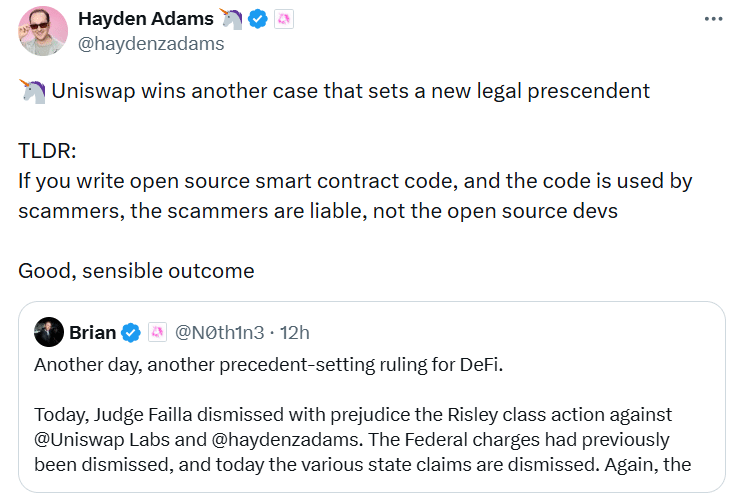
Hayden Adams shared his response on X regarding the Uniswap lawsuit, calling the outcome a “good, sensible outcome” and a new legal precedent. He emphasized that developers of open-source smart contract code cannot be held responsible when scammers misuse it. “If you write open-source smart contract code, and the code is used by scammers, the scammers are liable, not the open-source devs,” Adams said.
 Uniswap Lawsuit Ruling Redefines DeFi Legal Boundaries 5
Industry analysts praised the ruling as an important clarification for the DeFi ecosystem. Legal commentator Brian noted on X that the ruling sets another important precedent for DeFi. He explained that the court dismissed all remaining claims against Uniswap Labs and Hayden Adams, making it clear that simply providing a platform does not mean helping commit fraud.
What Does the Uniswap Lawsuit Mean for DeFi Users and Developers?
The Uniswap lawsuit dismissal gives developers clearer legal rules for building open DeFi platforms. They can create decentralized exchanges or lending services without being blamed for others’ fraud. For users, it’s a reminder to be careful, as if someone loses money to a rug pull, only the scammer can be held responsible, not Uniswap.
 Uniswap Lawsuit Ruling Redefines DeFi Legal Boundaries 6
The court said broader fraud concerns are “better addressed to Congress than to this Court,” meaning future rules may come from lawmakers. The ruling also stresses using audits, monitoring, and token checks. It protects developers legally but does not stop scams, so investors still need caution and good tools.
Conclusion
The Uniswap lawsuit is major moment for DeFi. Showing that just running a platform does not make you responsible for fraud. The court’s decision protects developers while reminding everyone that scams are still a real risk. Developers have less legal worry now, but users must be careful with their trades.
The dismissal with prejudice ends a long legal battle, while discussions about regulations and investor safety continue. The Uniswap lawsuit gives clear guidance for developers, warns users to stay alert, and sets a reference for lawmakers planning future rules.
Glossary
Rug Pull: Developers take funds and abandon the project.
Pump-and-Dump Scheme: Price is hyped up and then quickly sold for profit.
Class Action: Group lawsuit against one defendant.
Smart Contract: Self-running blockchain agreement.
Open-Source Code: Public code that anyone can access and use.
Frequently Asked Questions About the Uniswap Lawsuit
What was the Uniswap lawsuit about?
The lawsuit claimed that Uniswap was responsible for scam tokens traded on its platform.
What did court decide in Uniswap lawsuit?
The court decided that Uniswap is not legally responsible for scam tokens.
Can Uniswap be blamed for rug pulls on its platform?
No court said only scammers are responsible and not the platform.
What does this ruling mean for DeFi users?
It means users must be careful as they cannot sue the platform for scam tokens.
Could new laws for DeFi come in the future?
Yes, the judge said future rules may come from lawmakers instead of courts.
Sources
Cointelegraph
Binance
Spendnode
Read More: Uniswap Lawsuit Ruling Redefines DeFi Legal Boundaries">Uniswap Lawsuit Ruling Redefines DeFi Legal Boundaries
You May Also Like

Why Bitcoin Needed A Remodel With Segwit And Taproot

XRP Whales Accumulated 1.3 Billion XRP In Just 48 Hours. What’s Happening?
