

Mastercard Statistics 2026: Global Spending Trends Now
In a world where digital transactions are increasingly replacing cash, Mastercard stands as a cornerstone in facilitating secure and seamless payments. With a presence in over 200 countries, Mastercard has consistently driven innovations that connect individuals, businesses, and governments. As we dive into the latest data and trends around Mastercard, this article will explore its financial milestones, market standing, and the impact of its extensive network on the U.S. economy and beyond.
Editor’s Choice
- Mastercard’s total revenue reached $32.8 billion, up 16% year-over-year, driven by cross-border growth.
- Net income rose to $15.0 billion, up 16% year-over-year, fueled by strong consumer spending and fintech partnerships.
- Operating margin improved to 57.6%, reinforcing Mastercard’s efficiency despite rising infrastructure investments.
- Total transaction value hit $10.6 trillion, confirming Mastercard’s role in global digital commerce expansion.
- R&D spending emphasized AI-driven security and tokenization, supporting innovation initiatives.
- Mastercard’s stock gained amid strong investor confidence and innovation initiatives.
Recent Developments
- Mastercard reaffirmed its Net Zero goal for 2040, achieving a 46% reduction in emissions across Scopes 1, 2, and 3 as of 2025, exceeding 2027 targets.
- Mastercard’s agreement with the U.S. Treasury disbursed $50 billion in federal benefits via prepaid cards and digital solutions.
- The Fintech Express program added 72 new fintech partners globally, accelerating access to next-gen payment solutions.
- Sustainability-focused credit cards surpassed 1.5 million issued, empowering users to track and offset their carbon footprints.
- 88% of new Mastercard cards were issued digitally, continuing the shift toward plastic-free, digital-first card issuance.
- Mastercard’s Priceless Planet Coalition planted 7.4 million trees globally, advancing its climate restoration goals.
- The partnership with UNICEF reached 2.3 million beneficiaries through financial literacy programs in underserved communities.
Mastercard Financial Forecast
- Sales are expected to reach about $37,000 million in 2026, showing strong growth in Mastercard’s global payments network.
- Sales may increase to roughly $41,000 million in 2027, reflecting continued expansion in digital transactions.
- Sales could climb to nearly $46,000 million by 2028, highlighting steady long-term revenue growth.
- Free cash flow is forecast to reach about $18,000 million in 2026, indicating strong cash generation from operations.
- Free cash flow may rise to around $20,000 million in 2027, giving Mastercard more capital for investments and shareholder returns.
- Free cash flow could grow to roughly $22,500 million in 2028, strengthening the company’s financial flexibility.
- EBITDA is projected to reach about $23,000 million in 2026, reflecting strong operating performance.
- EBITDA may increase to nearly $26,000 million in 2027, supported by higher payment volumes.
- EBITDA could reach around $29,000 million in 2028, showing sustained profitability.
- Finance debt may narrow to about -$5,000 million in 2026, indicating improved debt management.
- Debt could decline further to roughly -$2,000 million in 2027, reducing financial pressure.
- Debt may shift to about $5,000 million in 2028, reflecting changes in financing strategy.
- Leverage may fall to about 0.23x in 2026, showing stronger balance sheet stability.
- Leverage could drop to around 0.05x in 2027, indicating very low debt relative to earnings.
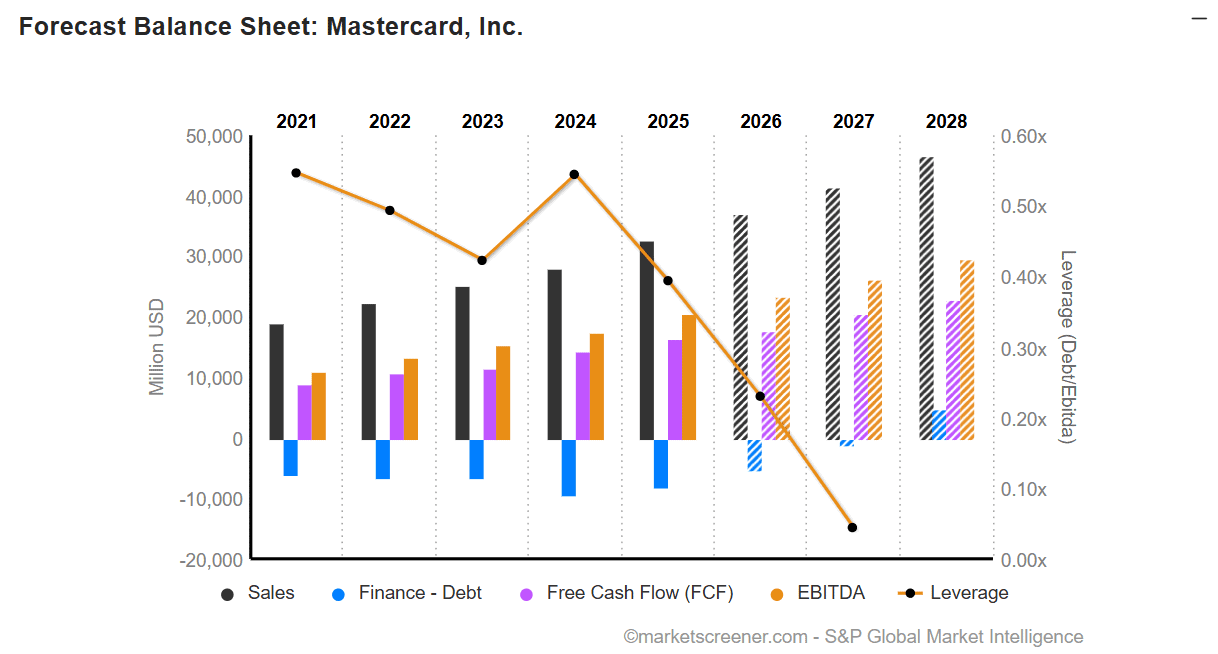 (Reference: MarketScreener)
General Mastercard Statistics
- Total cardholders worldwide reached 3.1 billion, driven by emerging markets and digital issuance.
- Net revenue grew at the high end of low double-digits, fueled by value-added services expansion.
- Cross-border volume surged by 14%, highlighting strong travel and digital commerce demand.
- Q4 2025 gross dollar volume rose 7% year-over-year on robust transaction processing.
- Digital cross-border excluding travel increased 19%, led by e-commerce and subscriptions.
- Mastercard Move transactions exceeded 35% growth, enhancing money movement endpoints.
- Q1 net revenue growth projected at low double-digits with 3.5-4ppt FX tailwind.
- Value-added services revenue up 22-26% in Q4, supporting cybersecurity and analytics.
Mastercard in the United States
- Total U.S. cardholders using Mastercard reached 275 million, fueled by digital banking adoption.
- U.S. transactions processed exceeded 45.2 billion, up 12.5% year-over-year from a consumer surge.
- Average credit card spending per cardholder hit $4,620, boosted by economic recovery.
- Debit card usage increased significantly during the pandemic and remains widely used for everyday consumer purchases.
- Retail partnerships accounted for 26.4% of total U.S. transactions via key alliances.
- Contactless payments grew by 31.2%, propelled by tap-to-pay infrastructure rollout.
Ownership by Level of Education
- Advanced degree holders represented 26.2% of Mastercard’s U.S. cardholder base.
- Undergraduate degree holders comprised 50.3% of all U.S. Mastercard debit users.
- High school diploma holders accounted for 35.1% of U.S. Mastercard users, favoring debit options.
- Students without college degrees made up 12.8% of new debit Mastercard accounts.
- Adults with some college used Mastercard debit for 37.4% of their transactions.
Cardholder and Transaction Statistics
- Global Mastercard cardholders reached 3.1 billion, driven by digital issuance in emerging markets.
- Contactless payments comprised 51.2% of U.S. Mastercard transactions, accelerating tap-to-pay adoption.
- Total global cardholder spending grew by 20.1%, boosted by travel and entertainment recovery.
- Cross-border transactions increased 25.8%, fueled by e-commerce and international remittances.
- E-commerce spending accounted for 32.4% of total Mastercard purchases worldwide.
- Purchase volume rose 9.2% year-over-year, led by strong consumer momentum.
Usage and Ownership Trends
- Credit card usage on Mastercard reached 47.2% of U.S. adults, driven by rewards and cashback incentives.
- Debit card ownership grew by 19.5%, led by real-time payments and mobile banking adoption.
- Mobile wallet integration usage surged 30.1% year-over-year with Apple Pay and Google Pay expansion.
- Contactless card usage hit 62.4% of North American Mastercard transactions, boosting checkout speed.
- Millennials and Gen Z accounted for 53.7% of new Mastercard credit accounts opened.
- Consumer trust in security features rose 24.3%, supported by AI-driven fraud detection.
- Average monthly spend per global user climbed to $682, fueled by e-commerce and subscriptions.
- Tokenized payment adoption increased 41%, enhancing secure online checkout experiences.
Top Credit Card Issuers by Market Share
- Chase leads with a 17.3% share as the top U.S. credit card issuer.
- American Express holds 12.3%, known for premium offerings.
- Citi secures 10.9%, strong in consumer and business segments.
- Capital One claims 10.7%, boosted by cashback rewards.
- Bank of America commands 9.2% via banking network synergies.
- Discover accounts for 8% with high satisfaction rates.
- Wells Fargo maintains 4%, mixing secured products.
- U.S. Bank captures 3.9% through co-branded portfolios.
- Barclays holds 2.5% via travel partnerships.
- Navy Federal represents 2.4%, targeting military members.
Ownership by Race
- Hispanic and Latino consumers comprised 24.8% of new U.S. Mastercard cardholders.
- Asian American consumers accounted for 20.1% of total U.S. Mastercard users.
- White Americans represented 41.3% of Mastercard’s U.S. user base.
- Multiracial and other groups made up 14.2% of U.S. Mastercard users.
- Mastercard campaigns drove 21.2% increase in new minority cardholders.
- Mobile wallet use among African American and Hispanic users grew 30.4%.
Ownership by Income
- High-income households (over $150,000) comprise 47.2% of Mastercard’s U.S. credit cardholders.
- Middle-income households ($50,000–$149,999) represent 42.1% of the U.S. customer base.
- Low-income households (under $50,000) saw Mastercard debit ownership rise 16.8%.
- Middle-income users spent an average of $4,380 yearly on credit cards.
- Lower-income cardholders increased their debit spending 14.9% on essentials.
- 60.4% of high-income households joined Mastercard rewards programs.
Credit Card Usage by Generation
- Young adults (18–24) make up 15% of total credit card usage. Many are just starting to build credit and often use debit cards more.
- Millennials (25–40) account for 35% of total credit activity. They are in their main earning and spending years, so they use credit cards often.
- Generation X (41–56) represents 30% of credit usage. Many in this group carry the highest credit card balances.
- Baby Boomers (57+) contribute 20% of total card usage. They still use credit cards regularly, but usually manage their spending more carefully.
Partnerships and Collaborations
- Mastercard and Apple Pay Later expanded to 22 countries, boosting installment usage 33.2%.
- Amazon partnership drove 29.1% increase in Mastercard platform transactions.
- Stripe integration captured 14.8% of new business users for online payments.
- Samsung digital ID secured 5 million biometric-linked Mastercard accounts.
- Microsoft AI collaboration reduced fraud and false declines 18.9%.
- Plaid boosted linked Mastercard accounts 34.7%.
- Shared digital wallet with Visa reached 65 million global users.
- Ericsson’s partnership enhanced mobile money for 120 million users.
Frequently Asked Questions (FAQs)
Mastercard holds approximately 24.9% global market share in credit card purchases.
Cross-border volumes showed strong growth, contributing to overall payment network gains.
Net revenue expected at the high end of low double-digits on a currency-neutral basis.
Conclusion
Mastercard’s influence in the global financial ecosystem is clear, from innovative digital payment solutions to steadfast market growth. With a focus on technological advancements and sustainable practices, Mastercard is not only driving financial connectivity but also positioning itself as a leader in responsible business practices.
As Mastercard continues to innovate with AI-powered fraud detection, blockchain, and biometric technology, it stands to reshape how individuals and businesses engage with financial services globally. For cardholders and investors alike, Mastercard’s trajectory today underscores its resilience, adaptability, and commitment to a secure, inclusive, and sustainable future.
The post Mastercard Statistics 2026: Global Spending Trends Now appeared first on CoinLaw.
You May Also Like

Will Bitcoin Soar or Stumble Next?

Why Did Luxembourg Allocate 1% of its Wealth Fund to Bitcoin?
