Bitcoin (BTC) Rejection at $70K Amid Middle East Crisis Dragging Down Global Markets
TLDR
- Bitcoin encountered its third rejection at the $70,000 level since February, retreating to approximately $67,600 during Asian trading hours on Wednesday.
- Alternative cryptocurrencies such as Solana, Cardano, and Dogecoin experienced steeper declines than Bitcoin on a seven-day timeframe.
- Asian stock markets faced significant selling pressure, with South Korean equities recording their largest two-day decline since the 2008 financial crisis.
- Crude oil prices jumped approximately 4.7% amid ongoing disruptions at the Strait of Hormuz linked to the Iranian conflict.
- American stock index futures weakened, following Tuesday’s session where the S&P 500, Dow Jones, and Nasdaq all closed lower by nearly 1%.
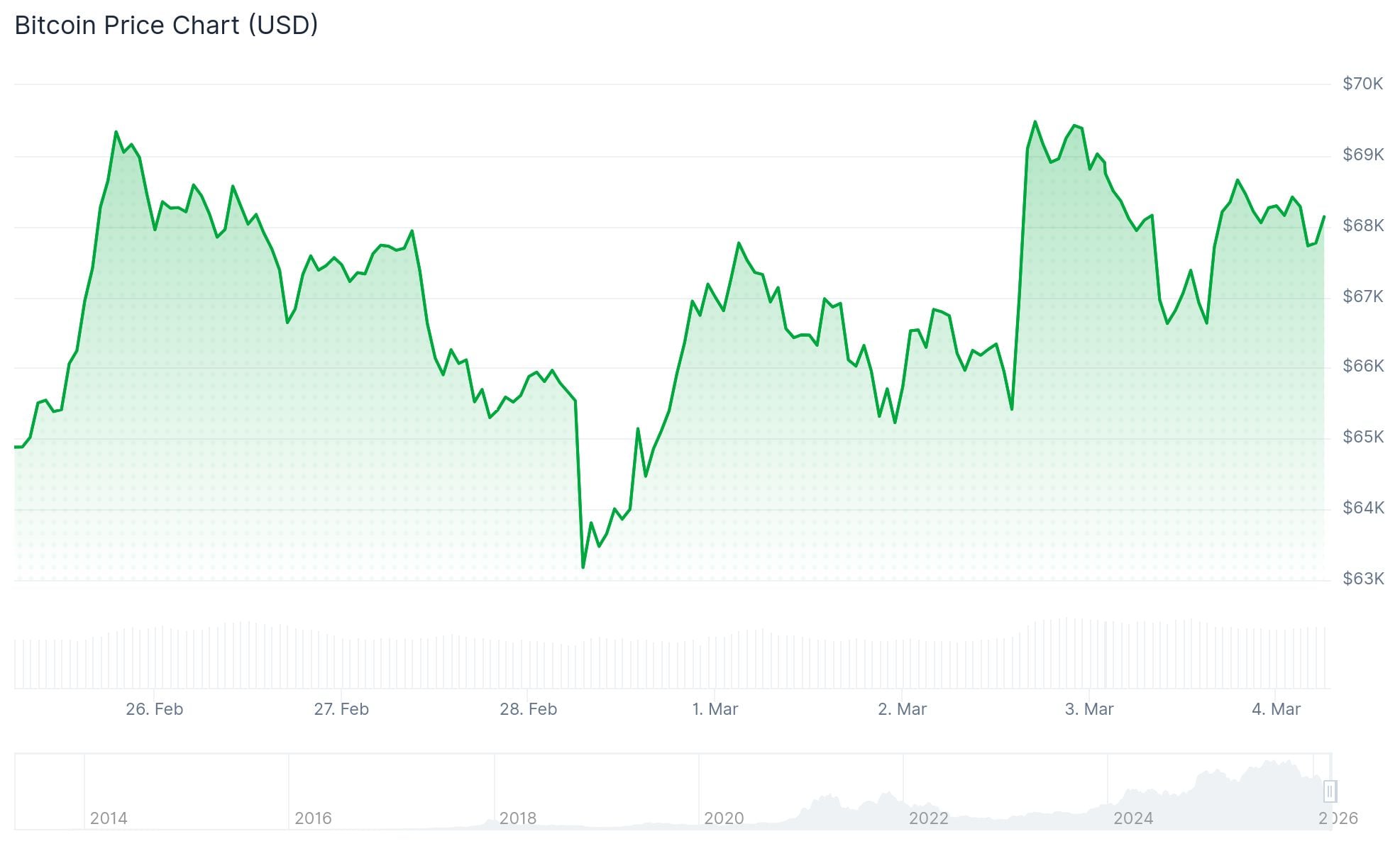
Bitcoin’s attempt to break above $70,000 failed for the third consecutive time since the February downturn, with the cryptocurrency retreating to $67,600 during Wednesday’s Asian trading hours as escalating Middle East tensions continued pressuring risk-sensitive assets worldwide.
 Bitcoin (BTC) Price
Bitcoin changed hands at $67,612 as Asian markets opened on Wednesday, representing a 0.7% decline over the previous 24-hour period. Despite the pullback, BTC maintained a 3.4% gain across the weekly timeframe, preserving gains from its weekend rally.
Ethereum declined 2.2% to settle at $1,957, partially erasing its recent upward momentum. The second-largest cryptocurrency still showed a 2.6% increase over the past week. BNB bucked the trend, climbing 5.2% weekly to touch $629.
Alternative cryptocurrencies bore the brunt of selling pressure. Dogecoin tumbled 2.9% in 24 hours and posted a 3.9% weekly decline. Cardano surrendered 4.2% in a single session and dropped 3.5% over seven days. Solana decreased 0.8% to $85.16, making it the weakest performer among major tokens with a 4.2% weekly loss.
XRP demonstrated relative resilience, dipping only 1.3% to $1.35, while managing a modest 1.5% gain for the week.
Market analysts at FxPro cautioned that repeated failures at range highs could send Bitcoin toward $63,000 as the next logical support level.
Wojciech Kaszycki, Chief Strategy Officer at BTCS SA, characterized the current market behavior as following a “shock, flush, rebuild” framework. He emphasized that sustained ETF capital flows, rather than short-term price recoveries, represent the critical indicator to monitor this week.
Asian Markets Take a Hit
Asian equity indices faced substantial downward pressure. South Korean markets experienced their most severe two-day selloff since the 2008 global financial crisis. Technology stocks within the MSCI Asia Pacific index plummeted 4%, dragging down Japanese, Taiwanese, and South Korean benchmarks.
The Indian rupee reached an all-time low, influenced by escalating costs for oil imports. Precious metals rallied, with gold advancing and pulling silver higher for the first time this week.
The Strait of Hormuz remains effectively closed to shipping following weekend military strikes. Brent crude surged 4.7% on Wednesday even as the United States announced intentions to provide naval escorts for tankers traversing the strait.
President Trump proposed an insurance framework for oil tankers via Truth Social but provided no concrete details. Elevated energy costs amplify inflation concerns, potentially delaying anticipated interest rate reductions.
US Stocks Also Under Pressure
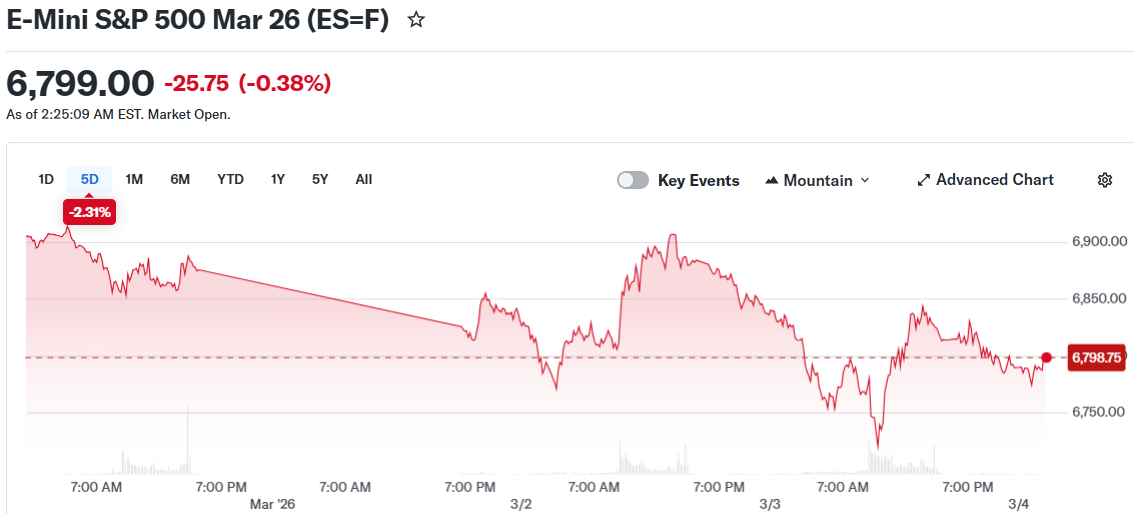
US equity futures declined during Tuesday evening trading. S&P 500 contracts fell 0.5%, Nasdaq 100 futures dropped 0.7%, while Dow futures edged higher by 0.4%.
 E-Mini S&P 500 Mar 26 (ES=F)
The S&P 500, Dow Jones Industrial Average, and Nasdaq Composite all finished Tuesday’s regular session down approximately 1%, though they recovered substantially from intraday lows.
Market participants are now focused on Wednesday’s ADP private sector employment data for insights into labor market conditions. Quarterly earnings releases from Broadcom, Costco, and Alibaba are scheduled for this week.
Bitget CEO Gracy Chen attributed Bitcoin’s current weakness partially to investor frustration with cryptocurrency performance, particularly as gold, silver, and major stock indices continue reaching record highs.
Remember: Preserve all tokens like [[EMBED_0]], [[IMG_0]], [[LINK_START_0]], [[LINK_END_0]], [[SCRIPT_0]], [[FIGURE_0]] etc. exactly as they appear. These are placeholders for embeds, images, and links that must not be changed.
The post Bitcoin (BTC) Rejection at $70K Amid Middle East Crisis Dragging Down Global Markets appeared first on Blockonomi.
You May Also Like

FCA komt in 2026 met aangepaste cryptoregels voor Britse markt

PBOC Sets Strongest Fix In 34 Months, Signaling Strategic Shift