JCB & Resona Launch World’s First UWB Payment Commercial Project
TOKYO – JCB Co., Ltd. (JCB), together with Resona Holdings, Inc. (Resona; TSE: 8308), announced the start of a project to commercialize ultra-wideband (UWB) payments that realize a new purchasing experience using UWB communication.
The two companies have agreed to launch the world’s first full-scale project for the practical application and commercialization of UWB payments. In 2026, JCB will work with multiple technology partners and collaborating merchants to demonstrate payment technology and value-added solutions for merchants, as well as user experience building projects to create new purchasing experiences. On top of that, JCB aims to launch small-scale commercial operations in 2027 and full-scale commercialization in earnest in 2028.
The two companies are participating in the FiRa® Consortium, which standardizes and contributes to the development of UWB communication technology, as well as builds new payment experiences and value-added solutions for stores using UWB technology.
 JCB Co., Ltd.
About the UWB Payment Project
Through the activities of the FiRa Consortium, JCB, and Resona will standardize technologies and experiences for payment applications, and with the support of FiRa Consortium’s participating vendors, conduct technology tests. From 2026, the two companies will demonstrate UWB payments and value-added solutions together with multiple partner merchants and provide feedback to FiRa on the necessary technology development.
In parallel, JCB and Resona will conduct research on user experience and store payment operations to confirm user and merchant acceptability.
Moreover, to reduce the introduction load for merchants as much as possible, the project aims to build a payment infrastructure that can widely accept payment solutions using UWB from competitors. The project is aimed to launch on a small scale in 2027 and commercialize on a full-scale in 2028.
In addition, the two companies will aim to realize new UWB payments through collaboration with a wide range of partners in Japan and other countries.
 JCB Co., Ltd.
The Background of This Project
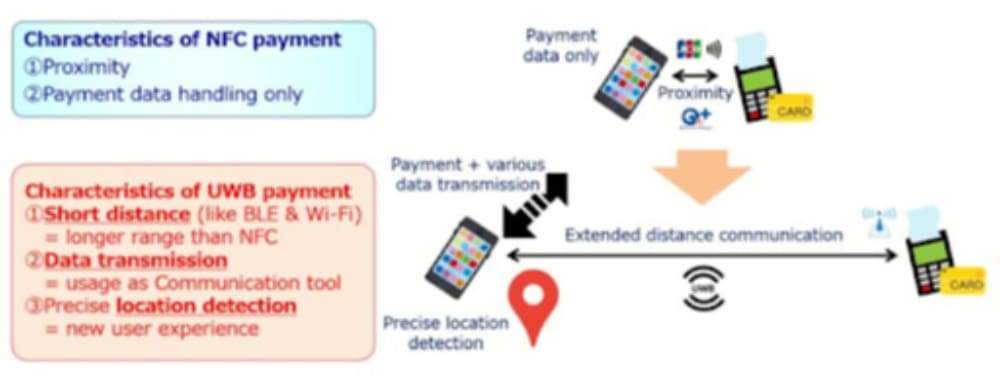
UWB communication technology is a short-range wireless communication technology that has the characteristics of (1) accurate location of devices and (2) high-speed data communication and is being used in Japan and overseas for location verification of digital keys for cars and homes, indoor navigation, and tags.
The technology is also used overseas in gateless public transportation systems. In the future, it is expected to be used for payments, as with NFC (Near Field Communication) and QR codes.
Outside Japan, the spread of smartphones with UWB functions has been slow, but in Japan, smartphones that can use UWB communication are widely available, and can be utilized in advance of the rest of the world. Moreover, the diversification of cashless payments and the wide range of value-added solutions for users and stores are also characteristics of Japan’s payment scene. The project believes that it is necessary to take advantage of this location and create new payment solutions to solve problems for users and stores and meet the needs of new solutions.
Overview of “UWB Payments”
UWB payments can greatly improve the purchasing experience. Until now, it has been necessary to physically touch a card or smartphone at a payment terminal in a merchant or to scan a QR code. UWB payments will leverage short-range communication characteristics to create a new purchasing experience, such as hands-free payments even with a smartphone in a pocket or bag, and to instantly convey user information, such as diet restrictions, to merchants.
Also, by utilizing the accurate location information of smartphones, it is possible to realize value-added solutions for both users and merchants that have never been seen before, such as improving the efficiency of navigation and waiting in stores, distributing personalized advertisements and coupons using smart displays, and providing new customer service for VIP customers. It is expected to be used not only to improve the experience but also to be used as a labor-saving solution to address labor shortages.
Examples of value-added solutions:
- Provide communication functions for both users and merchants. For example, it can be used to automate the communication of requests such as food allergy information, whether or not plastic bags are needed, whether receipts are present and addressed, loyalty program information, whether coupons are available and used, and requests such as handicap and assistance needs, and children’s chair preparations.
- Provide special customer service experiences for VIP customers and support store operations. Customers can receive a special customer service experience without verbally communicating with the merchant’s staff, allowing stores to provide appropriate customer service based on specific customer needs.
- Enable 1-to-1 marketing capabilities for customers. Marketing utilization, such as displaying personalized information on smart displays near customers, distributing coupons to customers, and displaying personalized pricing.
Past UWB Payments Initiatives
In January 2024, JCB and Resona entered into a strategic partnership for the “Hands-free Payment” project, an initiative to build a new payment experience that does not require smartphone operation using device-to-device communication technology. Using UWB communication technology by linking the smartphones held by customers who visit the store with payment terminals and various IoT devices installed in the store, it allows customers to complete the payment process from authentication to payment procedure without taking out a smartphone or activating the screen, and even keeping their smartphone in their bag or pocket. By utilizing this solution, customers can grasp information at the time of their visit to the store and receive customer service and new in-store experiences, such as providing services for VIPs, preferential treatment, and coupon distribution.
JCB also announced the development of a UWB-enabled app for iPhones and Apple Watches to support the project, along with a reference model of store checkout equipment and the launch of user testing. Through these efforts, JCB and Resona have been discussing and collaborating with their collaborative partners on technologies and business models.
Looking ahead, JCB and Resona will work with multiple technology partners and collaborating merchants to carry out proof-of-concept initiatives for payment and merchant value-added solutions in 2026, with a phased commercial rollout planned for 2027 and full-scale commercialization targeted for 2028.
About FiRa Consortium
The FiRa Consortium is a member-driven organization dedicated to transforming the way we interact with our environment by enabling precise location awareness for people and devices using the secured fine-ranging and positioning capabilities of Ultra-Wideband (UWB) technology. FiRa does this by driving the development of technical specifications and certifications, advocating for effective regulations, and defining a broad set of UWB use cases. To learn more about UWB and the FiRa Consortium, visit www.firaconsortium.org.
About Resona Holdings, Inc.
With the Group’s purpose of “Making the future positive with finance +,” we continue to take on the challenge of transformation and creation in order to transform the future into a positive one with ideas that go beyond the framework of finance. Adhering to our basic stance of “customer joy is Resona’s joy,” we will work to “strengthen value creativity” and “next-generation management infrastructure” to respond to customers and local communities.
About JCB Co., Ltd.
JCB is a major global payment brand and a leading credit card issuer and acquirer in Japan. JCB launched its card business in Japan in 1961 and began expanding worldwide in 1981. Its acceptance network includes about 71 million merchants worldwide. JCB Cards are now issued mainly in Asian countries and territories, with more than 175 million cardmembers. As part of its international growth strategy, JCB has formed alliances with hundreds of leading banks and financial institutions globally to increase its merchant coverage and cardmember base. As a comprehensive payment solutions provider, JCB is committed to delivering responsive, high-quality products and services to all customers worldwide.
For more information, please visit: www.global.jcb/en/
Contact
Anna Takeda
JCB Corporate Communications
Tel: +81-3-5778-8353
Email: [email protected]
You May Also Like

Is Doge Losing Steam As Traders Choose Pepeto For The Best Crypto Investment?

U.S. Moves Grip on Crypto Regulation Intensifies