

Texas Instruments (TXN): Stock Drops 4% on Chip Demand Slowdown After Tariff-Driven Surge
TLDRs;
- Texas Instruments stock slid after CFO warned of weaker demand post-tariff surge that boosted early 2025 sales.
- Customers rushed to place orders ahead of Trump’s April tariffs, creating a boom-bust cycle that left TI exposed.
- The company secured $1.6 billion in CHIPS Act grants, avoiding Intel’s controversial government equity stake approach.
- Free cash flow is strained by capital spending, slowing share buybacks and adding pressure to near-term investor returns.
Texas Instruments (NASDAQ: TXN) shares fell nearly 4.32% on Thursday, after the company’s Chief Financial Officer Rafael Lizardi flagged a sharp slowdown in chip demand following a short-lived surge earlier this year.
Speaking at the Citi Global TMT Conference, Lizardi revealed that semiconductor orders peaked from January to April 2025 as customers rushed to secure inventory ahead of U.S. tariffs on Chinese goods announced by President Donald Trump on April 2.
Once the tariffs were enacted, however, demand cooled quickly, leaving Texas Instruments exposed to the volatility created by shifting trade policy. The CFO explained that while the company had anticipated a pull-forward effect in orders, the steepness of the post-tariff drop reflected broader uncertainty across global supply chains.
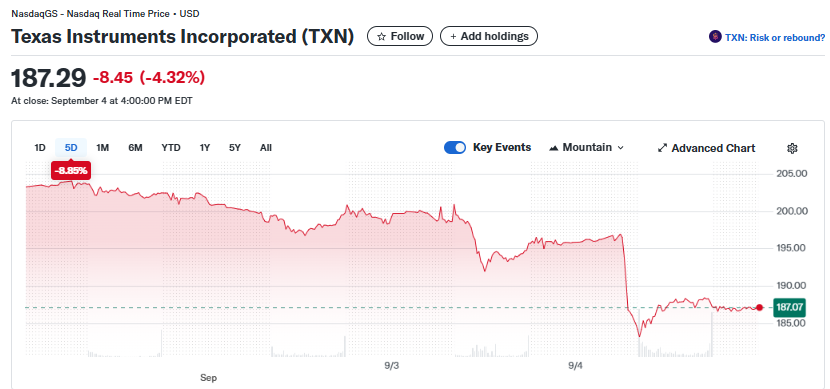 Texas Instruments Incorporated (TXN)
Tariffs Create Boom-Bust Cycles
The case of Texas Instruments underscores a recurring pattern in the semiconductor industry, tariff-driven demand surges followed by sharp corrections. Analysts note that customers tend to place large advance orders when trade restrictions loom, creating artificial spikes in sales data that distort longer-term demand trends.
This boom-bust effect has been documented before. During previous rounds of U.S.-China trade tensions, Dell warned of “mutually assured destruction” as component costs climbed, while Cisco highlighted looming risks of supply disruptions and higher consumer prices. Similarly, the Semiconductor Industry Association testified that tariffs covering $300 billion in Chinese imports would have “crippling consequences” for the industry.
For Texas Instruments, the recent slowdown reinforces that trade policy shifts have become a structural risk factor for semiconductor companies, influencing not just supply chains but also the cadence of customer purchasing strategies.
CHIPS Act
Even as Texas Instruments grapples with market uncertainty, the company has secured significant U.S. government support.
The Commerce Department has earmarked up to $1.6 billion in CHIPS Act funding for the Dallas-based chipmaker. Unlike Intel, which recently agreed to an unprecedented deal converting $8.87 billion in grants into a 9.9% government equity stake, Texas Instruments will receive its funding via a more conventional grant structure.
Lizardi emphasized that TI has not been approached regarding an equity arrangement and expects its partnership with the government to remain limited to grants. Analysts view this as a sign of Washington’s differentiated approach: tailoring incentives to individual company circumstances while maintaining leverage over critical supply chains.
Financial Pressures and Buyback Slowdown
While government funding provides a cushion, Texas Instruments continues to face financial headwinds. Free cash flow remains under pressure due to heavy capital expenditures tied to long-term expansion projects. As a result, the company has scaled back its stock buyback program, which has traditionally been a key pillar of shareholder returns.
Investors reacted negatively to this mix of weaker near-term demand, slower capital return, and ongoing geopolitical risk. Shares of TXN closed nearly 4% lower on Wednesday, marking one of the sharper declines in the semiconductor sector that day.
Still, with its strong balance sheet, diversified product portfolio, and government backing, Texas Instruments remains a central player in the global semiconductor landscape. The question now is whether the company can ride out policy-driven volatility while executing on long-term growth plans in areas like automotive and industrial chips.
The post Texas Instruments (TXN): Stock Drops 4% on Chip Demand Slowdown After Tariff-Driven Surge appeared first on CoinCentral.


You May Also Like
Pepe Coin Price Prediction 2026: Pepeto Presale Gains as EDX Markets Files for National Bank Charter

Bitcoin Depot Reports $3.7M Loss after Breach of Corporate Wallets




