This article details how neural density estimators, such as NPE, can accurately infer model parameters without the need for a likelihood function, ensuring a more realistic and verifiable simulation.This article details how neural density estimators, such as NPE, can accurately infer model parameters without the need for a likelihood function, ensuring a more realistic and verifiable simulation.

Neural Posterior Estimation (NPE) for Accurate Market Model Parameter Inference

Abstract and 1. Introduction

2. Relevant Work

3. Methods

3.1 Models

3.2 Summarising Features

3.3 Calibration of Market Model Parameters

4. Experiments

4.1 Zero Intelligence Trader

4.2 Extended Chiarella

4.3 Historical Data

5. Discussion & Future Work

6. Significance, Acknowledgments, and References

3.3 Calibration of Market Model Parameters

We use simulation-based inference in order to infer the parameter sets which most accurately match the features constructed by the embedding network. In order to verify that our simulation output remains realistic, we also compare our results against the stylised facts but do not use these data to train our networks. Simulationbased inference is a means of inferring the posterior probability distribution of a set of parameters without computing the likelihood, which is typically analytically intractable. It includes methods that use neural networks to perform this inference. We describe this in more detail below.

\
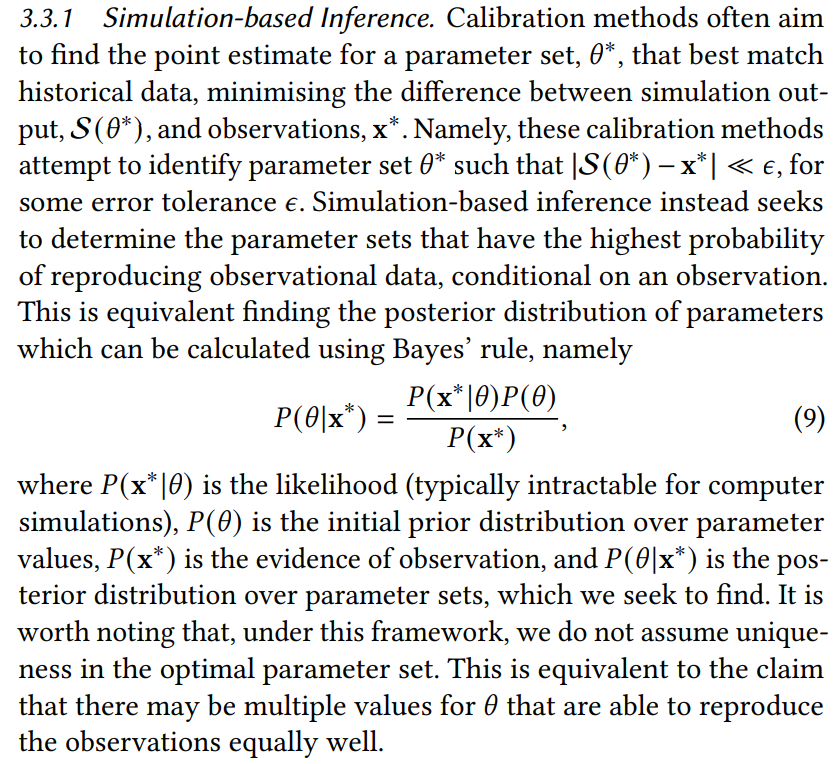
\ Simulation-based, or likelihood-free, methods avoid the need to calculate the likelihood function in Equation 9 by instead sampling from the joint distribution of simulation output and parameters [14]. These methods include ABC that, in its simplest form, samples from the joint distribution, 𝑃 (𝜃, x) = 𝑃 (𝜃)𝑃 (x) whilst keeping only those values that reproduce historical values within some tolerance, 𝜖. More recently, approaches that leverage density estimation techniques in deep learning, such as mixture density networks and normalising flows, have been shown to be both more efficient and accurate than ABC methods [14]. These methods include neural posterior estimation (NPE), neural likelihood estimation (NLE), and neural ratio estimation (NRE) [24, 27, 32]. In this work we focus only on NPE.

\ 3.3.2 Neural Density Estimators. Simulation-based inference estimates the posterior distribution of parameters by sampling from the joint distribution of simulation output and parameter sets. To do so, we use amortized variational inference, which converts the problem of approximating a probability density into a more tractable optimisation problem. Namely, we use neural density estimators, where the posterior is the target density that we seek to estimate and the simulator is the source of the training data for the network. In this work we use normalising flows, specifically neural spline flows (NSF) and masked-autoregressive flows (MAFs) [16, 29, 33]. For further details on neural density estimation, we refer the interested reader to the discussions in [31].

\

:::info Authors:

(1) Namid R. Stillman, Simudyne Limited, United Kingdom ([email protected]);

(2) Rory Baggott, Simudyne Limited, United Kingdom ([email protected]);

(3) Justin Lyon, Simudyne Limited, United Kingdom ([email protected]);

(4) Jianfei Zhang, Hong Kong Exchanges and Clearing Limited, Hong Kong ([email protected]);

(5) Dingqiu Zhu, Hong Kong Exchanges and Clearing Limited, Hong Kong ([email protected]);

(6) Tao Chen, Hong Kong Exchanges and Clearing Limited, Hong Kong ([email protected]);

(7) Perukrishnen Vytelingum, Simudyne Limited, United Kingdom ([email protected]).

:::


:::info This paper is available on arxiv under CC BY 4.0 DEED license.

:::

\

Market Opportunity
Moonveil Logo
Moonveil Price(MORE)
$0.002242
$0.002242$0.002242
+3.50%
USD
Moonveil (MORE) Live Price Chart
Disclaimer: The articles reposted on this site are sourced from public platforms and are provided for informational purposes only. They do not necessarily reflect the views of MEXC. All rights remain with the original authors. If you believe any content infringes on third-party rights, please contact [email protected] for removal. MEXC makes no guarantees regarding the accuracy, completeness, or timeliness of the content and is not responsible for any actions taken based on the information provided. The content does not constitute financial, legal, or other professional advice, nor should it be considered a recommendation or endorsement by MEXC.

You May Also Like

Strive Finalizes Semler Deal, Expands Its Corporate Bitcoin Treasury

Strive Finalizes Semler Deal, Expands Its Corporate Bitcoin Treasury

Strive had finalized its acquisition of Semler scientific after securing the approval of shareholders earlier in the week. The final deal brought both firms’ Bitcoin
Share
Tronweekly2026/01/17 12:30
Why 2026 Is The Year That Caribbean Mixology Will Finally Get Its Time In The Sun

Why 2026 Is The Year That Caribbean Mixology Will Finally Get Its Time In The Sun

The post Why 2026 Is The Year That Caribbean Mixology Will Finally Get Its Time In The Sun appeared on BitcoinEthereumNews.com. San Juan, Puerto Rico’s La Factoría
Share
BitcoinEthereumNews2026/01/17 12:24
EUR/CHF slides as Euro struggles post-inflation data

EUR/CHF slides as Euro struggles post-inflation data

The post EUR/CHF slides as Euro struggles post-inflation data appeared on BitcoinEthereumNews.com. EUR/CHF weakens for a second straight session as the euro struggles to recover post-Eurozone inflation data. Eurozone core inflation steady at 2.3%, headline CPI eases to 2.0% in August. SNB maintains a flexible policy outlook ahead of its September 25 decision, with no immediate need for easing. The Euro (EUR) trades under pressure against the Swiss Franc (CHF) on Wednesday, with EUR/CHF extending losses for the second straight session as the common currency struggles to gain traction following Eurozone inflation data. At the time of writing, the cross is trading around 0.9320 during the American session. The latest inflation data from Eurostat showed that Eurozone price growth remained broadly stable in August, reinforcing the European Central Bank’s (ECB) cautious stance on monetary policy. The Core Harmonized Index of Consumer Prices (HICP), which excludes volatile items such as food and energy, rose 2.3% YoY, in line with both forecasts and the previous month’s reading. On a monthly basis, core inflation increased by 0.3%, unchanged from July, highlighting persistent underlying price pressures in the bloc. Meanwhile, headline inflation eased to 2.0% YoY in August, down from 2.1% in July and slightly below expectations. On a monthly basis, prices rose just 0.1%, missing forecasts for a 0.2% increase and decelerating from July’s 0.2% rise. The inflation release follows last week’s ECB policy decision, where the central bank kept all three key interest rates unchanged and signaled that policy is likely at its terminal level. While officials acknowledged progress in bringing inflation down, they reiterated a cautious, data-dependent approach going forward, emphasizing the need to maintain restrictive conditions for an extended period to ensure price stability. On the Swiss side, disinflation appears to be deepening. The Producer and Import Price Index dropped 0.6% in August, marking a sharp 1.8% annual decline. Broader inflation remains…
Share
BitcoinEthereumNews2025/09/18 03:08