

👨🏿🚀TechCabal Daily – Show’s over, Showmax
TGIF! 
The news of Showmax’s shutdown sent me spiralling, and it is not because I care deeply about the streaming platform—frankly, my opinion is a speck in the cog—but because it resurfaced the existential questions I have always had about content streaming in Africa and what can actually work.
I found it interesting that the same group that tried to buy out Comcast’s 30% stake in Showmax only months ago, shortly after its MultiChoice takeover, has now come back to shut it all down after taking full control.
A few conversations I had helped me understand that Showmax struggled to build long‑term, sticky users, at least in this part of the world. People paid for Showmax when there was a trending reality show airing or when Shaka Ilembe was in peak season. Do not get me started on EPL matches; perhaps almost nobody paid for Showmax just to watch football when there are game houses and pirate apps.
Could Showmax’s new bet on African titles have won over new, stickier users? They did not wait long enough to see that play out. My theory is that streaming tethered to an existing culture base can create repeatable wins, and I am hoping to see operators lean into that. Yet, with piracy ever present, streaming remains a hard business.
(Takes hat off) Rest easy, Showmax.
—Emmanuel
- Quick Fire
 with Udeme Jalekun
 - MultiChoice is discontinuing Showmax
- Gig drivers in SA face licencing deadline
- Who secured the bag?

- World Wide Web 3
- Events
features
Quick Fire with Udeme Jalekun
 Image: Udeme Jalekun, Senior QA Engineer
Udeme Jalekun is a Senior Quality Assurance (QA) Engineer and educator who transitioned from customer support into quality engineering after identifying that most recurring production issues were preventable through stronger use-case testing. Her work spans functional and non-functional testing, including integration, system, performance, and automation testing, with a focus on building resilient, scalable systems that protect revenue and improve user experience.
- Explain your job to a five-year old.
Let’s assume the 5-year-old loves to watch the ‘Paw Patrol,’ I would explain software testing using that animation series. Each pup is awesome in their own way because of the unique tools in their pup packs, which they use for each of their missions. A software tester is the guy who checks that each tool does what it’s expected to do, how it is expected to and at the right time.
- What’s the biggest misconception startups and founders have about QA?
The biggest misconception many startups and founders have about QA is treating it as optional, something you add later when you’re bigger, not something you build with from day one. They assume developers can simply test their own work and that this will be “good enough,” especially when the pressure is to ship fast.
- Five years from now, what will separate average QA engineers from exceptional ones?
Product understanding and sector-based knowledge. With the advent of AI, many people feel that human thinking will be contracted to AI agents. But in principle, AI is trained by data, data obtained from humans’ responses to unprecedented challenges. The exceptional QA has interacted long and deeply enough with their sector/product/service and can predict edge cases and scenarios based on actual interactions with the systems under test and with people who have used the system under test.
We are expanding across Africa!

Fincra is expanding across Africa, building the financial infrastructure that powers Africa’s cross-border payments. Build with us. Explore open roles.
companies
MultiChoice to discontinue Showmax after 11 years
 Image Source: Tenor
In February 2026, when French media giant Canal+ said the current structure of Showmax, the streaming platform run by its newly acquired subsidiary MultiChoice Group, was unsustainable and that the group was rethinking its streaming ambitions, it sounded like the prelude to a restructuring.
A strategic pivot or maybe a redesign of how the platform worked. After all, streaming was supposed to be part of the future. But fresh in subscribers’ inboxes now is a different message: Showmax is being shut down.
Wasn’t streaming supposed to be the future? That’s the irony. Streaming was supposed to be the next chapter of television in Africa. In Nigeria, the over-the-top (OTT) video market (streaming platforms) is expected to have 14.8 million users by 2030. But that wasn’t enough.
So this is how the story ends: Launched in 2015, Showmax was MultiChoice’s answer to global streaming platforms such as Netflix and Amazon Prime Video. A major relaunch in 2024 came with new technology and bigger content pipelines. Yet, the numbers told a different story. Showmax accumulated losses of about €370 million ($428.9 million) in the three years leading up to the Canal+ takeover. Many African markets remain highly price-sensitive, and internet access still shapes how much streaming people can realistically consume.
What happens next? For now, subscribers can keep using the platform. The company says a migration plan for content and customers is being prepared. A migration plan is reportedly in the works, which means viewers may eventually be redirected to another service or bundled offering within the Canal+ ecosystem.
The Smarter Way to Save

At PalmPay, we don’t just talk about financial inclusion, we drive it by upskilling and empowering women for real careers in tech. Apply for Purple Woman 2026 and become one of 150 women equipped with the skills, experience, and opportunity to thrive. Learn more.
mobility
Ride-hailing apps have begun getting their licences, but drivers are nervous
 Image Source: Image Source: Zikoko Memes
In September 2025, South Africa introduced a new e-hailing operator licence under amendments to the National Land Transport Act. The goal was to bring ride-hailing into the same legal framework as other public transport services.
The amendment came with requirements, such as the visible vehicle branding, e-hailing operating permits tied to fixed routes, and panic buttons, but platforms must first register as official e-hailing operators before their drivers can apply for permits.
Two platforms are already through the door: Bolt and WANATU have secured their e-hailing operator licences from the National Public Transport Regulator (NPTR), the country’s transport regulator, ahead of the March 11 deadline. That means they’re now officially recognised under the new framework and can legally run ride-hailing services in the country. Uber has also applied and is awaiting approval.
Why ride-hailing drivers are shaking in their boots: The criteria that platforms must be licenced before their drivers get a permit makes them nervous. Without the proper permits, drivers risk paying up to R100,000 ($5,700) in fines and potentially renewed tension with the taxi industry, as taxi operators often view e-hailing as illegal, leading to intimidation and driver harm.
That’s why many drivers are watching the rollout anxiously. “What happens after March 11?” That’s the big unknown hanging over the industry.
Enjoy affordable fares on Wakanow

At Wakanow Affiliate Forum, you’ll learn how to transform everyday travel conversations into a consistent revenue stream. If you want a practical side hustle with structure and support Join us March 13, 12PM, Balmoral Event Center. Register here.
insights
Funding tracker
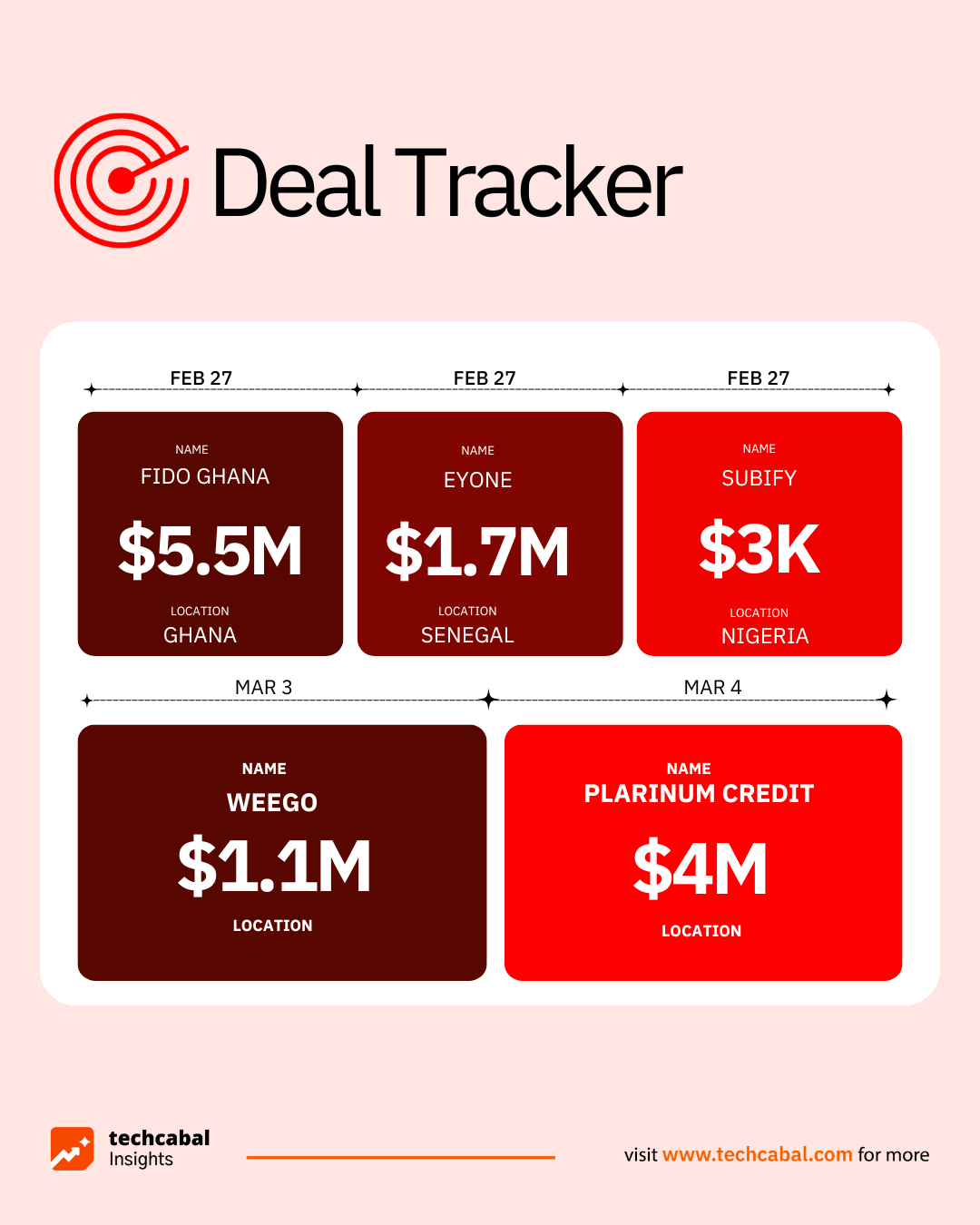 Image Source: Success Sotonwa, TechCabal Insights
Fido Ghana, a Ghanaian fintech startup, secured $5.5 million in debt funding from the Regional MSME Investment Fund for Sub-Saharan Africa (REGMIFA), managed by Swiss-based impact investment manager Symbiotics. (Mar 3)
Here are the other deals for the week:
- Eyone, a Senegalese healthtech startup, raised $1.7 million in funding from Oyass Capital. (Feb 27)
- Weego, a Moroccan–Senegalese mobility startup, secured $1.1 million in funding from Azur Innovation Fund. (Mar 3)
- Platinum Credit, a Ugandan fintech startup, secured $4 million in funding from Symbiotics. (Mar 4)
- Subify, a Nigerian fintech startup, secured a $3,000 award following the Proof Lab challenge and from angel investor Ashley Barrett. (Feb 27)
Follow us on Twitter, Instagram, and LinkedIn for more funding announcements. Before you go, CBN has a plan to make regulation work for fintechs. Find out what it looks like here.
CRYPTO TRACKER
The World Wide Web3
Source:

|
Coin Name |
Current Value |
Day |
Month |
|---|---|---|---|
| Bitcoin | $70,381 |
– 2.93% |
– 7.85% |
| Ether | $2,065 |
– 2.55% |
– 9.06% |
| BNB | $644 |
– 1.52% |
– 14.85% |
| Solana | $87.93 |
– 2.59% |
– 10.32% |
* Data as of 06.26 AM WAT, March 6, 2026.
JOB OPENINGS
- Big Cabal Media — Senior Motion Designer, YouTube Growth Strategist, Quality Assurance Engineer — Lagos, Nigeria
- Fincra — Country Manager, Kenya — Remote (Kenya)
- Fincra — Country Manager, Mozambique — Remote (Mozambique)
- Fincra — Country Manager, South Africa — Remote (South Africa)
- Fincra — Senior Product Engineer, Senior Marketing Specialist, and several other roles — Remote (anywhere in the world)
There are more jobs on TechCabal’s job board. If you have job opportunities to share, please submit them at bit.ly/tcxjobs.
- Nigeria’s loan apps are pulling back from the small loans that built them
- Nigerian AI startup Intron expands speech recognition platform to 57 languages
Written by: Success Sotonwa, Opeyemi Kareem, and Emmanuel Nwosu
Edited by: Emmanuel Nwosu & Ganiu Oloruntade
Want more of TechCabal?
Sign up for our insightful newsletters on the business and economy of tech in Africa.
- The Next Wave: futuristic analysis of the business of tech in Africa.
- Francophone Weekly by TechCabal: insider insights and analysis of Francophone’s tech ecosystem
P:S If you’re often missing TC Daily in your inbox, check your Promotions folder and move any edition of TC Daily from “Promotions” to your “Main” or “Primary” folder and TC Daily will always come to you.



You May Also Like

Bitcoin Miners Warn No Bottom Yet, CryptoQuant Says—What On-Chain Metrics Reveal

Anchor plops Trumper in hotseat over president’s 'grift'

Veterans urge GOP to back War Powers Resolution and honor 13 Americans killed in Iran



