Silver has cooled off after a strong start to March. The metal briefly traded in the $94–$96 range during the first days of the month, but it has since pulled backSilver has cooled off after a strong start to March. The metal briefly traded in the $94–$96 range during the first days of the month, but it has since pulled back

Silver Short Positions Collapse as Price Discovery Moves to Shanghai

2026/03/08 19:00
3 min read
For feedback or concerns regarding this content, please contact us at [email protected]

Silver has cooled off after a strong start to March. The metal briefly traded in the $94–$96 range during the first days of the month, but it has since pulled back and is now hovering around $84 per ounce. The drop has slowed the momentum that built during the recent rally, but some analysts believe the bigger structural story in the silver market is only beginning.

Former financial journalist Willem Middelkoop shared an update on X arguing that a major change is happening in the silver market. His post points to a big decline in large short positions on the COMEX futures exchange and suggests that price discovery may now be shifting from Chicago to Shanghai.

Large Silver Shorts Are Rapidly Shrinking

Middelkoop’s tweet focuses on the behavior of the largest traders in the COMEX silver market. Based on the data he shared, the four largest short sellers have been forced to heavily reduce their positions since 2024.

In fact, he claims those traders have already closed nearly half of their COMEX short exposure over the past two years.

That change matters because large concentrated short positions have long been a defining feature of the silver market. For decades, critics of the futures market have argued that a small group of major institutions held outsized short positions that helped suppress price rallies.

If those large traders continue covering shorts, it could remove a major source of selling pressure.

Middelkoop also notes that open interest on COMEX has been declining, which suggests the exchange is becoming less dominant in the silver price formation process. As activity drops in Chicago, other trading venues are gaining influence.

The Chart Shows How Concentrated the Silver Shorts Still Are

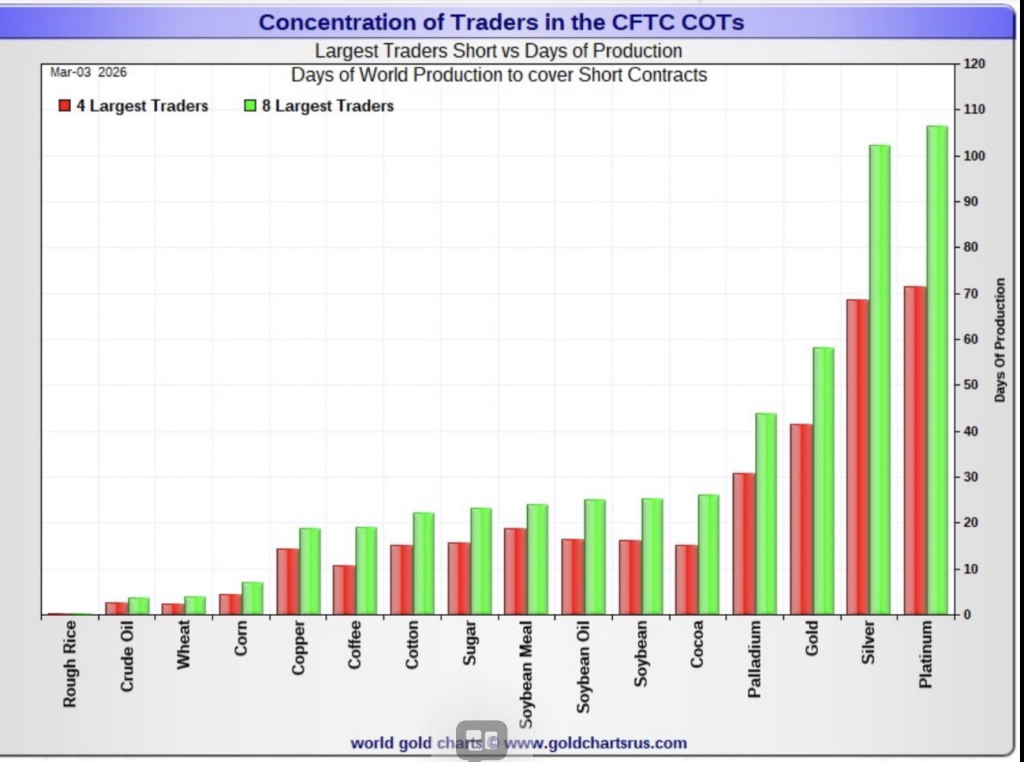
The chart Middelkoop shared illustrates just how concentrated short positions remain in certain commodity markets. It compares the largest four traders and the largest eight traders across a range of commodities and shows how many days of global production would be required to cover their short contracts.

Silver stands out immediately.

Among all commodities shown on the chart, silver and platinum have the largest short exposure relative to production, with the eight largest traders controlling positions equal to more than 100 days of global supply.
Source: X/@wmiddelkoop

Even the four largest traders alone represent roughly 70 days of world production in short exposure. That level of concentration is far higher than what appears in markets like oil, wheat, copper, or coffee.

This imbalance is one reason the idea of a silver short squeeze continues to circulate in the precious metals community.

According to Middelkoop, the decline in COMEX open interest combined with the reduction in large short positions indicates that the center of gravity for silver pricing may be moving away from traditional Western futures markets.

Instead, the Shanghai Gold Exchange and Shanghai silver markets could increasingly influence global price discovery as trading activity shifts east.

For now, the silver price remains in a consolidation phase after its recent drop from the mid-$90s. But if large traders continue reducing short exposure while demand shifts toward physical markets, the dynamics behind the metal’s price could start to look very different in the years ahead.

Subscribe to our YouTube channel for daily crypto updates, market insights, and expert analysis.

The post Silver Short Positions Collapse as Price Discovery Moves to Shanghai appeared first on CaptainAltcoin.


Market Opportunity
Metal Blockchain Logo
Metal Blockchain Price(METAL)
$0.13663
$0.13663$0.13663
-1.30%
USD
Metal Blockchain (METAL) Live Price Chart
Disclaimer: The articles reposted on this site are sourced from public platforms and are provided for informational purposes only. They do not necessarily reflect the views of MEXC. All rights remain with the original authors. If you believe any content infringes on third-party rights, please contact [email protected] for removal. MEXC makes no guarantees regarding the accuracy, completeness, or timeliness of the content and is not responsible for any actions taken based on the information provided. The content does not constitute financial, legal, or other professional advice, nor should it be considered a recommendation or endorsement by MEXC.

You May Also Like

‘Bitcoin Is Going to Die’ – The Latest Death Warning Comes from Oscar-Nominated Actor

‘Bitcoin Is Going to Die’ – The Latest Death Warning Comes from Oscar-Nominated Actor

Terrence Howard said he is not touching BTC as it's going to die.
Share
CryptoPotato2026/03/09 15:15
Cashing In On University Patents Means Giving Up On Our Innovation Future

Cashing In On University Patents Means Giving Up On Our Innovation Future

The post Cashing In On University Patents Means Giving Up On Our Innovation Future appeared on BitcoinEthereumNews.com. “It’s a raid on American innovation that would deliver pennies to the Treasury while kneecapping the very engine of our economic and medical progress,” writes Pipes. Getty Images Washington is addicted to taxing success. Now, Commerce Secretary Howard Lutnick is floating a plan to skim half the patent earnings from inventions developed at universities with federal funding. It’s being sold as a way to shore up programs like Social Security. In reality, it’s a raid on American innovation that would deliver pennies to the Treasury while kneecapping the very engine of our economic and medical progress. Yes, taxpayer dollars support early-stage research. But the real payoff comes later—in the jobs created, cures discovered, and industries launched when universities and private industry turn those discoveries into real products. By comparison, the sums at stake in patent licensing are trivial. Universities collectively earn only about $3.6 billion annually in patent income—less than the federal government spends on Social Security in a single day. Even confiscating half would barely register against a $6 trillion federal budget. And yet the damage from such a policy would be anything but trivial. The true return on taxpayer investment isn’t in licensing checks sent to Washington, but in the downstream economic activity that federally supported research unleashes. Thanks to the bipartisan Bayh-Dole Act of 1980, universities and private industry have powerful incentives to translate early-stage discoveries into real-world products. Before Bayh-Dole, the government hoarded patents from federally funded research, and fewer than 5% were ever licensed. Once universities could own and license their own inventions, innovation exploded. The result has been one of the best returns on investment in government history. Since 1996, university research has added nearly $2 trillion to U.S. industrial output, supported 6.5 million jobs, and launched more than 19,000 startups. Those companies pay…
Share
BitcoinEthereumNews2025/09/18 03:26
Win Big at Shark Secret Casino for Real Cash!

Win Big at Shark Secret Casino for Real Cash!

Cryptsy - Latest Cryptocurrency News and Predictions Cryptsy - Latest Cryptocurrency News and Predictions - Experts in Crypto Casinos Did you know the online gambling
Share
Cryptsy2026/03/09 15:28



