

Online Banking Usage Statistics 2026: Shocking Growth
As our lives become increasingly digital, online banking has evolved from a convenience to a necessity. From managing accounts on the go to transferring funds with a tap, online banking is now deeply integrated into daily routines. The banking landscape today shows unprecedented growth and diversity, with millions around the world logging into their bank accounts through mobile apps, web browsers, and wearable devices.
But beyond mere usage, shifts in demographics, technology, and security concerns shape the future of digital banking. In this article, we’ll explore the latest statistics that highlight how online banking usage is evolving worldwide and what to expect in the near future.
Editor’s Choice
- The number of online banking users worldwide is projected to surpass 4.2 billion users, or about 53% of the global population, by 2026.
- Around 216.8 million Americans now use digital banking services, with 77% of their banking interactions occurring via digital channels.
- Approximately 72% of U.S. adults have adopted mobile banking, contributing to a global base of about 2.17 billion mobile banking users.
- Digital banking is now preferred by 77% of consumers, with 41% favoring mobile apps and 33.5% web browsers for managing bank accounts.
- North America’s online banking engagement rate has reached about 85% of users, while Europe reports around 78% of adults using online banking.
Recent Developments
- A UK experiment found AI-driven fake news could lead 60.8% of exposed individuals to consider withdrawing bank deposits, raising bank-run risk.
- The Reserve Bank of India reports digital payment fraud rising in double digits annually and will introduce bank.in and fin.in domains starting April 2025 to combat spoofing.
- AMP Bank GO’s security features have blocked over 1,000 mule and fraudulent account attempts within six months.
- Lloyds Banking Group plans about 289 UK branch closures by the end of 2026, including 13 Bank of Scotland sites, as over 21 million customers use its apps.
- Under a new Australian law, sharing non-consensual AI deepfakes can trigger fines of $165,000, while non-compliant platforms face penalties up to $825,000.
Leading Online Banking Platforms by User Base
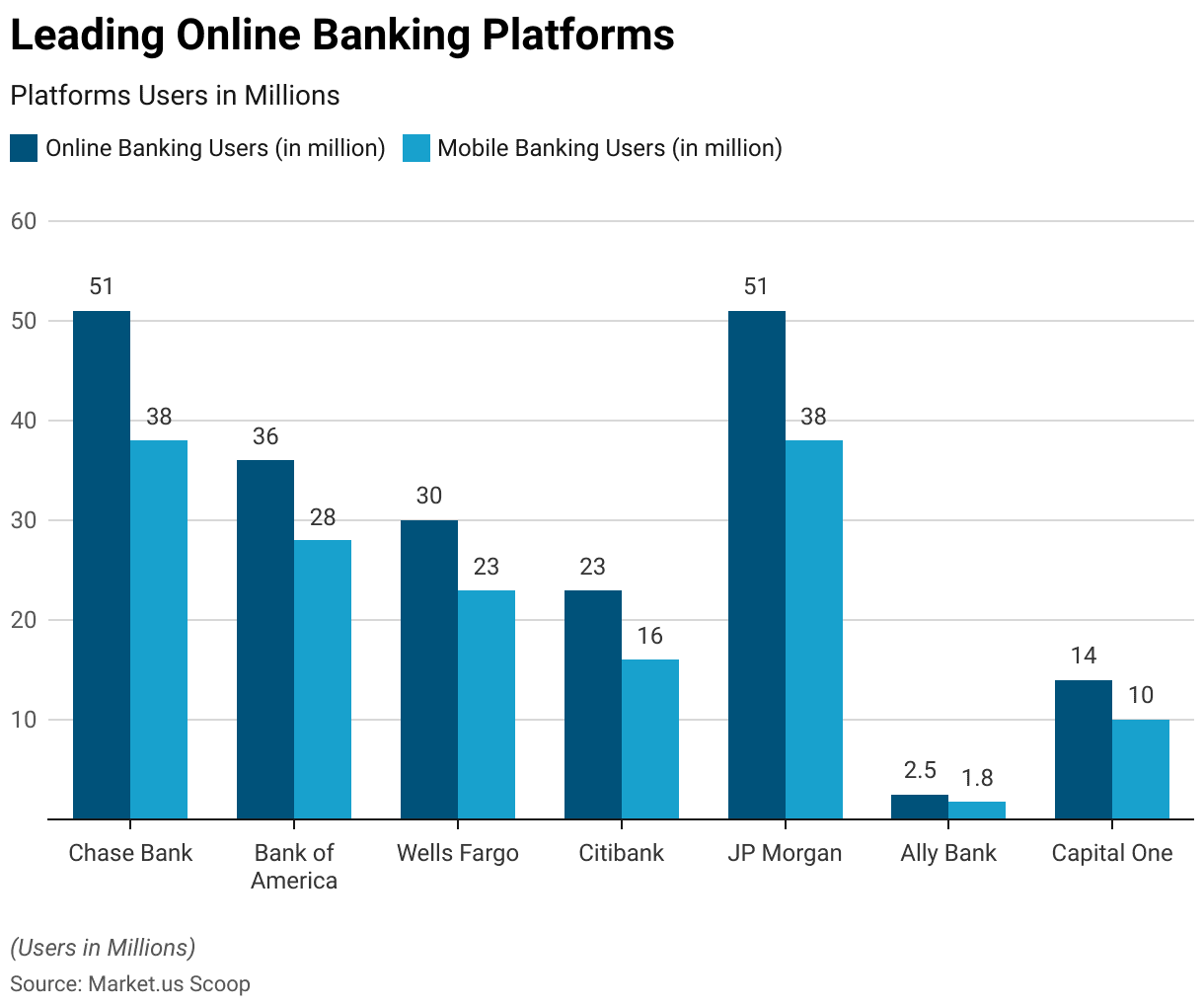
- Chase Bank leads with 51 million online banking users and 38 million mobile banking users, reflecting strong digital adoption.
- JP Morgan also reports 51 million online users and 38 million mobile users, highlighting its large digital customer base.
- Bank of America has 36 million online banking users and 28 million mobile users, making it one of the most widely used digital platforms.
- Wells Fargo serves about 30 million online users and 23 million mobile banking users across its digital channels.
- Citibank reaches 23 million online banking users and 16 million mobile banking users.
- Capital One reports 14 million online users and 10 million mobile users, showing strong mobile engagement.
- Ally Bank, a digital-first institution, has 2.5 million online users and 1.8 million mobile banking users.
- Across banks, mobile banking usage is lower than online banking, but still represents millions of active users per platform.
 (Reference: Market.us Scoop)
Primary Methods to Access a Bank Account
- Mobile banking apps are the top choice for about 54–55% of bank customers as their primary way to manage accounts.
- Online banking via laptop or PC is preferred most often by roughly 22% of customers.
- About 8–9% of customers say visiting a physical branch is still their main banking method.
- ATM usage as the primary method has declined to around 5–6% of customers.
- Telephone banking is now the main method for only about 4% of users.
- Around 39% of U.S. adults use only mobile banking and avoid branches entirely.
- Roughly 42% of consumers globally prefer mobile apps, compared with 36% who favor website banking and 18% who still choose branches.
- About 8% of smartwatch owners use banking and finance apps to check balances and receive alerts.
- In-app bill payments (utilities, insurance, subscriptions) are handled via mobile or online banking by over 40% of users.
- Around 64.2% of mobile banking users log in with Face ID, Touch ID, or other biometrics instead of passwords.
Online Banking Usage by Age Group in the U.S.
- Around 92–93% of U.S. millennials report using online or mobile banking services regularly.
- An estimated 88–90% of Gen X customers actively engage with online or mobile banking channels.
- Roughly 72–75% of Baby Boomers now use some form of online or mobile banking.
- Overall, about 77–80% of all U.S. banking customers prefer managing accounts via mobile app or computer.
How Users Perform Different Banking Activities
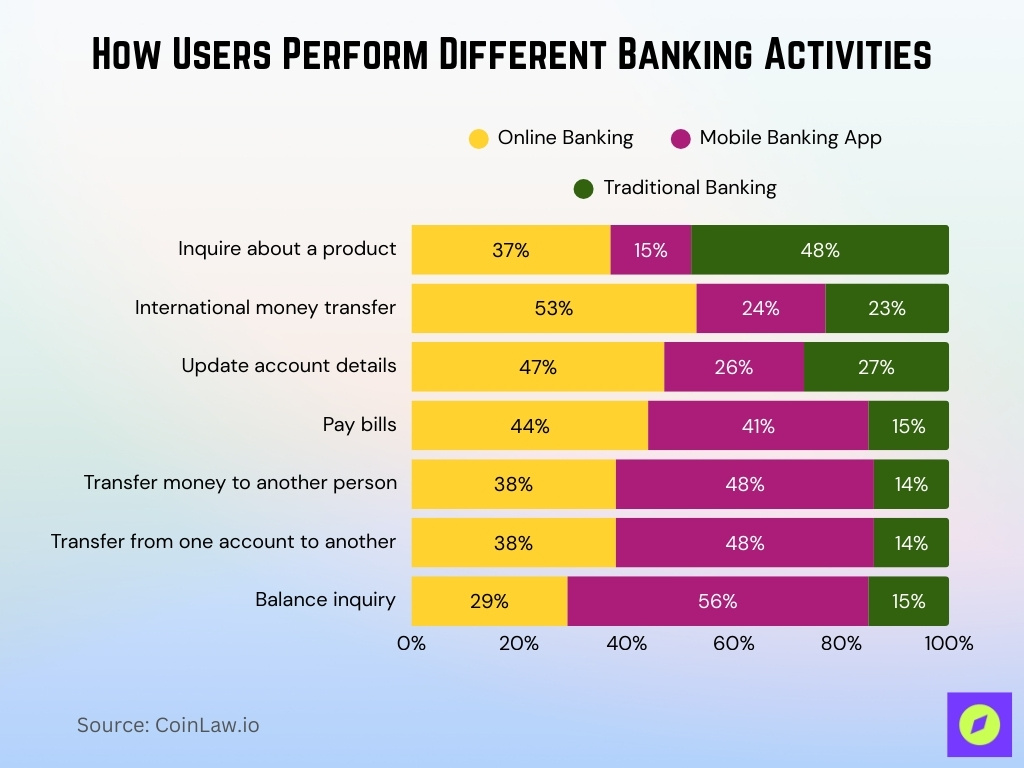
- 48% of users inquire about banking products through traditional banking, compared with 37% using online banking and 15% using mobile apps.
- 53% of users conduct international money transfers through online banking, versus 24% using mobile apps and 23% using traditional banking.
- 47% update account details through online banking, while 26% use mobile apps and 27% rely on traditional banking.
- Bill payments are split across channels with 44% using online banking, 41% using mobile apps, and 15% using traditional banking.
- 48% of users send money to others through mobile banking apps, compared with 38% using online banking and 14% using traditional banking.
- 48% transfer money between accounts using mobile apps, while 38% use online banking and 14% rely on traditional banking.
- 56% check account balances through mobile banking apps, compared with 29% using online banking and 15% using traditional banking.
- Overall, mobile banking apps dominate quick daily tasks, while online banking remains strong for more complex activities like international transfers.
 (Reference: Market.us Scoop)
Security Concerns and Authentication Advances
- 83% of digital banking users worry about data breaches and privacy risks.
- 77% of mobile banking users rely on biometric authentication, such as fingerprint or Face ID, to log in.
- 70% of banks worldwide have deployed multi-factor authentication for account access.
- Over 90% of leading digital banks implement end-to-end encryption to secure data in transit.
- Developers will integrate AI-powered behavioral analytics into 40% of MFA solutions for real-time anomaly detection.
- 84% of consumers have used at least one biometric authentication method, and fingerprint biometrics alone have reached 70% global adoption.
- Behavioral biometrics and analytics reduce synthetic ID fraud by up to 63% and account takeover attempts by 41% where implemented.
- Over 50% of financial institutions use tokenization and device-based credentials to secure payment and login data.
- Passwordless methods such as passkeys and biometrics now account for roughly 24% of all authentications in large-scale deployments.
Challenges and Future Opportunities
- Cybersecurity investments by 80% of digital banks combat rising threats.
- Digital banks face 15% annual churn due to competitive switching.
- 65% of neobanks struggle with regulatory compliance burdens.
- 52% of users seek financial literacy tools in banking apps.
- Emerging markets show 25% digital banking growth in Africa and Southeast Asia.
- 30% of users prefer green banking with sustainable options.
- 42% of digital banks partner with fintechs for innovation.
- 28% of customers are concerned about AI ethics in finance.
- Cross-border payments reduced fees by 18% via digital banks.
- 24% of neobanks launch loyalty programs for retention.
Technological Innovations in Online Banking
- 88% of banks adopt artificial intelligence to power chatbots, fraud detection, and personalized services.
- The banking sector values the blockchain market at $16.27 billion, using it to improve transaction transparency.
- Banks use machine learning for credit scoring, cutting loan approval times by 77%.
- The global voice banking market, driven by voice recognition adoption, has reached $2.19 billion.
- 58%+ of banks deploy robotic process automation to automate routine tasks.
- 68% of banks adopt cloud-based solutions to support core operations and scalability.
- Leading banks explore quantum computing for advanced risk modeling and large-scale data processing.
- The digital twins market in finance grows at an 11.6% CAGR, enabling simulations and risk analysis.
- The predictive analytics market in banking grows at a 20% CAGR, supporting customer retention strategies.
Global Online Banking Usage by Region
- The Far East and China will reach about 974.3 million active online banking users.
- The Middle East and Africa will grow to roughly 198 million active online banking users.
- Europe’s online banking user base will climb to around 435 million users.
- North America will account for approximately 279.7 million active online banking users.
- Latin America will increase to nearly 198 million active online banking users.
- Europe will achieve about 70% online banking penetration among the adult population.
- In China, over 80% of internet users engage in online banking.
Frequently Asked Questions (FAQs)
About 91% of Americans use some form of online or mobile banking, and 71% of all bank interactions are now digital.
Mobile payments account for around 49% of all digital banking transactions worldwide.
About 55% of bank accounts are now opened through digital platforms rather than in-branch processes.
Conclusion
Online banking has fundamentally transformed how we manage our finances, with this year marking a year of notable growth and change. As neobanks gain ground against traditional banks and new technologies redefine security and user experiences, online banking adoption will likely keep rising globally. However, the future presents both challenges and opportunities, from tackling cybersecurity risks to meeting customer demands for innovative features. Ultimately, banks that prioritize digital transformation, user satisfaction, and robust security measures will lead the way in an increasingly digital world of finance.
The post Online Banking Usage Statistics 2026: Shocking Growth appeared first on CoinLaw.
You May Also Like

Wormhole launches reserve tying protocol revenue to token

The Benefits of a Dedicated Mortgage Broker for Your Homeownership Journey
