Nemo Protocol, a decentralized finance (DeFi) yield platform operating on the Sui blockchain, fell victim to a cyberattack that resulted in $2.4 million in losses just ahead of its scheduled maintenance window on Monday and Tuesday. The security breach was initially detected by PeckShieldAlert on September 8, which reported via X that approximately $2.4 million in USDC had been drained from Nemo’s systems. According to the blockchain security firm’s investigation, the hacker swiftly moved the stolen assets via Circle by bridging USDC on Arbitrum to Ethereum. $6.3M TVL Crashes 75% as Users Flee Nemo Protocol Nemo acknowledged the incident in a subsequent tweet, stating that the protocol had experienced a security breach the previous evening that affected its Market pool. The development team confirmed that an investigation was in progress to identify the root cause of the vulnerability. As a precautionary measure, all smart contract operations were temporarily halted. The attack’s impact was immediately felt. According to DeFiLlama data, Nemo’s total value locked (TVL) collapsed to approximately $1.57 million from over $6.3 million before the breach.Source: DefilLama User withdrawals exceeded $3.8 million worth of USDC and SUI tokens as investors rushed to exit, fearing the exploit’s scope might be more extensive than initially disclosed.Source: DefilLama The breach specifically targeted Nemo’s yield-trading mechanism, which enables users to divide staked assets into Principal Tokens (PTs) and Yield Tokens (YTs) for yield speculation purposes. According to blockchain security auditor CertiK, security risks may arise from multiple sources, including coding errors, blockchain network vulnerabilities, and programming language limitations. Sui Blockchain Security Crisis Contributed to $2.37 Billion DeFi Losses in 2025 Notably, the Nemo security breach marks the third major hack targeting DeFi protocols this month. Earlier in September, Venus protocol lost $13.5 million to attackers, followed by an $8.4 million theft from the Bunni protocol. Similarly, in the Sui ecosystem, the Nemo incident follows another significant breach on the Layer-1 network from earlier this year. On May 22, Cetus Protocol, a prominent decentralized exchange and liquidity provider, suffered a $223 million exploit. The attacker leveraged an arithmetic overflow flaw in a third-party code library to complete the drain within 15 minutes. Moreover, these DeFi-focused attacks are on the rise in 2025. SlowMist’s mid-year analysis revealed that the blockchain sector experienced over $2.37 billion in losses across 121 security incidents during the first half of the year.Source: SlowMist DeFi protocols alone accounted for 76% of these cases, although centralized exchanges recorded higher individual losses. A complementary report from Hacken’s 2025 mid-year security assessment estimated total crypto industry losses at over $3.1 billion within the first six months.Source: Hacken Access control vulnerabilities, including misconfigured wallets and compromised legacy keys, represented 59% of these losses, while DeFi-specific smart contract exploits accounted for $263 million, or roughly 8%. A recent interview between Cryptonews and Mitchell Amador, founder and CEO of Immunefi, highlighted why conventional security methodologies prove inadequate in Web3’s open-source ecosystem. Amador explained that “Traditional audits, being static and pre-launch focused, fail to identify post-deployment vulnerabilities present in dynamic DeFi environments.” He advocated for bug bounty programs as a solution to incentivize ethical hackers, fundamentally restructuring cybersecurity economics to make defensive measures more lucrative than offensive onesNemo Protocol, a decentralized finance (DeFi) yield platform operating on the Sui blockchain, fell victim to a cyberattack that resulted in $2.4 million in losses just ahead of its scheduled maintenance window on Monday and Tuesday. The security breach was initially detected by PeckShieldAlert on September 8, which reported via X that approximately $2.4 million in USDC had been drained from Nemo’s systems. According to the blockchain security firm’s investigation, the hacker swiftly moved the stolen assets via Circle by bridging USDC on Arbitrum to Ethereum. $6.3M TVL Crashes 75% as Users Flee Nemo Protocol Nemo acknowledged the incident in a subsequent tweet, stating that the protocol had experienced a security breach the previous evening that affected its Market pool. The development team confirmed that an investigation was in progress to identify the root cause of the vulnerability. As a precautionary measure, all smart contract operations were temporarily halted. The attack’s impact was immediately felt. According to DeFiLlama data, Nemo’s total value locked (TVL) collapsed to approximately $1.57 million from over $6.3 million before the breach.Source: DefilLama User withdrawals exceeded $3.8 million worth of USDC and SUI tokens as investors rushed to exit, fearing the exploit’s scope might be more extensive than initially disclosed.Source: DefilLama The breach specifically targeted Nemo’s yield-trading mechanism, which enables users to divide staked assets into Principal Tokens (PTs) and Yield Tokens (YTs) for yield speculation purposes. According to blockchain security auditor CertiK, security risks may arise from multiple sources, including coding errors, blockchain network vulnerabilities, and programming language limitations. Sui Blockchain Security Crisis Contributed to $2.37 Billion DeFi Losses in 2025 Notably, the Nemo security breach marks the third major hack targeting DeFi protocols this month. Earlier in September, Venus protocol lost $13.5 million to attackers, followed by an $8.4 million theft from the Bunni protocol. Similarly, in the Sui ecosystem, the Nemo incident follows another significant breach on the Layer-1 network from earlier this year. On May 22, Cetus Protocol, a prominent decentralized exchange and liquidity provider, suffered a $223 million exploit. The attacker leveraged an arithmetic overflow flaw in a third-party code library to complete the drain within 15 minutes. Moreover, these DeFi-focused attacks are on the rise in 2025. SlowMist’s mid-year analysis revealed that the blockchain sector experienced over $2.37 billion in losses across 121 security incidents during the first half of the year.Source: SlowMist DeFi protocols alone accounted for 76% of these cases, although centralized exchanges recorded higher individual losses. A complementary report from Hacken’s 2025 mid-year security assessment estimated total crypto industry losses at over $3.1 billion within the first six months.Source: Hacken Access control vulnerabilities, including misconfigured wallets and compromised legacy keys, represented 59% of these losses, while DeFi-specific smart contract exploits accounted for $263 million, or roughly 8%. A recent interview between Cryptonews and Mitchell Amador, founder and CEO of Immunefi, highlighted why conventional security methodologies prove inadequate in Web3’s open-source ecosystem. Amador explained that “Traditional audits, being static and pre-launch focused, fail to identify post-deployment vulnerabilities present in dynamic DeFi environments.” He advocated for bug bounty programs as a solution to incentivize ethical hackers, fundamentally restructuring cybersecurity economics to make defensive measures more lucrative than offensive ones

Nemo Protocol Loses $2.4M to Hackers on Sui Blockchain Before Planned Maintenance

2025/09/09 00:36
3 min read

Nemo Protocol, a decentralized finance (DeFi) yield platform operating on the Sui blockchain, fell victim to a cyberattack that resulted in $2.4 million in losses just ahead of its scheduled maintenance window on Monday and Tuesday.

The security breach was initially detected by PeckShieldAlert on September 8, which reported via X that approximately $2.4 million in USDC had been drained from Nemo’s systems.

According to the blockchain security firm’s investigation, the hacker swiftly moved the stolen assets via Circle by bridging USDC on Arbitrum to Ethereum.

$6.3M TVL Crashes 75% as Users Flee Nemo Protocol

Nemo acknowledged the incident in a subsequent tweet, stating that the protocol had experienced a security breach the previous evening that affected its Market pool.

The development team confirmed that an investigation was in progress to identify the root cause of the vulnerability.

As a precautionary measure, all smart contract operations were temporarily halted.

The attack’s impact was immediately felt. According to DeFiLlama data, Nemo’s total value locked (TVL) collapsed to approximately $1.57 million from over $6.3 million before the breach.
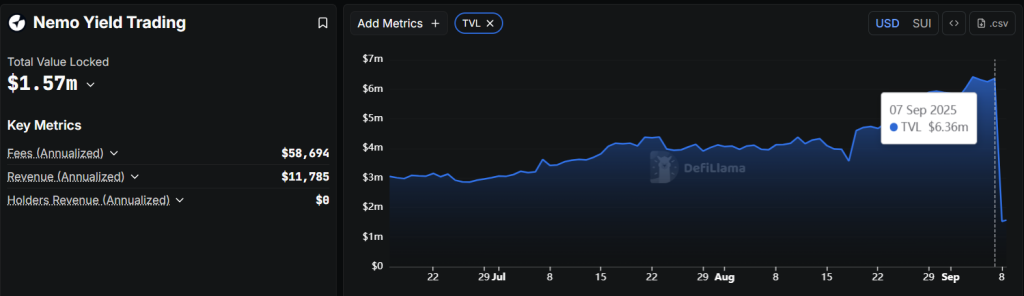
Nemo Protocol Loses $2.4M to Hackers on Sui Blockchain Before Planned MaintenanceSource: DefilLama

User withdrawals exceeded $3.8 million worth of USDC and SUI tokens as investors rushed to exit, fearing the exploit’s scope might be more extensive than initially disclosed.

Nemo Protocol Loses $2.4M to Hackers on Sui Blockchain Before Planned MaintenanceSource: DefilLama

The breach specifically targeted Nemo’s yield-trading mechanism, which enables users to divide staked assets into Principal Tokens (PTs) and Yield Tokens (YTs) for yield speculation purposes.

According to blockchain security auditor CertiK, security risks may arise from multiple sources, including coding errors, blockchain network vulnerabilities, and programming language limitations.

Sui Blockchain Security Crisis Contributed to $2.37 Billion DeFi Losses in 2025

Notably, the Nemo security breach marks the third major hack targeting DeFi protocols this month.

Earlier in September, Venus protocol lost $13.5 million to attackers, followed by an $8.4 million theft from the Bunni protocol.

Similarly, in the Sui ecosystem, the Nemo incident follows another significant breach on the Layer-1 network from earlier this year.

On May 22, Cetus Protocol, a prominent decentralized exchange and liquidity provider, suffered a $223 million exploit.

The attacker leveraged an arithmetic overflow flaw in a third-party code library to complete the drain within 15 minutes.

Moreover, these DeFi-focused attacks are on the rise in 2025.

SlowMist’s mid-year analysis revealed that the blockchain sector experienced over $2.37 billion in losses across 121 security incidents during the first half of the year.

Nemo Protocol Loses $2.4M to Hackers on Sui Blockchain Before Planned MaintenanceSource: SlowMist

DeFi protocols alone accounted for 76% of these cases, although centralized exchanges recorded higher individual losses.

A complementary report from Hacken’s 2025 mid-year security assessment estimated total crypto industry losses at over $3.1 billion within the first six months.

Nemo Protocol Loses $2.4M to Hackers on Sui Blockchain Before Planned MaintenanceSource: Hacken

Access control vulnerabilities, including misconfigured wallets and compromised legacy keys, represented 59% of these losses, while DeFi-specific smart contract exploits accounted for $263 million, or roughly 8%.

A recent interview between Cryptonews and Mitchell Amador, founder and CEO of Immunefi, highlighted why conventional security methodologies prove inadequate in Web3’s open-source ecosystem.

Amador explained that “Traditional audits, being static and pre-launch focused, fail to identify post-deployment vulnerabilities present in dynamic DeFi environments.”

He advocated for bug bounty programs as a solution to incentivize ethical hackers, fundamentally restructuring cybersecurity economics to make defensive measures more lucrative than offensive ones.


Market Opportunity
SUI Logo
SUI Price(SUI)
$0.9168
$0.9168$0.9168
+6.87%
USD
SUI (SUI) Live Price Chart
Disclaimer: The articles reposted on this site are sourced from public platforms and are provided for informational purposes only. They do not necessarily reflect the views of MEXC. All rights remain with the original authors. If you believe any content infringes on third-party rights, please contact [email protected] for removal. MEXC makes no guarantees regarding the accuracy, completeness, or timeliness of the content and is not responsible for any actions taken based on the information provided. The content does not constitute financial, legal, or other professional advice, nor should it be considered a recommendation or endorsement by MEXC.
Tags:

You May Also Like

Service sector continues to dive formal employment

Service sector continues to dive formal employment

THE NUMBER of workers in formal employment — those employed by establishments with 10 or more workers — numbered 6.14 million in August 2024, the Philippine Statistics
Share
Bworldonline2026/03/01 20:17
This Trump cover-up is appalling — and may have met its match

This Trump cover-up is appalling — and may have met its match

The federal judiciary has stiffened its resolve toward the Trump administration. The Supreme Court ruled 6-3 last week against the authority that President Donald
Share
Rawstory2026/03/01 21:08
Canada Canadian Portfolio Investment in Foreign Securities rose from previous $9.04B to $17.41B in July

Canada Canadian Portfolio Investment in Foreign Securities rose from previous $9.04B to $17.41B in July

The post Canada Canadian Portfolio Investment in Foreign Securities rose from previous $9.04B to $17.41B in July appeared on BitcoinEthereumNews.com. Information on these pages contains forward-looking statements that involve risks and uncertainties. Markets and instruments profiled on this page are for informational purposes only and should not in any way come across as a recommendation to buy or sell in these assets. You should do your own thorough research before making any investment decisions. FXStreet does not in any way guarantee that this information is free from mistakes, errors, or material misstatements. It also does not guarantee that this information is of a timely nature. Investing in Open Markets involves a great deal of risk, including the loss of all or a portion of your investment, as well as emotional distress. All risks, losses and costs associated with investing, including total loss of principal, are your responsibility. The views and opinions expressed in this article are those of the authors and do not necessarily reflect the official policy or position of FXStreet nor its advertisers. The author will not be held responsible for information that is found at the end of links posted on this page. If not otherwise explicitly mentioned in the body of the article, at the time of writing, the author has no position in any stock mentioned in this article and no business relationship with any company mentioned. The author has not received compensation for writing this article, other than from FXStreet. FXStreet and the author do not provide personalized recommendations. The author makes no representations as to the accuracy, completeness, or suitability of this information. FXStreet and the author will not be liable for any errors, omissions or any losses, injuries or damages arising from this information and its display or use. Errors and omissions excepted. The author and FXStreet are not registered investment advisors and nothing in this article is intended…
Share
BitcoinEthereumNews2025/09/18 02:38