New analysis by trader Plan C argues that using the Genesis block as Bitcoin’s model origin point has produced two miscalibrations, and that switching to April New analysis by trader Plan C argues that using the Genesis block as Bitcoin’s model origin point has produced two miscalibrations, and that switching to April

Why the Genesis Block Might be the Wrong Starting Point for Bitcoin Price Models

2026/03/10 19:29
4 min read
For feedback or concerns regarding this content, please contact us at [email protected]

New analysis by trader Plan C argues that using the Genesis block as Bitcoin’s model origin point has produced two miscalibrations, and that switching to April 6, 2009 resolves both without any slope drift.

What the Model Comparison Actually Tests

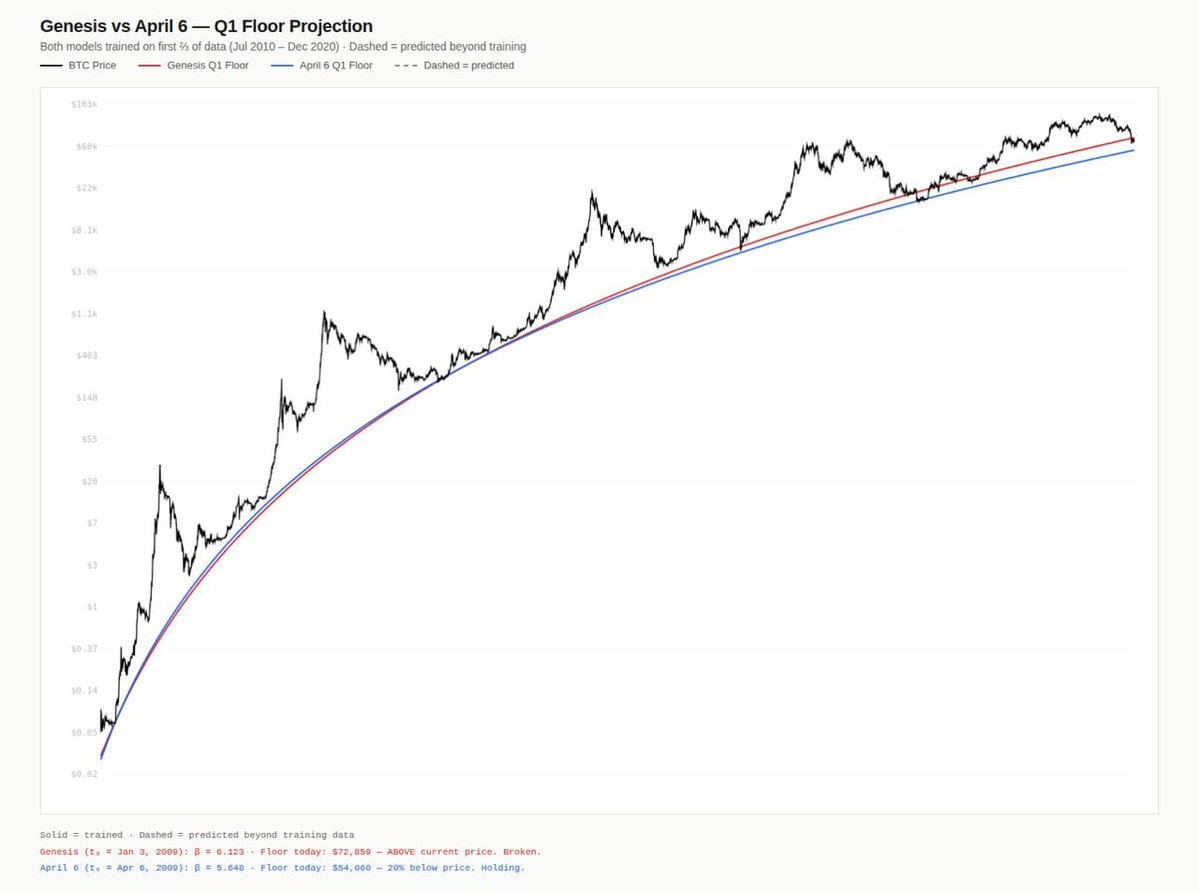
Plan C, the analyst behind this research, trained two separate quantile floor projection models on the first two-thirds of Bitcoin’s price history, from July 2010 through December 2020, then measured how accurately each model predicted the remaining one-third of the data. The only variable that differs between them is the start date. One model anchors to the Genesis block, January 3, 2009. The other anchors to April 6, 2009.
Source: https://x.com/TheRealPlanC/status/2031241250586677287

The results are not close. The April 6 model nailed the FTX crash low, stayed completely stable throughout, and currently projects Bitcoin’s first quantile floor at approximately $55,000. The Genesis block model spent 12% of the time during the test period below its own first quantile, meaning it repeatedly predicted a floor that Bitcoin’s actual price broke through. To compensate, the model’s slope drifted down to approximately $59,000 before recalibrating.

That drift is the technical failure. A model that requires its slope to adjust after the fact is not predicting. It is following.

Why Start Dates Matter in Power Law Models

Bitcoin price models built on power law regression are highly sensitive to the anchor point because the entire curve extrapolates from it. Moving the start date by a few months on a logarithmic scale shifts every subsequent projection. The Genesis block is an intuitive starting point because it is Bitcoin’s literal beginning. But the Genesis block period includes months of zero price discovery and essentially no market activity, data points that introduce noise rather than signal into the regression.

April 6, 2009 represents a different kind of anchor, though Plan C does not specify precisely why that date produces superior results in the post. The implication is that it captures the beginning of meaningful network activity rather than the ceremonial launch, giving the model a cleaner foundation to extrapolate from.

The Two Failures and What They Mean

The Genesis block model failed during FTX. Bitcoin’s collapse to approximately $15,500 in November 2022 broke below the model’s predicted floor, which should have been a support level. A model floor that does not hold is not a floor.

The same model would have failed again during the current pullback from $100,000 toward $60,000 if the slope had not drifted downward to accommodate the breach. The drift is the model saving itself from a second public failure by quietly moving the goalposts. Plan C is pointing out that the goalpost movement is happening and that it indicates miscalibration rather than accuracy.

$4.58 Billion in Token Unlocks Are Coming This Week

The April 6 model requires no such adjustment. It held during FTX, it held during the current correction, and its projected floor sits at $55,000 without any post-hoc slope correction.

What $55,000 as a Floor Actually Implies

Bitcoin currently trades around $67,000 to $69,000. A first quantile floor of $55,000 means the model considers prices below that level to represent the bottom 25% of historical Bitcoin valuations relative to its long-term growth curve. It is not a prediction that Bitcoin will fall to $55,000. It is a statement about where the model considers the lower bound of normal price behavior to sit.

Whether that boundary holds depends on whether Bitcoin’s long-term growth curve continues following the same power law trajectory it has traced since 2009. Every cycle has tested that assumption. So far it has held. The question the model raises without answering is whether the next test breaks it or confirms it again.

The post Why the Genesis Block Might be the Wrong Starting Point for Bitcoin Price Models appeared first on ETHNews.


Market Opportunity
Blockstreet Logo
Blockstreet Price(BLOCK)
$0.005794
$0.005794$0.005794
-1.42%
USD
Blockstreet (BLOCK) Live Price Chart
Disclaimer: The articles reposted on this site are sourced from public platforms and are provided for informational purposes only. They do not necessarily reflect the views of MEXC. All rights remain with the original authors. If you believe any content infringes on third-party rights, please contact [email protected] for removal. MEXC makes no guarantees regarding the accuracy, completeness, or timeliness of the content and is not responsible for any actions taken based on the information provided. The content does not constitute financial, legal, or other professional advice, nor should it be considered a recommendation or endorsement by MEXC.

You May Also Like

Winklevoss Twins Move $130M Bitcoin to Gemini Wallets

Winklevoss Twins Move $130M Bitcoin to Gemini Wallets

Crypto investors are watching the latest moves from twins Cameron Winklevoss and Tyler Winklevoss. According to blockchain tracking data, wallets linked to the
Share
Coinfomania2026/03/10 20:12
What to Expect in Laptop Rental Services: A Cost Breakdown

What to Expect in Laptop Rental Services: A Cost Breakdown

Laptop rental services are emerging as a popular choice. This is true, especially among businesses that require temporary equipment. Renting a laptop can be an
Share
Techbullion2026/03/10 20:05
Breaking: CME Group Unveils Solana and XRP Options

Breaking: CME Group Unveils Solana and XRP Options

CME Group launches Solana and XRP options, expanding crypto offerings. SEC delays Solana and XRP ETF approvals, market awaits clarity. Strong institutional demand drives CME’s launch of crypto options contracts. In a bold move to broaden its cryptocurrency offerings, CME Group has officially launched options on Solana (SOL) and XRP futures. Available since October 13, 2025, these options will allow traders to hedge and manage exposure to two of the most widely traded digital assets in the market. The new contracts come in both full-size and micro-size formats, with expiration options available daily, monthly, and quarterly, providing flexibility for a diverse range of market participants. This expansion aligns with the rising demand for innovative products in the crypto space. Giovanni Vicioso, CME Group’s Global Head of Cryptocurrency Products, noted that the new options offer increased flexibility for traders, from institutions to active individual investors. The growing liquidity in Solana and XRP futures has made the introduction of these options a timely move to meet the needs of an expanding market. Also Read: Vitalik Buterin Reveals Ethereum’s Bold Plan to Stay Quantum-Secure and Simple! Rapid Growth in Solana and XRP Futures Trading CME Group’s decision to roll out options on Solana and XRP futures follows the substantial growth in these futures products. Since the launch of Solana futures in March 2025, more than 540,000 contracts, totaling $22.3 billion in notional value, have been traded. In August 2025, Solana futures set new records, with an average daily volume (ADV) of 9,000 contracts valued at $437.4 million. The average daily open interest (ADOI) hit 12,500 contracts, worth $895 million. Similarly, XRP futures, which launched in May 2025, have seen significant adoption, with over 370,000 contracts traded, totaling $16.2 billion. XRP futures also set records in August 2025, with an ADV of 6,600 contracts valued at $385 million and a record ADOI of 9,300 contracts, worth $942 million. Institutional Demand for Advanced Hedging Tools CME Group’s expansion into options is a direct response to growing institutional interest in sophisticated cryptocurrency products. Roman Makarov from Cumberland Options Trading at DRW highlighted the market demand for more varied crypto products, enabling more advanced risk management strategies. Joshua Lim from FalconX also noted that the new options products meet the increasing need for institutional hedging tools for assets like Solana and XRP, further cementing their role in the digital asset space. The launch of options on Solana and XRP futures marks another step toward the maturation of the cryptocurrency market, providing a broader range of tools for managing digital asset exposure. SEC’s Delay on Solana and XRP ETF Approvals While CME Group expands its offerings, the broader market is also watching the progress of Solana and XRP exchange-traded funds (ETFs). The U.S. Securities and Exchange Commission (SEC) has delayed its decisions on multiple crypto-related ETF filings, including those for Solana and XRP. Despite the delay, analysts anticipate approval may be on the horizon. This week, REX Shares and Osprey Funds are expected to launch an XRP ETF that will hold XRP directly and allocate at least 40% of its assets to other XRP-related ETFs. Despite the delays, some analysts believe that approval could come soon, fueling further interest in these assets. The delay by the SEC has left many crypto investors awaiting clarity, but approval of these ETFs could fuel further momentum in the Solana and XRP futures markets. Also Read: Tether CEO Breaks Silence on $117,000 Bitcoin Price – Market Reacts! The post Breaking: CME Group Unveils Solana and XRP Options appeared first on 36Crypto.
Share
Coinstats2025/09/18 02:35