Neural vocoder is the final model in the Text to Speech (TTS) pipeline. It turns a mel‑spectrogram into the sound you can actually hear. WaveNet, WaveGlow, HiFi‑GAN, and FastDiff are the four contenders.Neural vocoder is the final model in the Text to Speech (TTS) pipeline. It turns a mel‑spectrogram into the sound you can actually hear. WaveNet, WaveGlow, HiFi‑GAN, and FastDiff are the four contenders.

Inside the Neural Vocoder Zoo: WaveNet to Diffusion in Four Audio Clips

2025/09/09 02:33
8 min read

Hey everyone, I’m Oleh Datskiv, Lead AI Engineer at the R&D Data Unit of N-iX. Lately, I’ve been working on text-to-speech systems and, more specifically, on the unsung hero behind them: the neural vocoder.

Let me introduce you to this final step of the TTS pipeline — the part that turns abstract spectrograms into the natural-sounding speech we hear.

Introduction

If you’ve worked with text‑to‑speech in the past few years, you’ve used a vocoder - even if you didn’t notice it. The neural vocoder is the final model in the Text to Speech (TTS) pipeline; it turns a mel‑spectrogram into the sound you can actually hear.

Since the release of WaveNet in 2016, neural vocoders have evolved rapidly. They become faster, lighter, and more natural-sounding. From flow-based to GANs to diffusion, each new approach has pushed the field closer to real-time, high-fidelity speech.

2024 felt like a definitive turning point: diffusion-based vocoders like FastDiff were finally fast enough to be considered for real-time usage, not just batch synthesis as before. That opened up a range of new possibilities. The most notable ones were smarter dubbing pipelines, higher-quality virtual voices, and more expressive assistants, even if you’re not utilizing a high-end GPU cluster.

But with so many options that we now have, the questions remain:

  • How do these models sound side-by-side?
  • Which ones keep latency low enough for live or interactive use?
  • What is the best choice of a vocoder for you?

This post will examine four key vocoders: WaveNet, WaveGlow, HiFi‑GAN, and FastDiff. We’ll explain how each model works and what makes them different. Most importantly, we’ll let you hear the results of their work so you can decide which one you like better. Also, we will share custom benchmarks of model evaluation that were done through our research.

What Is a Neural Vocoder?

At a high level, every modern TTS system still follows the same basic path:
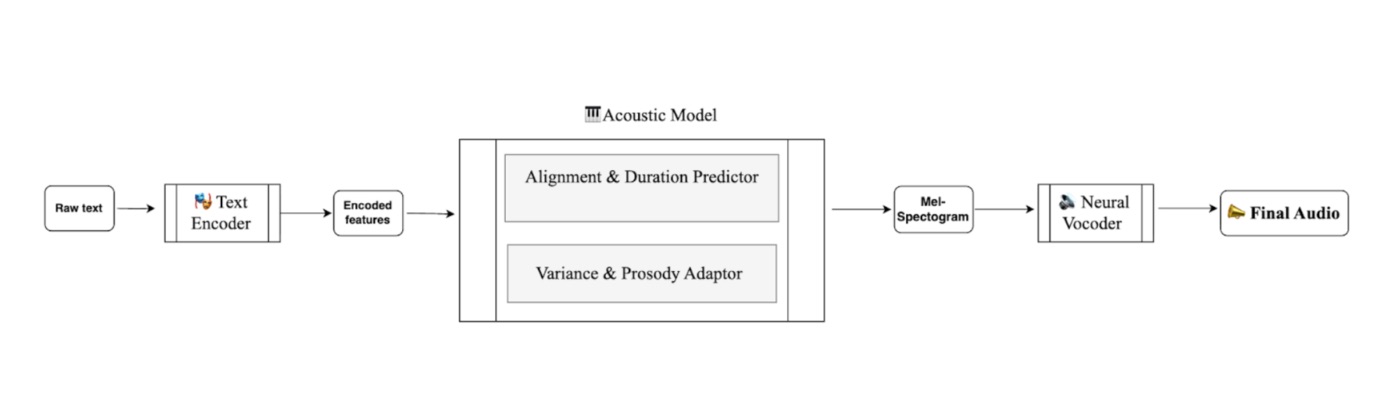
\ Let’s quickly go over what each of these blocks does and why we are focusing on the vocoder today:

  1. Text encoder: It changes raw text or phonemes into detailed linguistic embeddings.
  2. Acoustic model: This stage predicts how the speech should sound over time. It turns linguistic embeddings into mel spectrograms that show timing, melody, and expression. It has two critical sub-components:
  3. Alignment & duration predictor: This component determines how long each phoneme should last, ensuring the rhythm of speech feels natural and human
  4. Variance/prosody adaptor: At this stage, the adaptor injects pitch, energy, and style, shaping the melody, emphasis, and emotional contour of the sentence.
  5. Neural vocoder: Finally, this model converts the prosody-rich mel spectrogram into actual sound, the waveform we can hear.

The vocoder is where good pipelines live or die. Map mels to waveforms perfectly, and the result is a studio-grade actor. Get it wrong, and even with the best acoustic model, you will get metallic buzz in the generated audio. That’s why choosing the right vocoder matters - because they’re not all built the same. Some optimize for speed, others for quality. The best models balance naturalness, speed, and clarity.

The Vocoder Lineup

Now, let's meet our four contenders. Each represents a different generation of neural speech synthesis, with its unique approach to balancing the trade-offs between audio quality, speed, and model size. The numbers below are drawn from the original papers. Thus, the actual performance will vary depending on your hardware and batch size. We will share our benchmark numbers later in the article for a real‑world check.

  1. WaveNet (2016): The original fidelity benchmark

Google's WaveNet was a landmark that redefined audio quality for TTS. As an autoregressive model, it generates audio one sample at a time, with each new sample conditioned on all previous ones. This process resulted in unprecedented naturalness at the time (MOS=4.21), setting a "gold standard" that researchers still benchmark against today. However, this sample-by-sample approach also makes WaveNet painfully slow, restricting its use to offline studio work rather than live applications.

  1. WaveGlow (2019): Leap to parallel synthesis

To solve WaveNet's critical speed problem, NVIDIA's WaveGlow introduced a flow-based, non-autoregressive architecture. Generating the entire waveform in a single forward pass drastically reduced inference time to approximately 0.04 RTF, making it much faster than in real time. While the quality is excellent (MOS≈3.961), it was considered a slight step down from WaveNet's fidelity. Its primary limitations are a larger memory footprint and a tendency to produce a subtle high-frequency hiss, especially with noisy training data.

  1. HiFi-GAN (2020): Champion of efficiency

HiFi-GAN marked a breakthrough in efficiency using a Generative Adversarial Network (GAN) with a clever multi-period discriminator. This architecture allows it to produce extremely high-fidelity audio (MOS=4.36), which is competitive with WaveNet, but is fast from a remarkably small model (13.92 MB). It's ultra-fast on a GPU (<0.006×RTF) and can even achieve real-time performance on a CPU, which is why HiFi-GAN quickly became the default choice for production systems like chatbots, game engines, and virtual assistants.

  1. FastDiff (2025): Diffusion quality at real-time speed

Proving that diffusion models don't have to be slow, FastDiff represents the current state-of-the-art in balancing quality and speed. Pruning the reverse diffusion process to as few as four steps achieves top-tier audio quality (MOS=4.28) while maintaining fast speeds for interactive use (~0.02×RTF on a GPU). This combination makes it one of the first diffusion-based vocoders viable for high-quality, real-time speech synthesis, opening the door for more expressive and responsive applications.

Each of these models reflects a significant shift in vocoder design. Now that we've seen how they work on paper, it's time to put them to the test with our own benchmarks and audio comparisons.

\n Let’s Hear It — A/B Audio Gallery

Nothing beats your ears!

We will use the following sentences from the LJ Speech Dataset to test our vocoders. Later in the article, you can also listen to the original audio recording and compare it with the generated one.

Sentences:

  1. “A medical practitioner charged with doing to death persons who relied upon his professional skill.”
  2. “Nothing more was heard of the affair, although the lady declared that she had never instructed Fauntleroy to sell.”
  3. “Under the new rule, visitors were not allowed to pass into the interior of the prison, but were detained between the grating.”

The metrics we will use to evaluate the model’s results are listed below. These include both objective and subjective metrics:

  • Naturalness (MOS): How human-like does it sound (rated by real people on a 1/5 scale)
  • Clarity (PESQ / STOI): Objective scores that help measure intelligibility and noise/artifacts. The higher, the better.
  • Speed (RTF): An RTF of 1 means it takes 1 second to generate 1 second of audio. For anything interactive, you’ll want this at 1 or below

Audio Players

(Grab headphones and tap the buttons to hear each model.)

| Sentence | Ground truth | WaveNet | WaveGlow | HiFi‑GAN | FastDiff | |----|:---:|:---:|:---:|:---:|:---:| | S1 | ▶️ | ▶️ | ▶️ | ▶️ | ▶️ | | S2 | ▶️ | ▶️ | ▶️ | ▶️ | ▶️ | | S3 | ▶️ | ▶️ | ▶️ | ▶️ | ▶️ |

\n Quick‑Look Metrics

Here, we will show you the results obtained for the models we evaluate.

| Model | RTF ↓ | MOS ↑ | PESQ ↑ | STOI ↑ | |----|:---:|:---:|:---:|:---:| | WaveNet | 1.24 | 3.4 | 1.0590 | 0.1616 | | WaveGlow | 0.058 | 3.7 | 1.0853 | 0.1769 | | HiFi‑GAN | 0.072 | 3.9 | 1.098 | 0.186 | | FastDiff | 0.081 | 4.0 | 1.131 | 0.19 |

\n *For the MOS evaluation, we used voices from 150 participants with no background in music.

** As an acoustic model, we used Tacotron2 for WaveNet and WaveGlow, and FastSpeech2 for HiFi‑GAN and FastDiff.

\n Bottom line

Our journey through the vocoder zoo shows that while the gap between speed and quality is shrinking, there’s no one-size-fits-all solution. Your choice of a vocoder in 2025 and beyond should primarily depend on your project's needs and technical requirements, including:

  • Runtime constraints (Is it an offline generation or a live, interactive application?)
  • Quality requirements (What’s a higher priority: raw speed or maximum fidelity?)
  • Deployment targets (Will it run on a powerful cloud GPU, a local CPU, or a mobile device?)

As the field progresses, the lines between these choices will continue to blur, paving the way for universally accessible, high-fidelity speech that is heard and felt.

Market Opportunity
Hifi Finance Logo
Hifi Finance Price(HIFI)
$0.01263
$0.01263$0.01263
-3.88%
USD
Hifi Finance (HIFI) Live Price Chart
Disclaimer: The articles reposted on this site are sourced from public platforms and are provided for informational purposes only. They do not necessarily reflect the views of MEXC. All rights remain with the original authors. If you believe any content infringes on third-party rights, please contact [email protected] for removal. MEXC makes no guarantees regarding the accuracy, completeness, or timeliness of the content and is not responsible for any actions taken based on the information provided. The content does not constitute financial, legal, or other professional advice, nor should it be considered a recommendation or endorsement by MEXC.

You May Also Like

Telegram Turns DeFi With New Yield Options for BTC and ETH

Telegram Turns DeFi With New Yield Options for BTC and ETH

The post Telegram Turns DeFi With New Yield Options for BTC and ETH appeared on BitcoinEthereumNews.com. The yield feature is powered by DeFi protocols like Morpho
Share
BitcoinEthereumNews2026/02/27 05:17
Shiba Inu Price Struggles Below 26-Day EMA — Is a Breakdown or Breakout Next?

Shiba Inu Price Struggles Below 26-Day EMA — Is a Breakdown or Breakout Next?

Shiba Inu is once again testing a familiar ceiling. The 26-day exponential moving average (EMA) remains dynamic resistance, blocking what has been a fragile recovery
Share
Coinstats2026/02/27 04:39
Unprecedented Surge: Gold Price Hits Astounding New Record High

Unprecedented Surge: Gold Price Hits Astounding New Record High

BitcoinWorld Unprecedented Surge: Gold Price Hits Astounding New Record High While the world often buzzes with the latest movements in Bitcoin and altcoins, a traditional asset has quietly but powerfully commanded attention: gold. This week, the gold price has once again made headlines, touching an astounding new record high of $3,704 per ounce. This significant milestone reminds investors, both traditional and those deep in the crypto space, of gold’s enduring appeal as a store of value and a hedge against uncertainty. What’s Driving the Record Gold Price Surge? The recent ascent of the gold price to unprecedented levels is not a random event. Several powerful macroeconomic forces are converging, creating a perfect storm for the precious metal. Geopolitical Tensions: Escalating conflicts and global instability often drive investors towards safe-haven assets. Gold, with its long history of retaining value during crises, becomes a preferred choice. Inflation Concerns: Persistent inflation in major economies erodes the purchasing power of fiat currencies. Consequently, investors seek assets like gold that historically maintain their value against rising prices. Central Bank Policies: Many central banks globally are accumulating gold at a significant pace. This institutional demand provides a strong underlying support for the gold price. Furthermore, expectations around interest rate cuts in the future also make non-yielding assets like gold more attractive. These factors collectively paint a picture of a cautious market, where investors are looking for stability amidst a turbulent economic landscape. Understanding Gold’s Appeal in Today’s Market For centuries, gold has held a unique position in the financial world. Its latest record-breaking performance reinforces its status as a critical component of a diversified portfolio. Gold offers a tangible asset that is not subject to the same digital vulnerabilities or regulatory shifts that can impact cryptocurrencies. While digital assets offer exciting growth potential, gold provides a foundational stability that appeals to a broad spectrum of investors. Moreover, the finite supply of gold, much like Bitcoin’s capped supply, contributes to its perceived value. The current market environment, characterized by economic uncertainty and fluctuating currency values, only amplifies gold’s intrinsic benefits. It serves as a reliable hedge when other asset classes, including stocks and sometimes even crypto, face downward pressure. How Does This Record Gold Price Impact Investors? A soaring gold price naturally raises questions for investors. For those who already hold gold, this represents a significant validation of their investment strategy. For others, it might spark renewed interest in this ancient asset. Benefits for Investors: Portfolio Diversification: Gold often moves independently of other asset classes, offering crucial diversification benefits. Wealth Preservation: It acts as a robust store of value, protecting wealth against inflation and economic downturns. Liquidity: Gold markets are highly liquid, allowing for relatively easy buying and selling. Challenges and Considerations: Opportunity Cost: Investing in gold means capital is not allocated to potentially higher-growth assets like equities or certain cryptocurrencies. Volatility: While often seen as stable, gold prices can still experience significant fluctuations, as evidenced by its rapid ascent. Considering the current financial climate, understanding gold’s role can help refine your overall investment approach. Looking Ahead: The Future of the Gold Price What does the future hold for the gold price? While no one can predict market movements with absolute certainty, current trends and expert analyses offer some insights. Continued geopolitical instability and persistent inflationary pressures could sustain demand for gold. Furthermore, if global central banks continue their gold acquisition spree, this could provide a floor for prices. However, a significant easing of inflation or a de-escalation of global conflicts might reduce some of the immediate upward pressure. Investors should remain vigilant, observing global economic indicators and geopolitical developments closely. The ongoing dialogue between traditional finance and the emerging digital asset space also plays a role. As more investors become comfortable with both gold and cryptocurrencies, a nuanced understanding of how these assets complement each other will be crucial for navigating future market cycles. The recent surge in the gold price to a new record high of $3,704 per ounce underscores its enduring significance in the global financial landscape. It serves as a powerful reminder of gold’s role as a safe haven asset, a hedge against inflation, and a vital component for portfolio diversification. While digital assets continue to innovate and capture headlines, gold’s consistent performance during times of uncertainty highlights its timeless value. Whether you are a seasoned investor or new to the market, understanding the drivers behind gold’s ascent is crucial for making informed financial decisions in an ever-evolving world. Frequently Asked Questions (FAQs) Q1: What does a record-high gold price signify for the broader economy? A record-high gold price often indicates underlying economic uncertainty, inflation concerns, and geopolitical instability. Investors tend to flock to gold as a safe haven when they lose confidence in traditional currencies or other asset classes. Q2: How does gold compare to cryptocurrencies as a safe-haven asset? Both gold and some cryptocurrencies (like Bitcoin) are often considered safe havens. Gold has a centuries-long history of retaining value during crises, offering tangibility. Cryptocurrencies, while newer, offer decentralization and can be less susceptible to traditional financial system failures, but they also carry higher volatility and regulatory risks. Q3: Should I invest in gold now that its price is at a record high? Investing at a record high requires careful consideration. While the price might continue to climb due to ongoing market conditions, there’s also a risk of a correction. It’s crucial to assess your personal financial goals, risk tolerance, and consider diversifying your portfolio rather than putting all your capital into a single asset. Q4: What are the main factors that influence the gold price? The gold price is primarily influenced by global economic uncertainty, inflation rates, interest rate policies by central banks, the strength of the U.S. dollar, and geopolitical tensions. Demand from jewelers and industrial uses also play a role, but investment and central bank demand are often the biggest drivers. Q5: Is gold still a good hedge against inflation? Historically, gold has proven to be an effective hedge against inflation. When the purchasing power of fiat currencies declines, gold tends to hold its value or even increase, making it an attractive asset for preserving wealth during inflationary periods. To learn more about the latest crypto market trends, explore our article on key developments shaping Bitcoin’s price action. This post Unprecedented Surge: Gold Price Hits Astounding New Record High first appeared on BitcoinWorld.
Share
Coinstats2025/09/18 02:30