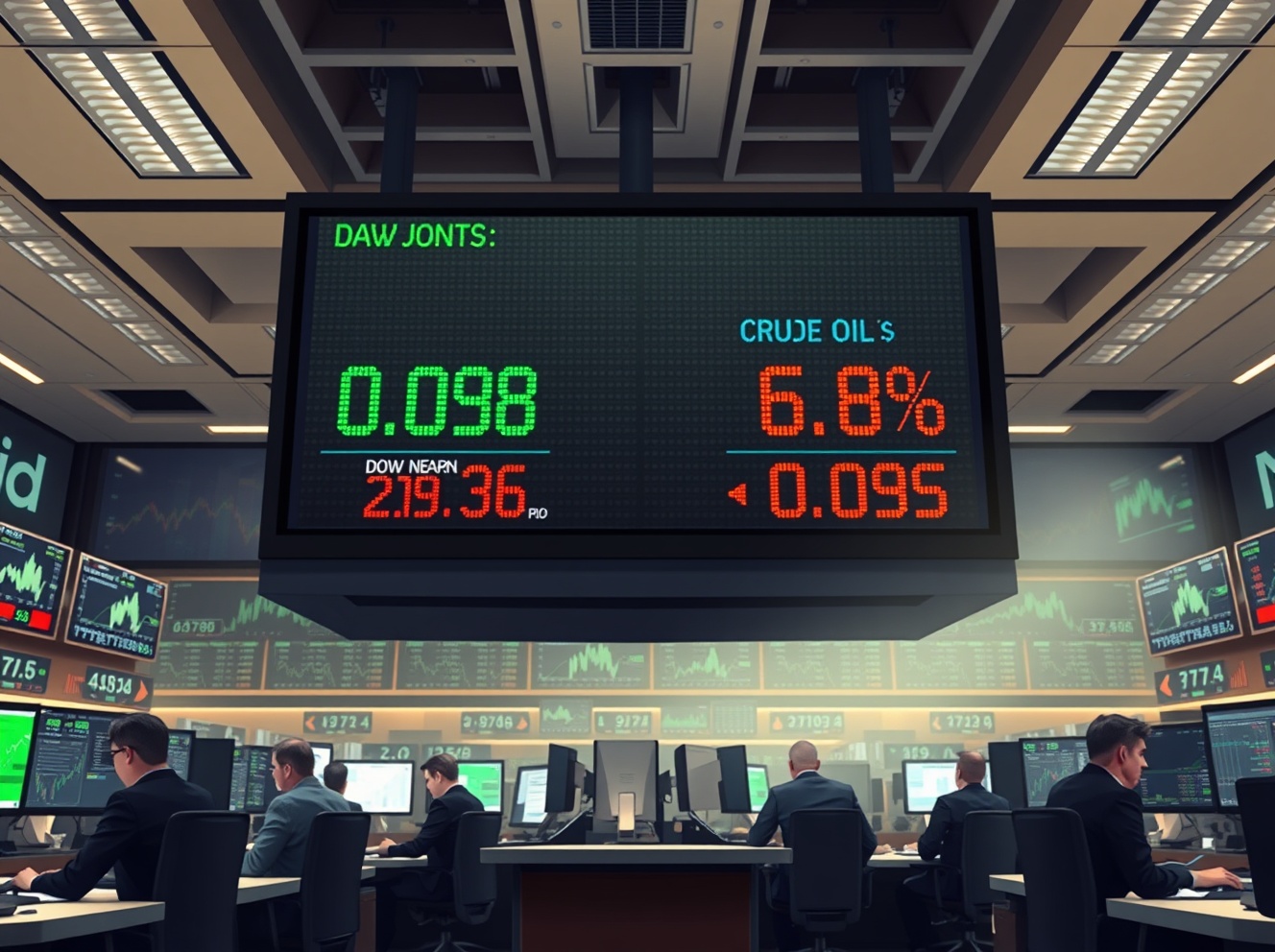
BitcoinWorld Dow Jones Industrial Average Soars as Oil Prices Plunge on Easing Iran Pressure NEW YORK, April 10, 2025 – The Dow Jones Industrial Average postedBitcoinWorld Dow Jones Industrial Average Soars as Oil Prices Plunge on Easing Iran Pressure NEW YORK, April 10, 2025 – The Dow Jones Industrial Average posted

Dow Jones Industrial Average Soars as Oil Prices Plunge on Easing Iran Pressure

2026/03/11 02:35
6 min read
For feedback or concerns regarding this content, please contact us at [email protected]

BitcoinWorld

Dow Jones Industrial Average Soars as Oil Prices Plunge on Easing Iran Pressure

NEW YORK, April 10, 2025 – The Dow Jones Industrial Average posted significant gains today, propelled by a sharp decline in global oil prices. This market movement follows rising diplomatic optimism regarding potential easing of geopolitical pressure on Iran. Consequently, investors are reassessing the risk premium baked into energy markets.

Dow Jones Industrial Average Rises on Market Reassessment

The Dow Jones Industrial Average climbed over 450 points in Thursday’s trading session. This rally marked its strongest single-day performance in three weeks. Market breadth was notably positive, with advancing issues outnumbering decliners by a wide margin. Furthermore, the S&P 500 and Nasdaq Composite also registered solid gains, indicating broad-based market strength. Trading volume was above the 30-day average, suggesting strong conviction behind the move.

Analysts point to several interconnected factors driving the surge. Primarily, the precipitous drop in crude oil futures alleviated immediate inflation concerns. Lower energy costs typically boost corporate profit margins and consumer spending power. Simultaneously, sectors sensitive to fuel prices, like industrials and transportation, led the advance. For instance, shares of major airlines and package delivery companies jumped more than 5%.

Oil Prices Plunge on Geopolitical Shifts

Brent crude futures, the global benchmark, fell sharply by over 7% to settle below $78 per barrel. Similarly, West Texas Intermediate (WTI) crude dropped approximately 6.5%. This represents the largest single-day percentage decline for both benchmarks since November 2024. The sell-off accelerated following reports from European diplomatic sources.

These reports indicated renewed dialogue aimed at reviving aspects of the Joint Comprehensive Plan of Action (JCPOA). While a full restoration is not imminent, markets reacted to the potential for increased Iranian oil exports. Iran holds some of the world’s largest proven crude reserves. An incremental increase in its exports could help balance a currently tight global supply picture.

  • Brent Crude: Fell 7.2% to $77.84/barrel.
  • WTI Crude: Fell 6.5% to $73.15/barrel.
  • Market Implied Volatility (OVX): Dropped 15%, signaling reduced fear.

Additionally, the U.S. Energy Information Administration (EIA) reported a larger-than-expected build in domestic crude inventories. This data further pressured prices by highlighting adequate short-term supply.

Expert Analysis on the Iran Factor

“The market is pricing in a marginal reduction in the geopolitical risk premium,” stated Dr. Anya Petrova, Lead Geopolitical Strategist at Global Macro Insights. “It’s not about a flood of new oil hitting the market tomorrow. Instead, it’s about the direction of travel. Any credible path toward de-escalation removes a key upside risk for oil prices, which equity markets view favorably.” Petrova, who has advised international energy agencies for over 15 years, emphasized the psychological impact on trader sentiment.

Historical context supports this analysis. Previous periods of diplomatic engagement with Iran have correlated with lower oil price volatility. For example, the initial implementation of the JCPOA in 2016 contributed to a prolonged period of lower, more stable prices. However, experts caution that the current situation involves complex variables not present a decade ago.

Broader Economic Impacts and Market Mechanics

The relationship between oil prices and equity markets is multifaceted. A sudden drop in oil prices acts as a de facto tax cut for consumers and businesses. This dynamic can stimulate economic activity. Moreover, it alters expectations for central bank policy. Lower energy costs directly reduce headline inflation figures.

Consequently, investors have adjusted their forecasts for the Federal Reserve’s interest rate path. Futures markets now indicate a slightly higher probability of rate cuts later in 2025. This shift benefits growth-oriented sectors, particularly technology, which outperformed in today’s session. The following table illustrates the sector performance within the S&P 500:

Sector Daily Performance Primary Driver
Industrials +3.8% Lower input costs
Consumer Discretionary +3.2% Boost to disposable income
Information Technology +2.9% Lower rate expectations
Energy -4.1% Direct commodity price impact

However, the energy sector faced significant headwinds. Major integrated oil companies and exploration firms saw their share prices decline. This divergence highlights the nuanced nature of today’s market action. It also underscores the importance of sector rotation in a dynamic trading environment.

Conclusion

In summary, the rise of the Dow Jones Industrial Average is directly linked to the plunge in oil prices, which itself stems from hopes of easing pressure on Iran. This chain reaction demonstrates the profound sensitivity of financial markets to geopolitical developments. While the immediate price action is clear, its sustainability depends on the progression of diplomatic talks and subsequent shifts in actual oil supply. Investors will continue to monitor statements from key capitals and OPEC+ responses closely. The day’s events reaffirm that in global markets, politics and economics remain inextricably linked.

FAQs

Q1: Why does the Dow Jones go up when oil prices go down?
Often, lower oil prices reduce business costs and consumer expenses, acting as a stimulus. This can boost corporate earnings and economic growth prospects, which equity markets favor. However, a sustained crash can signal weak global demand, which is negative.

Q2: How could easing pressure on Iran affect global oil supply?
Easing sanctions could allow Iran to increase its crude oil exports legally. Iran has the capacity to add over 1 million barrels per day to the global market relatively quickly, which would increase supply and typically lower prices.

Q3: What is the ‘geopolitical risk premium’ in oil prices?
This is the extra amount buyers pay for oil due to fears of supply disruptions from conflicts, sanctions, or political instability. When tensions ease, as with Iran hopes, this premium shrinks, and the base price falls.

Q4: Did anything else contribute to the drop in oil prices today?
Yes. A larger-than-expected increase in U.S. crude oil inventories reported by the EIA indicated stronger short-term supply, which added downward pressure alongside the Iran news.

Q5: Will this trend continue?
Market trends depend on future data and events. If diplomatic progress with Iran stalls or reverses, oil prices could rebound, potentially pressuring stocks. Conversely, confirmed progress could extend the current market dynamic.

This post Dow Jones Industrial Average Soars as Oil Prices Plunge on Easing Iran Pressure first appeared on BitcoinWorld.


Disclaimer: The articles reposted on this site are sourced from public platforms and are provided for informational purposes only. They do not necessarily reflect the views of MEXC. All rights remain with the original authors. If you believe any content infringes on third-party rights, please contact [email protected] for removal. MEXC makes no guarantees regarding the accuracy, completeness, or timeliness of the content and is not responsible for any actions taken based on the information provided. The content does not constitute financial, legal, or other professional advice, nor should it be considered a recommendation or endorsement by MEXC.

You May Also Like

Is Doge Losing Steam As Traders Choose Pepeto For The Best Crypto Investment?

Is Doge Losing Steam As Traders Choose Pepeto For The Best Crypto Investment?

The post Is Doge Losing Steam As Traders Choose Pepeto For The Best Crypto Investment? appeared on BitcoinEthereumNews.com. Crypto News 17 September 2025 | 17:39 Is dogecoin really fading? As traders hunt the best crypto to buy now and weigh 2025 picks, Dogecoin (DOGE) still owns the meme coin spotlight, yet upside looks capped, today’s Dogecoin price prediction says as much. Attention is shifting to projects that blend culture with real on-chain tools. Buyers searching “best crypto to buy now” want shipped products, audits, and transparent tokenomics. That frames the true matchup: dogecoin vs. Pepeto. Enter Pepeto (PEPETO), an Ethereum-based memecoin with working rails: PepetoSwap, a zero-fee DEX, plus Pepeto Bridge for smooth cross-chain moves. By fusing story with tools people can use now, and speaking directly to crypto presale 2025 demand, Pepeto puts utility, clarity, and distribution in front. In a market where legacy meme coin leaders risk drifting on sentiment, Pepeto’s execution gives it a real seat in the “best crypto to buy now” debate. First, a quick look at why dogecoin may be losing altitude. Dogecoin Price Prediction: Is Doge Really Fading? Remember when dogecoin made crypto feel simple? In 2013, DOGE turned a meme into money and a loose forum into a movement. A decade on, the nonstop momentum has cooled; the backdrop is different, and the market is far more selective. With DOGE circling ~$0.268, the tape reads bearish-to-neutral for the next few weeks: hold the $0.26 shelf on daily closes and expect choppy range-trading toward $0.29–$0.30 where rallies keep stalling; lose $0.26 decisively and momentum often bleeds into $0.245 with risk of a deeper probe toward $0.22–$0.21; reclaim $0.30 on a clean daily close and the downside bias is likely neutralized, opening room for a squeeze into the low-$0.30s. Source: CoinMarketcap / TradingView Beyond the dogecoin price prediction, DOGE still centers on payments and lacks native smart contracts; ZK-proof verification is proposed,…
Share
BitcoinEthereumNews2025/09/18 00:14
Wormhole launches reserve tying protocol revenue to token

Wormhole launches reserve tying protocol revenue to token

The post Wormhole launches reserve tying protocol revenue to token appeared on BitcoinEthereumNews.com. Wormhole is changing how its W token works by creating a new reserve designed to hold value for the long term. Announced on Wednesday, the Wormhole Reserve will collect onchain and offchain revenues and other value generated across the protocol and its applications (including Portal) and accumulate them into W, locking the tokens within the reserve. The reserve is part of a broader update called W 2.0. Other changes include a 4% targeted base yield for tokenholders who stake and take part in governance. While staking rewards will vary, Wormhole said active users of ecosystem apps can earn boosted yields through features like Portal Earn. The team stressed that no new tokens are being minted; rewards come from existing supply and protocol revenues, keeping the cap fixed at 10 billion. Wormhole is also overhauling its token release schedule. Instead of releasing large amounts of W at once under the old “cliff” model, the network will shift to steady, bi-weekly unlocks starting October 3, 2025. The aim is to avoid sharp periods of selling pressure and create a more predictable environment for investors. Lockups for some groups, including validators and investors, will extend an additional six months, until October 2028. Core contributor tokens remain under longer contractual time locks. Wormhole launched in 2020 as a cross-chain bridge and now connects more than 40 blockchains. The W token powers governance and staking, with a capped supply of 10 billion. By redirecting fees and revenues into the new reserve, Wormhole is betting that its token can maintain value as demand for moving assets and data between chains grows. This is a developing story. This article was generated with the assistance of AI and reviewed by editor Jeffrey Albus before publication. Get the news in your inbox. Explore Blockworks newsletters: Source: https://blockworks.co/news/wormhole-launches-reserve
Share
BitcoinEthereumNews2025/09/18 01:55
Cryptos Signal Divergence Ahead of Fed Rate Decision

Cryptos Signal Divergence Ahead of Fed Rate Decision

The post Cryptos Signal Divergence Ahead of Fed Rate Decision appeared on BitcoinEthereumNews.com. Crypto assets send conflicting signals ahead of the Federal Reserve’s September rate decision. On-chain data reveals a clear decrease in Bitcoin and Ethereum flowing into centralized exchanges, but a sharp increase in altcoin inflows. The findings come from a Tuesday report by CryptoQuant, an on-chain data platform. The firm’s data shows a stark divergence in coin volume, which has been observed in movements onto centralized exchanges over the past few weeks. Bitcoin and Ethereum Inflows Drop to Multi-Month Lows Sponsored Sponsored Bitcoin has seen a dramatic drop in exchange inflows, with the 7-day moving average plummeting to 25,000 BTC, its lowest level in over a year. The average deposit per transaction has fallen to 0.57 BTC as of September. This suggests that smaller retail investors, rather than large-scale whales, are responsible for the recent cash-outs. Ethereum is showing a similar trend, with its daily exchange inflows decreasing to a two-month low. CryptoQuant reported that the 7-day moving average for ETH deposits on exchanges is around 783,000 ETH, the lowest in two months. Other Altcoins See Renewed Selling Pressure In contrast, other altcoin deposit activity on exchanges has surged. The number of altcoin deposit transactions on centralized exchanges was quite steady in May and June of this year, maintaining a 7-day moving average of about 20,000 to 30,000. Recently, however, that figure has jumped to 55,000 transactions. Altcoins: Exchange Inflow Transaction Count. Source: CryptoQuant CryptoQuant projects that altcoins, given their increased inflow activity, could face relatively higher selling pressure compared to BTC and ETH. Meanwhile, the balance of stablecoins on exchanges—a key indicator of potential buying pressure—has increased significantly. The report notes that the exchange USDT balance, around $273 million in April, grew to $379 million by August 31, marking a new yearly high. CryptoQuant interprets this surge as a reflection of…
Share
BitcoinEthereumNews2025/09/18 01:01