BitMEX Founder Arthur Hayes Reveals His Bitcoin (BTC) Re-Entry Strategy
TLDR
- BitMEX co-founder Arthur Hayes is holding off on Bitcoin investments until the Federal Reserve pivots to easier monetary policy
- Bitcoin sits near $69,926, representing a 45% decline from its October peak of $126,000
- Hayes cautions that escalating US-Iran conflict could spark sell-offs across equities and cryptocurrency markets
- He emphasizes that “money printing is good for Bitcoin” — not military conflict — and plans to re-enter when quantitative easing resumes
- Despite near-term bearish outlook, Hayes maintains his long-term Bitcoin price projection of $250,000
Arthur Hayes, who co-founded cryptocurrency exchange BitMEX, has made his stance crystal clear: he wouldn’t invest even one dollar in Bitcoin under current market conditions. During an appearance on Natalie Brunell’s Coin Stories podcast, Hayes explained that he’s holding out for a definitive shift in US Federal Reserve policy.
Bitcoin’s current price hovers around $69,926. This represents a steep 45% pullback from the cryptocurrency’s October all-time high of $126,000.
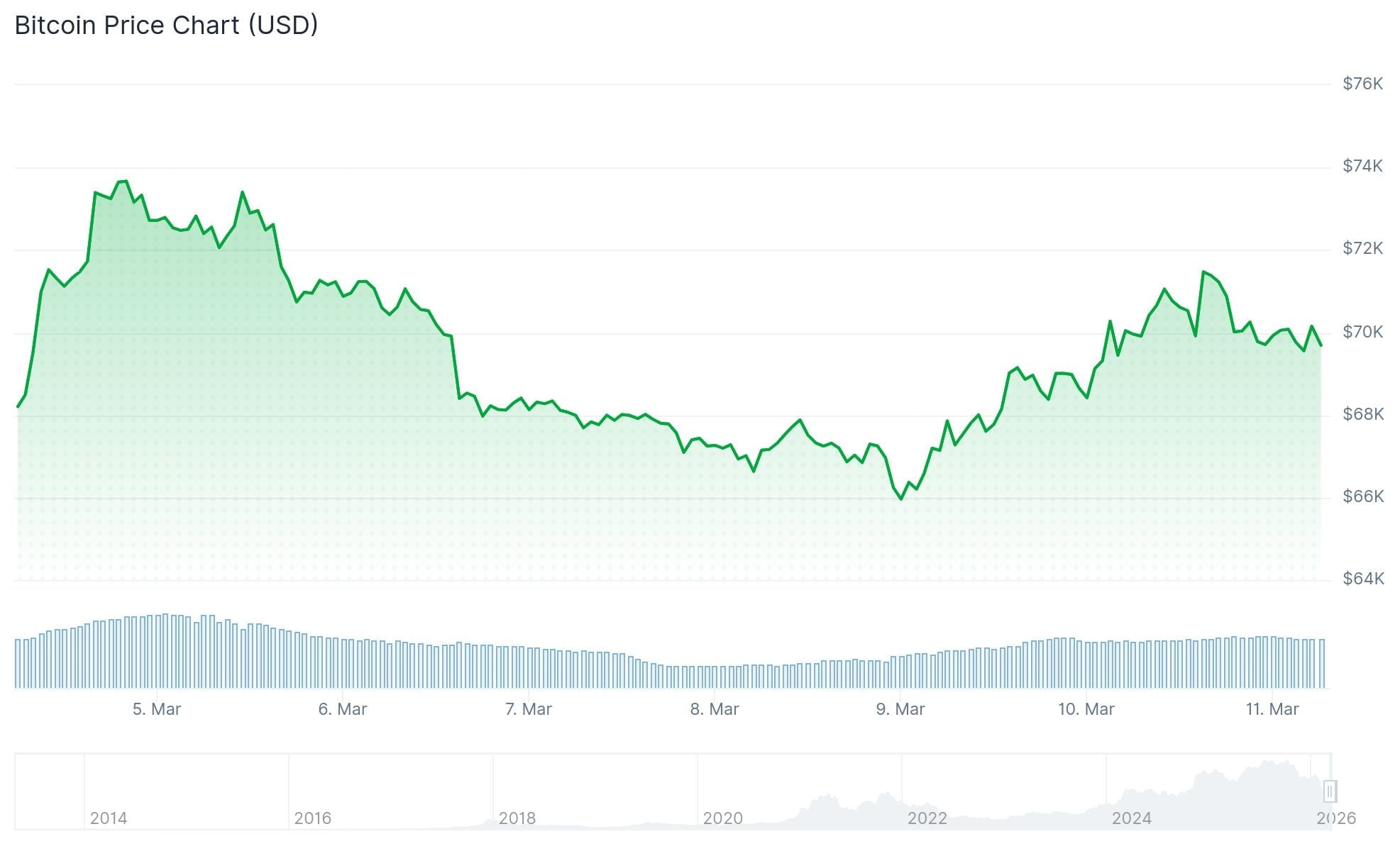 Bitcoin (BTC) Price
Hayes highlighted the escalating US-Iran tensions as a primary concern driving his cautious approach. He believes that prolonged military engagement would eventually force the Federal Reserve to expand monetary supply.
The BitMEX founder was careful to differentiate between armed conflict and monetary expansion. He pushed back against the notion that warfare directly benefits Bitcoin.
Downside Risk Still on the Table
Hayes didn’t rule out further price deterioration for Bitcoin, suggesting that a drop below $60,000 remains possible if macroeconomic headwinds intensify. Such a move, he warned, could trigger cascading liquidations.
Bitcoin momentarily dipped to the $60,000 threshold on February 6 before recovering modestly. According to Hayes, current valuations still leave considerable downside exposure.
He suggested that sustained weakness in equity markets could pull Bitcoin lower in tandem. A widespread flight from risk assets, in his view, would likely result in forced selling across the crypto sector.
Other Analysts More Optimistic
Hayes’ bearish near-term outlook contrasts sharply with other market observers. Analyst Michaël van de Poppe recently highlighted robust strength in the Nasdaq as a bullish signal for Bitcoin.
Hayes isn’t completely dismissive of Bitcoin’s prospects. He acknowledged that he doesn’t anticipate extended periods of sub-$100,000 trading in the coming years.
His ambitious $250,000 Bitcoin price target remains unchanged. Hayes has been publicly advocating for this forecast since late last year.
The crypto veteran emphasized that his current sideline position stems purely from macroeconomic considerations rather than any fundamental concerns about Bitcoin’s long-term value proposition.
He stressed that monitoring central bank policy shifts is paramount. The moment monetary authorities pivot from restrictive to accommodative policy, Hayes indicated, he’ll actively accumulate Bitcoin.
Following its brief touch of $60,000 on February 6, Bitcoin has entered a modest recovery phase and currently trades near $69,926.
The post BitMEX Founder Arthur Hayes Reveals His Bitcoin (BTC) Re-Entry Strategy appeared first on Blockonomi.


You May Also Like

How To Time The Dogecoin Bottom And When The Price Will Reach $2

South Korean Banking Giant Enters Stablecoin Race with Kaia Pilot