

Canopii’s Revolutionary Robotic Greenhouses Promise to Transform Indoor Farming Forever
BitcoinWorld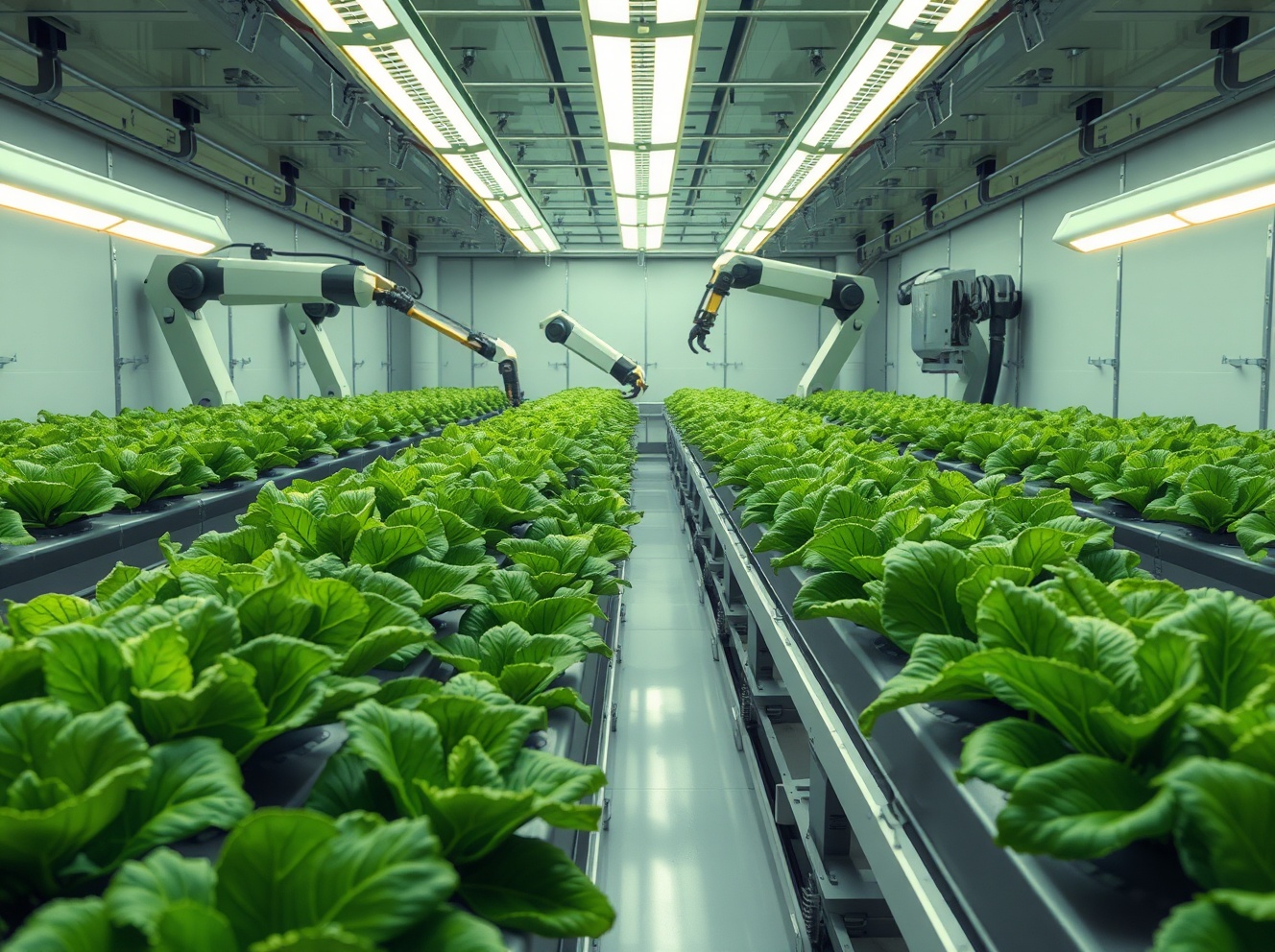
Canopii’s Revolutionary Robotic Greenhouses Promise to Transform Indoor Farming Forever
PORTLAND, Oregon – June 9, 2025 – While many indoor farming ventures have struggled with sustainability and profitability, Canopii emerges with a fundamentally different approach. This innovative startup combines robotics, automation, and sustainable design to create self-contained farming systems that could reshape local food production. Founder David Ashton’s vision stems from personal experience with California’s agricultural challenges during historic droughts.
Canopii’s Autonomous Farming Revolution
Canopii develops completely autonomous robotic greenhouses that manage the entire crop cycle without human intervention. These compact systems produce remarkable yields while using minimal resources. Each unit occupies space comparable to a basketball court yet generates up to 40,000 pounds of fresh produce annually. The technology requires only one standard water spigot and operates on household electrical power.
The company’s current focus includes herbs and specialty greens like baby bok choy and gai lan. However, the modular design allows for future expansion to other crops. Manufacturing partner GK Designs produces these systems with precision engineering that enables mass production capabilities similar to automotive manufacturing.
Addressing Past Industry Failures
The indoor farming sector has experienced significant turbulence in recent years. High-profile companies like Bowery Farming and Plenty raised hundreds of millions in venture capital before facing financial difficulties. Many operations struggled with energy costs, complex technology integration, and unrealistic scaling expectations.
Canopii deliberately avoided these pitfalls through careful planning and diversified funding. The company secured $2.3 million in grants from organizations including the National Science Foundation before pursuing venture capital. This strategic approach allowed for methodical development and testing without pressure for premature scaling.
Strategic Growth Through Diversified Funding
“The capital stack has to be diversified beyond VC,” Ashton explained during a recent interview. “We’re five years in and still iterating on one farm, which has allowed us to learn so much. If we got VC right away and tried to scale after year one or two, that’s not possible with food infrastructure.”
This patient development strategy contrasts sharply with industry norms. Canopii’s total funding of approximately $3.6 million represents a fraction of what competitors have raised. The company maintains that this disciplined approach enables sustainable growth and technological refinement.
Technical Innovation and Efficiency
Canopii’s systems achieve remarkable energy efficiency by operating on standard household power. The entire farm runs on 100 AMPs at 240 volts, making installation possible in various locations including urban backyards. This accessibility represents a significant advancement in distributed agriculture technology.
The autonomous nature of these systems reduces labor costs dramatically. From seeding to harvesting, robotic systems handle all cultivation tasks. This automation ensures consistent quality while eliminating human error in the growing process.
Resource Management Breakthroughs
Water conservation represents another key innovation. Traditional outdoor lettuce farming in California’s Central Valley requires approximately 3.5 acre-feet of water per acre annually. Canopii’s closed-loop systems use dramatically less water while producing equivalent yields in much smaller spaces.
The company’s technology also addresses transportation emissions by enabling local production. Currently, the average food item travels 1,500 miles from farm to consumer. Canopii’s distributed model could significantly reduce these food miles while providing fresher produce.
Market Response and Future Plans
Interest in Canopii’s technology comes from diverse sectors including schools, restaurants, and casinos. These institutions seek reliable, local produce sources with consistent quality and availability. The company’s first commercial farm in downtown Portland will serve as a demonstration site for potential franchise partners.
Franchising represents a core component of Canopii’s expansion strategy. The company plans to license its technology to operators who can manage local production and distribution. This model combines centralized technology development with decentralized operations.
Timeline of Development and Milestones
Canopii’s journey began with Ashton’s observations during California’s drought years. The company progressed through several key phases:
- 2018-2020: Initial concept development and NSF grant applications
- 2021: $250,000 NSF grant for prototype development
- 2022: $1 million grant for full-scale prototype
- 2023-2024: System refinement and testing
- 2025: Automation milestone achieved and commercial deployment begins
Industry Context and Competitive Landscape
The global indoor farming market continues evolving despite previous setbacks. According to recent agricultural technology reports, the sector shows renewed interest in sustainable, efficient systems. Canopii’s approach differs from vertical farming operations through its emphasis on autonomy and energy efficiency.
Traditional greenhouse operations still dominate controlled environment agriculture. However, these facilities often require significant manual labor and lack the automation capabilities of newer systems. Canopii’s technology bridges this gap while maintaining operational simplicity.
Conclusion
Canopii represents a promising evolution in indoor farming technology through its focus on autonomy, efficiency, and sustainable growth. The company’s robotic greenhouses address previous industry challenges while creating new possibilities for local food production. As the first commercial deployment begins in Portland, the agricultural technology community watches closely. Canopii’s success could demonstrate a viable path forward for indoor farming that balances innovation with practical implementation.
FAQs
Q1: What makes Canopii different from previous indoor farming companies?
Canopii focuses on complete automation, energy efficiency, and diversified funding rather than rapid venture capital-fueled expansion. The company’s systems operate on household power and use minimal water while producing significant yields.
Q2: How much produce can one Canopii farm produce annually?
Each autonomous farm can produce up to 40,000 pounds of fresh herbs and specialty greens annually while occupying space equivalent to a basketball court.
Q3: What crops does Canopii currently grow?
The company focuses on herbs and specialty greens including baby bok choy and gai lan (Chinese broccoli). The modular design allows for potential expansion to other crops in the future.
Q4: How does Canopii address water conservation?
The closed-loop systems use dramatically less water than traditional agriculture. Each farm requires only one standard water spigot connection, representing significant conservation compared to conventional farming methods.
Q5: What is Canopii’s business model for expansion?
The company plans to franchise its technology to local operators while maintaining centralized research and development. This approach combines scalable technology with distributed operations tailored to local markets.
This post Canopii’s Revolutionary Robotic Greenhouses Promise to Transform Indoor Farming Forever first appeared on BitcoinWorld.


You May Also Like

Jane Street doubles Singapore office capacity to 250 amid Asia expansion

Dogecoin (DOGE) Price Prediction 2026–2030 Outlook




