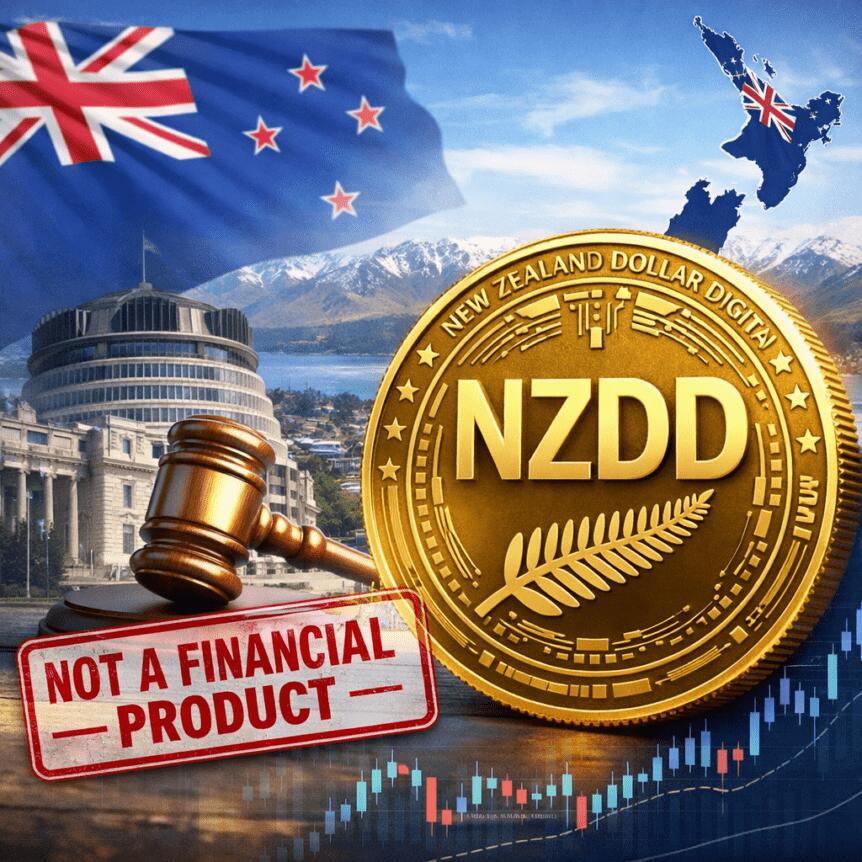
New Zealand’s financial regulator has designated a local currency-pegged stablecoin, NZDD, as not a financial product—a distinction that a leading law firm saysNew Zealand’s financial regulator has designated a local currency-pegged stablecoin, NZDD, as not a financial product—a distinction that a leading law firm says

New Zealand Regulator: NZDD Stablecoin Is Not a Financial Product
For feedback or concerns regarding this content, please contact us at [email protected]
New Zealand Regulator: Nzdd Stablecoin Is Not A Financial Product

New Zealand’s financial regulator has designated a local currency-pegged stablecoin, NZDD, as not a financial product—a distinction that a leading law firm says could sharpen regulatory clarity for stablecoins and fintech pilots. The Financial Markets Authority (FMA) published the designation in a designations notice tied to its fintech sandbox initiative. The authority stressed that NZDD’s economic substance is that it is not a debt security, not an investment, and that holders do not receive income, interest, or other gains. While the move is product-specific, it signals a pragmatic approach to financial innovation that seeks to balance market access with investor protections.

Key takeaways

  • The designation confirms NZDD is not treated as a debt security or an investment under current rules, setting a clearer expectation for issuers and users of currency-pegged stablecoins in New Zealand.
  • The ruling stems from the FMA’s fintech sandbox, illustrating how live testing of digital assets can inform regulatory design without broad-brush sweeping conclusions.
  • Officials caution that the designation applies to the specific product and version of NZDD described in the notice and does not constitute a blanket policy for all stablecoins.
  • The FMA intends to broaden the sandbox with an on‑ramp or restricted license for FinTech firms, a step that could ease market access while preserving protective guardrails that can be adjusted as firms mature.
  • Market context signals notable interest in New Zealand’s crypto space: Protocol Theory estimated that about half of the country’s population is either crypto investors or considering investing, while DataCube Research projects the local crypto market could reach roughly $254 billion in value.

Tickers mentioned:

Market context: The designation arrives amid a wider regulatory push to balance innovation with safeguards as the crypto sector matures. Regulators in multiple jurisdictions are carving clearer pathways for digital assets through sandbox tests and phased licensing regimes, with IMF guidelines on stablecoin risks serving as references for policy discussions and industry practices.

Sentiment: Neutral

Price impact: Neutral. The article describes regulatory actions and sandbox plans rather than market moves or price data.

Trading idea (Not Financial Advice): Hold. The development represents regulatory clarity and potential for future licensing, but no immediate market positioning is warranted from these announcements alone.

Market context: The NZDD designation comes as New Zealand trial sites a broader push to align financial innovation with consumer protections. Regulators in various jurisdictions are testing frameworks that support fintech and tokenized assets while delineating when traditional securities rules apply. IMF guidelines on stablecoin risks are among the reference points cited by policymakers and industry observers as they weigh designations, licensing paths, and cross-border standards. For readers following this space, the New Zealand case adds to a growing mosaic of how regulators distinguish stablecoins from conventional debt or equity instruments without stifling innovation.

Why it matters

The FMA’s designation of NZDD as not a financial product marks a deliberate regulatory stance that could influence how issuers approach digital assets within New Zealand’s borders. By clarifying that NZDD is not a debt security and does not promise income, the regulator provides a concrete example of how a currency-pegged stablecoin might be classified in a way that does not automatically trigger securities laws. This distinction matters for issuers seeking to pilot new digital instruments within a governed framework, as it can reduce uncertainty around product design, disclosures, and investor protections required in the sandbox environment.

Law firm MinterEllisonRuddWatts, which advised the NZDD issuer in relation to its sandbox participation, described the move as an important step toward broader regulatory certainty for stablecoins in the country. The firm stressed that the designation is not a general ruling on all stablecoins but a product-specific decision that may serve as a reference point for future iterations and other token designs. The acknowledgment that policy can evolve in parallel with technological innovation underscores a regulated but adaptive approach—one that seeks to embrace fintech growth while maintaining guardrails to guard consumer interests.

Beyond the legal classification, the FMA’s sandbox expansion signals a practical pathway for market participants. Officials have indicated plans to introduce an on‑ramp or restricted license for FinTech firms as part of the sandbox, with the aim of providing regulated access to the market under targeted restrictions that could be gradually relaxed as a company demonstrates capability and compliance. This incremental licensing approach could lower the barrier to entry for crypto-enabled services and related fintech ventures, enabling more experimentation under supervision rather than in a purely speculative, unregulated milieu. The move also aligns with international norms seen in other jurisdictions that favor controlled innovation over outright prohibition, a stance that could attract startups seeking a compliant foothold in the Asia-Pacific region.

Public interest in New Zealand’s crypto ecosystem remains high. A 2024 Protocol Theory report noted that nearly half of the country’s roughly 5.2 million residents are already crypto investors or actively considering investment, underscoring the market’s potential. DataCube Research projects the domestic crypto market could reach about $254 billion in value, a horizon that reinforces why regulatory clarity matters for participants ranging from exchanges and wallet providers to developers building compliant tokenized financial products. All of these threads—the clarity on NZDD, the sandbox expansion, and the broader market milieu—illustrate a regulatory environment that seeks to foster responsible innovation while acknowledging the need for ongoing policy refinement.

As New Zealand continues to refine its approach, observers will be watching for how NZDD’s designation influences subsequent product classifications and licensing decisions within the sandbox. Will other stablecoins or tokenized instruments gain similar determinations, and how quickly will the on‑ramp licenses be rolled out to accommodate growing interest? The answers will shape the next phase of crypto and fintech activity in the country, potentially setting a model for other small economies navigating the balance between innovation and oversight.

What to watch next

  • Details of the on-ramp or restricted FinTech license as part of the FMA sandbox expansion, including eligibility criteria and any phased rollout timeline.
  • Whether additional stablecoins or digital assets will receive product-specific designations under the sandbox framework.
  • Any further guidance from the FMA or related agencies on the regulatory treatment of crypto assets and fintech innovations beyond NZDD.
  • Updates to IMF-stated guidelines or international standards that could influence New Zealand’s ongoing regulatory evolution.

Sources & verification

  • FMA stablecoin designation notice detailing NZDD’s classification and the sandbox link: https://www.fma.govt.nz/business/legislation/secondary-legislation/designations/financial-markets-conduct-ecdd-holdings-limited-stablecoin-designation-notice-2026/
  • MinterEllisonRuddWatts article on the first-of-its-kind designation: https://www.minterellison.co.nz/insights/first-of-its-kind-designation-nzdd-stablecoin-declared-not-a-financial-product
  • FMA expands sandbox page announcing broader licensing options: https://www.fma.govt.nz/news/all-releases/media-releases/fma-expands-sandbox/
  • IMF guidelines referenced in industry discussion: https://cointelegraph.com/news/imf-guidelines-stablecoin-risks-regulations
  • Protocol Theory 2024 report on NZ crypto investor prevalence: https://hub.easycrypto.com/news/the-next-wave-of-crypto-users-in-new-zealand#:~:text=New%20research%20by%20Protocol%20Theory,ownership%20for%20building%20financial%20freedom.
  • DataCube Research projection for New Zealand’s crypto market: https://www.datacuberesearch.com/new-zealand-fintech-cryptocurrency-market

Regulatory clarity and market momentum in New Zealand

The case of NZDD demonstrates how regulators can pursue a nuanced recognition of new financial instruments without stifling experimentation. By drawing a clear line between what constitutes a financial product and what does not, the FMA provides a navigable path for issuers, developers, and investors who are eager to participate in a digitized financial landscape. The sandbox framework, with its potential on‑ramp licenses, offers a controlled environment in which firms can test products, governance structures, and consumer protections before expanding into broader markets. In a world where stablecoins and tokenized assets attract increasing policy attention, New Zealand’s approach adds to a growing set of case studies that illustrate how a thoughtful, phased regulatory model can support innovation while maintaining systemic safeguards.

What it means for the wider crypto ecosystem

For developers, exchanges, and fintechs operating in or eyeing New Zealand, the designation and the sandbox expansion could lower friction for compliant product launches and pilot programs. For investors, it signals a regulatory environment that distinguishes between stablecoins with real-world utility and instruments that fall under traditional securities rules. And for policymakers, it offers a live example of how to balance innovation with investor protection, a balance that many jurisdictions continue to strive for as the crypto economy matures and scales. As international dialogue around stablecoins evolves, New Zealand’s measured, evidence-based approach may serve as a practical blueprint for other regulators seeking to modernize financial legislation without compromising safety and resilience.

This article was originally published as New Zealand Regulator: NZDD Stablecoin Is Not a Financial Product on Crypto Breaking News – your trusted source for crypto news, Bitcoin news, and blockchain updates.


Market Opportunity
Notcoin Logo
Notcoin Price(NOT)
$0.0003988
$0.0003988$0.0003988
+1.86%
USD
Notcoin (NOT) Live Price Chart
Disclaimer: The articles reposted on this site are sourced from public platforms and are provided for informational purposes only. They do not necessarily reflect the views of MEXC. All rights remain with the original authors. If you believe any content infringes on third-party rights, please contact [email protected] for removal. MEXC makes no guarantees regarding the accuracy, completeness, or timeliness of the content and is not responsible for any actions taken based on the information provided. The content does not constitute financial, legal, or other professional advice, nor should it be considered a recommendation or endorsement by MEXC.

You May Also Like

Tether Backs Ark Labs’ $5.2 Million Bet on Bitcoin’s Stablecoin Revival

Tether Backs Ark Labs’ $5.2 Million Bet on Bitcoin’s Stablecoin Revival

The post Tether Backs Ark Labs’ $5.2 Million Bet on Bitcoin’s Stablecoin Revival appeared on BitcoinEthereumNews.com. In brief Ark Labs secured backing from Tether
Share
BitcoinEthereumNews2026/03/12 21:44
Summarize Any Stock’s Earnings Call in Seconds Using FMP API

Summarize Any Stock’s Earnings Call in Seconds Using FMP API

Turn lengthy earnings call transcripts into one-page insights using the Financial Modeling Prep APIPhoto by Bich Tran Earnings calls are packed with insights. They tell you how a company performed, what management expects in the future, and what analysts are worried about. The challenge is that these transcripts often stretch across dozens of pages, making it tough to separate the key takeaways from the noise. With the right tools, you don’t need to spend hours reading every line. By combining the Financial Modeling Prep (FMP) API with Groq’s lightning-fast LLMs, you can transform any earnings call into a concise summary in seconds. The FMP API provides reliable access to complete transcripts, while Groq handles the heavy lifting of distilling them into clear, actionable highlights. In this article, we’ll build a Python workflow that brings these two together. You’ll see how to fetch transcripts for any stock, prepare the text, and instantly generate a one-page summary. Whether you’re tracking Apple, NVIDIA, or your favorite growth stock, the process works the same — fast, accurate, and ready whenever you are. Fetching Earnings Transcripts with FMP API The first step is to pull the raw transcript data. FMP makes this simple with dedicated endpoints for earnings calls. If you want the latest transcripts across the market, you can use the stable endpoint /stable/earning-call-transcript-latest. For a specific stock, the v3 endpoint lets you request transcripts by symbol, quarter, and year using the pattern: https://financialmodelingprep.com/api/v3/earning_call_transcript/{symbol}?quarter={q}&year={y}&apikey=YOUR_API_KEY here’s how you can fetch NVIDIA’s transcript for a given quarter: import requestsAPI_KEY = "your_api_key"symbol = "NVDA"quarter = 2year = 2024url = f"https://financialmodelingprep.com/api/v3/earning_call_transcript/{symbol}?quarter={quarter}&year={year}&apikey={API_KEY}"response = requests.get(url)data = response.json()# Inspect the keysprint(data.keys())# Access transcript contentif "content" in data[0]: transcript_text = data[0]["content"] print(transcript_text[:500]) # preview first 500 characters The response typically includes details like the company symbol, quarter, year, and the full transcript text. If you aren’t sure which quarter to query, the “latest transcripts” endpoint is the quickest way to always stay up to date. Cleaning and Preparing Transcript Data Raw transcripts from the API often include long paragraphs, speaker tags, and formatting artifacts. Before sending them to an LLM, it helps to organize the text into a cleaner structure. Most transcripts follow a pattern: prepared remarks from executives first, followed by a Q&A session with analysts. Separating these sections gives better control when prompting the model. In Python, you can parse the transcript and strip out unnecessary characters. A simple way is to split by markers such as “Operator” or “Question-and-Answer.” Once separated, you can create two blocks — Prepared Remarks and Q&A — that will later be summarized independently. This ensures the model handles each section within context and avoids missing important details. Here’s a small example of how you might start preparing the data: import re# Example: using the transcript_text we fetched earliertext = transcript_text# Remove extra spaces and line breaksclean_text = re.sub(r'\s+', ' ', text).strip()# Split sections (this is a heuristic; real-world transcripts vary slightly)if "Question-and-Answer" in clean_text: prepared, qna = clean_text.split("Question-and-Answer", 1)else: prepared, qna = clean_text, ""print("Prepared Remarks Preview:\n", prepared[:500])print("\nQ&A Preview:\n", qna[:500]) With the transcript cleaned and divided, you’re ready to feed it into Groq’s LLM. Chunking may be necessary if the text is very long. A good approach is to break it into segments of a few thousand tokens, summarize each part, and then merge the summaries in a final pass. Summarizing with Groq LLM Now that the transcript is clean and split into Prepared Remarks and Q&A, we’ll use Groq to generate a crisp one-pager. The idea is simple: summarize each section separately (for focus and accuracy), then synthesize a final brief. Prompt design (concise and factual) Use a short, repeatable template that pushes for neutral, investor-ready language: You are an equity research analyst. Summarize the following earnings call sectionfor {symbol} ({quarter} {year}). Be factual and concise.Return:1) TL;DR (3–5 bullets)2) Results vs. guidance (what improved/worsened)3) Forward outlook (specific statements)4) Risks / watch-outs5) Q&A takeaways (if present)Text:<<<{section_text}>>> Python: calling Groq and getting a clean summary Groq provides an OpenAI-compatible API. Set your GROQ_API_KEY and pick a fast, high-quality model (e.g., a Llama-3.1 70B variant). We’ll write a helper to summarize any text block, then run it for both sections and merge. import osimport textwrapimport requestsGROQ_API_KEY = os.environ.get("GROQ_API_KEY") or "your_groq_api_key"GROQ_BASE_URL = "https://api.groq.com/openai/v1" # OpenAI-compatibleMODEL = "llama-3.1-70b" # choose your preferred Groq modeldef call_groq(prompt, temperature=0.2, max_tokens=1200): url = f"{GROQ_BASE_URL}/chat/completions" headers = { "Authorization": f"Bearer {GROQ_API_KEY}", "Content-Type": "application/json", } payload = { "model": MODEL, "messages": [ {"role": "system", "content": "You are a precise, neutral equity research analyst."}, {"role": "user", "content": prompt}, ], "temperature": temperature, "max_tokens": max_tokens, } r = requests.post(url, headers=headers, json=payload, timeout=60) r.raise_for_status() return r.json()["choices"][0]["message"]["content"].strip()def build_prompt(section_text, symbol, quarter, year): template = """ You are an equity research analyst. Summarize the following earnings call section for {symbol} ({quarter} {year}). Be factual and concise. Return: 1) TL;DR (3–5 bullets) 2) Results vs. guidance (what improved/worsened) 3) Forward outlook (specific statements) 4) Risks / watch-outs 5) Q&A takeaways (if present) Text: <<< {section_text} >>> """ return textwrap.dedent(template).format( symbol=symbol, quarter=quarter, year=year, section_text=section_text )def summarize_section(section_text, symbol="NVDA", quarter="Q2", year="2024"): if not section_text or section_text.strip() == "": return "(No content found for this section.)" prompt = build_prompt(section_text, symbol, quarter, year) return call_groq(prompt)# Example usage with the cleaned splits from Section 3prepared_summary = summarize_section(prepared, symbol="NVDA", quarter="Q2", year="2024")qna_summary = summarize_section(qna, symbol="NVDA", quarter="Q2", year="2024")final_one_pager = f"""# {symbol} Earnings One-Pager — {quarter} {year}## Prepared Remarks — Key Points{prepared_summary}## Q&A Highlights{qna_summary}""".strip()print(final_one_pager[:1200]) # preview Tips that keep quality high: Keep temperature low (≈0.2) for factual tone. If a section is extremely long, chunk at ~5–8k tokens, summarize each chunk with the same prompt, then ask the model to merge chunk summaries into one section summary before producing the final one-pager. If you also fetched headline numbers (EPS/revenue, guidance) earlier, prepend them to the prompt as brief context to help the model anchor on the right outcomes. Building the End-to-End Pipeline At this point, we have all the building blocks: the FMP API to fetch transcripts, a cleaning step to structure the data, and Groq LLM to generate concise summaries. The final step is to connect everything into a single workflow that can take any ticker and return a one-page earnings call summary. The flow looks like this: Input a stock ticker (for example, NVDA). Use FMP to fetch the latest transcript. Clean and split the text into Prepared Remarks and Q&A. Send each section to Groq for summarization. Merge the outputs into a neatly formatted earnings one-pager. Here’s how it comes together in Python: def summarize_earnings_call(symbol, quarter, year, api_key, groq_key): # Step 1: Fetch transcript from FMP url = f"https://financialmodelingprep.com/api/v3/earning_call_transcript/{symbol}?quarter={quarter}&year={year}&apikey={api_key}" resp = requests.get(url) resp.raise_for_status() data = resp.json() if not data or "content" not in data[0]: return f"No transcript found for {symbol} {quarter} {year}" text = data[0]["content"] # Step 2: Clean and split clean_text = re.sub(r'\s+', ' ', text).strip() if "Question-and-Answer" in clean_text: prepared, qna = clean_text.split("Question-and-Answer", 1) else: prepared, qna = clean_text, "" # Step 3: Summarize with Groq prepared_summary = summarize_section(prepared, symbol, quarter, year) qna_summary = summarize_section(qna, symbol, quarter, year) # Step 4: Merge into final one-pager return f"""# {symbol} Earnings One-Pager — {quarter} {year}## Prepared Remarks{prepared_summary}## Q&A Highlights{qna_summary}""".strip()# Example runprint(summarize_earnings_call("NVDA", 2, 2024, API_KEY, GROQ_API_KEY)) With this setup, generating a summary becomes as simple as calling one function with a ticker and date. You can run it inside a notebook, integrate it into a research workflow, or even schedule it to trigger after each new earnings release. Free Stock Market API and Financial Statements API... Conclusion Earnings calls no longer need to feel overwhelming. With the Financial Modeling Prep API, you can instantly access any company’s transcript, and with Groq LLM, you can turn that raw text into a sharp, actionable summary in seconds. This pipeline saves hours of reading and ensures you never miss the key results, guidance, or risks hidden in lengthy remarks. Whether you track tech giants like NVIDIA or smaller growth stocks, the process is the same — fast, reliable, and powered by the flexibility of FMP’s data. Summarize Any Stock’s Earnings Call in Seconds Using FMP API was originally published in Coinmonks on Medium, where people are continuing the conversation by highlighting and responding to this story
Share
Medium2025/09/18 14:40
PayPal USD Expands to TRON Network via LayerZero

PayPal USD Expands to TRON Network via LayerZero

The post PayPal USD Expands to TRON Network via LayerZero appeared on BitcoinEthereumNews.com. This content is provided by a sponsor. PRESS RELEASE. September 18, 2025 – Geneva, Switzerland – TRON DAO, the community-governed DAO dedicated to accelerating the decentralization of the internet through blockchain technology and decentralized applications (dApps), announced today that PayPal USD will be available on the TRON network through Stargate Hydra as a permissionless token, […] Source: https://news.bitcoin.com/paypal-usd-expands-to-tron-network-via-layerzero/
Share
BitcoinEthereumNews2025/09/18 23:12