

Oil Prices Rise Above $100 as Iraq Tanker Attacks and Oman Port Closure Disrupt Middle East Supply
TLDR
- Brent crude briefly topped $101/barrel Thursday before settling around $98, up 6.6% on the day
- Two oil tankers were struck in Iraqi waters in the Persian Gulf, killing at least one sailor
- Oman evacuated all vessels from its Mina Al Fahal export terminal as a precaution
- China banned refined fuel exports in March to protect domestic supply
- The IEA announced a record 400 million barrel reserve release to try to cool prices
Oil markets surged again Thursday as new attacks on tankers and port closures added to fears about supply from the Middle East.
Brent crude jumped as high as $101.59 per barrel early in the session before pulling back to around $98. West Texas Intermediate rose over 6% to $92.61. Both benchmarks had already hit close to $120 earlier this week.
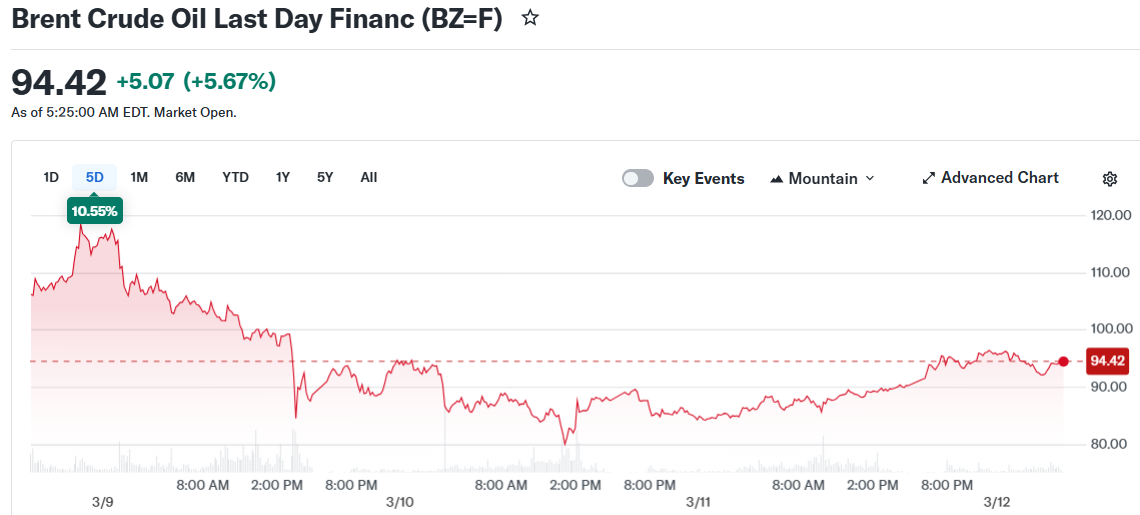 Brent Crude Oil Last Day Financ (BZ=F)
Two oil tankers were struck in the northern Persian Gulf in Iraqi waters. Video shared online showed the vessels on fire. Iraqi port director Farhan al-Fartousi told The Wall Street Journal that one sailor was killed and rescue teams were working to evacuate crew. Iraq shut all its oil ports following the attack.
Oman separately evacuated all ships from its Mina Al Fahal export terminal as a precaution after the wave of attacks on regional shipping. That terminal is one of the few remaining routes for Middle East crude to reach global markets. Operations there later returned to normal.
The Strait of Hormuz, through which roughly 20% of global oil supply passes, remains effectively closed. Iran has warned that no crude will pass through the strait. The closure has forced Gulf producers including Iraq, Kuwait, and Saudi Arabia to cut output.
China Tightens Fuel Export Curbs
China announced an immediate ban on refined fuel exports in March. Chinese refiners also began canceling agreed export cargoes of gasoline and diesel. The country’s top processors had already been told to stop signing new contracts.
Goldman Sachs warned that oil prices could exceed the 2008 peak of $147.50 per barrel if Hormuz flows remain restricted through March.
ANZ analysts said markets were still underpricing the likely duration of disruptions. “Once a conflict extends beyond the initial shock phase, oil markets tend to shift from pricing uncertainty to pricing endurance,” they wrote.
Emergency Reserve Releases Limit Further Gains
The International Energy Agency is preparing a record release of 400 million barrels from strategic reserves. U.S. President Donald Trump said Wednesday the U.S. would release 172 million barrels from the Strategic Petroleum Reserve.
The conflict entered its thirteenth consecutive day Thursday with no clear end in sight. Iran said any ceasefire would require guarantees from both the U.S. and Israel not to strike Iran again. Washington has not agreed to those terms.
U.S. oil inventory data released Wednesday showed a larger-than-expected build of 3.8 million barrels in the prior week.
The post Oil Prices Rise Above $100 as Iraq Tanker Attacks and Oman Port Closure Disrupt Middle East Supply appeared first on CoinCentral.


You May Also Like

turnaround drags, China sales slump

Elon Musk trial on track as Washington securities case probes Twitter stake disclosure




