Solus Partners’ report, “The Compliance Infrastructure Stack,” finds that the resilience of Web3 neobanks depends on ownership of their infrastructure layers andSolus Partners’ report, “The Compliance Infrastructure Stack,” finds that the resilience of Web3 neobanks depends on ownership of their infrastructure layers and

Solus Partners Releases Report On Web3 Neobanks, Mapping Infrastructure, Licensing, And Regulatory Risks
2026/03/12 17:48
5 min read
For feedback or concerns regarding this content, please contact us at [email protected]
Solus Partners Releases Report On Web3 Neobanks, Mapping Infrastructure, Licensing, And Regulatory Risks

Research and advisory firm Solus Partners has released a new report titled “The Compliance Infrastructure Stack,”offering a detailed analysis of how Web3 neobanks construct regulatory moats and manage infrastructure dependencies. 

The report emphasizes that the defensibility of a Web3 neobank is determined not by its user interface or token incentives, but by how many layers of its infrastructure stack it owns versus rents, and whether it holds the licenses required to operate those layers independently.

The study highlights the rise of stablecoin-native neobanks, which allow users to hold dollar-pegged assets, spend via Visa or Mastercard, earn yield, and move funds across borders at near-zero cost. While the market remains in its early stages—with Web3 neobanks representing less than 0.2% of the $143–195 billion global neobank opportunity—the infrastructure decisions made today will determine which platforms survive regulatory scrutiny. Unlike most existing coverage that focuses on product features or user growth, this report takes a bottom-up approach, reverse-engineering the infrastructure stacks of several platforms to answer critical questions, such as Who owns their infrastructure versus renting it? Where are the hidden single points of failure? Which platforms hold the necessary licenses to operate independently under tightening regulations?

The answers are increasingly relevant as the Web3 neobank sector enters a regulatory phase transition. The full enforcement of MiCA in December 2024 will require CASP authorization for any platform offering crypto exchange, custody, or transfer services in the EU, with transitional periods expiring between mid-2025 and mid-2027. Platforms that fail to obtain authorization risk either ceasing EU operations or facing penalties of up to 12.5% of annual turnover.

Market Overview And Platform Taxonomy

The report begins with an analysis of market sizing, platform taxonomy, and the stablecoin infrastructure landscape.The global neobank market reached an estimated $143–195 billion in 2024 and is projected to grow to $210–261 billion in 2025, with long-term forecasts indicating a 40–49% CAGR through the early 2030s. Approximately 350 million consumers worldwide are projected to use neobank services by 2025, with Europe accounting for 37–41% of revenue. Latin America’s neobank user base doubled from 85 million in 2022 to 170 million by 2024, driven primarily by Nubank, while U.S. digital-only bank users reached 39 million, a 22% year-over-year increase.
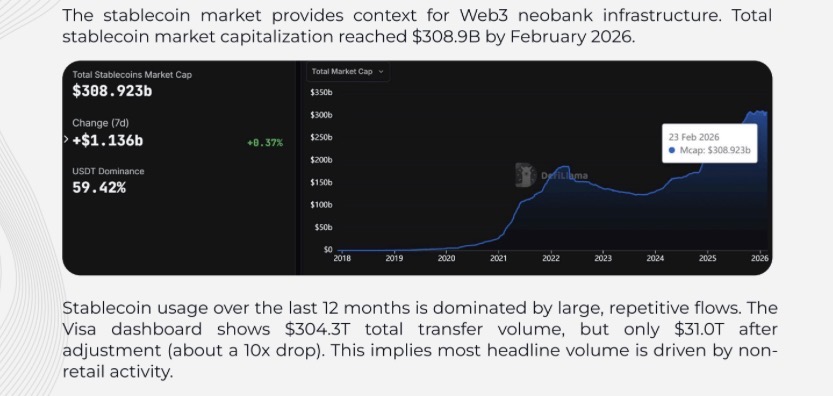
Solus Partners Releases Report On Web3 Neobanks, Mapping Infrastructure, Licensing, And Regulatory RisksScreenshot

While no major research firm tracks Web3 neobanks as a standalone market, CoinGecko’s neobank token category tracked 21 projects with a combined market capitalization of $2.7 billion in early 2026.

The platform taxonomy categorizes neobanks into Web2, hybrid, and Web3-native models, highlighting their approach to account management, custody, and blockchain integration. Notable projects include Chime, Monzo, N26, Revolut, Nubank, Cash App, Gnosis Pay, Fiat24, and Holyheld. The report further examines key market dynamics shaping Web3 neobanks through 2025 and 2026, covering stablecoin settlement, crypto card volumes, and institutional bank entry.

Regulatory Landscape

The report provides a forward-looking regulatory analysis for the upcoming year, highlighting how MiCA enforcement and related measures will impact Web3 neobank operations. Regulatory readiness, license acquisition, and compliance strategies are examined for each platform, showing which companies are positioned to survive and thrive as rules tighten.
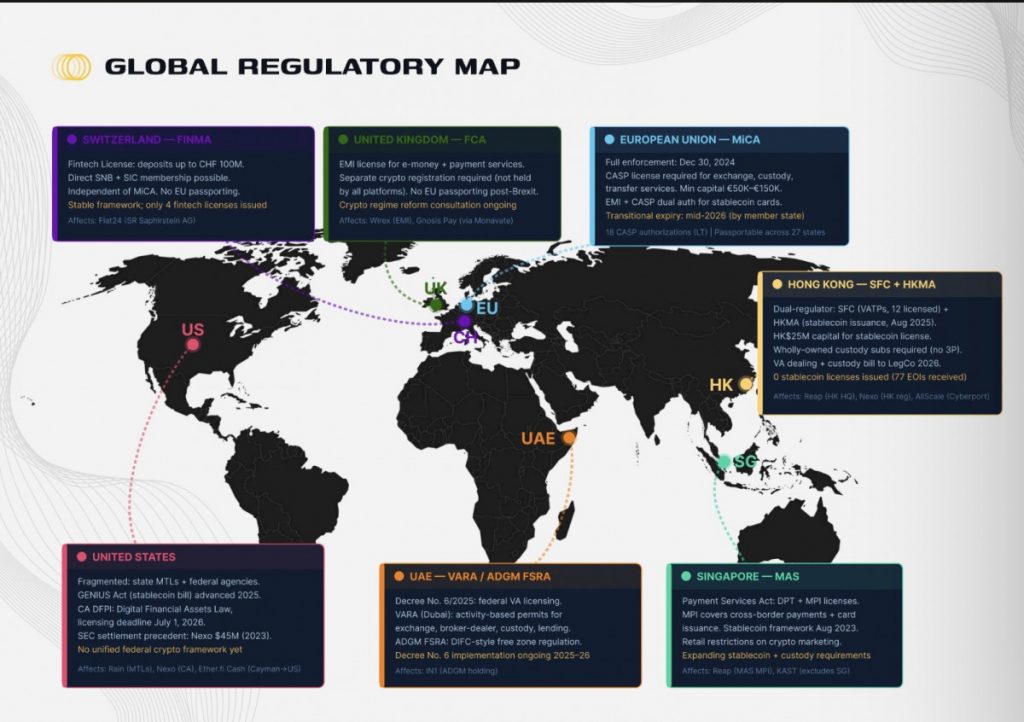
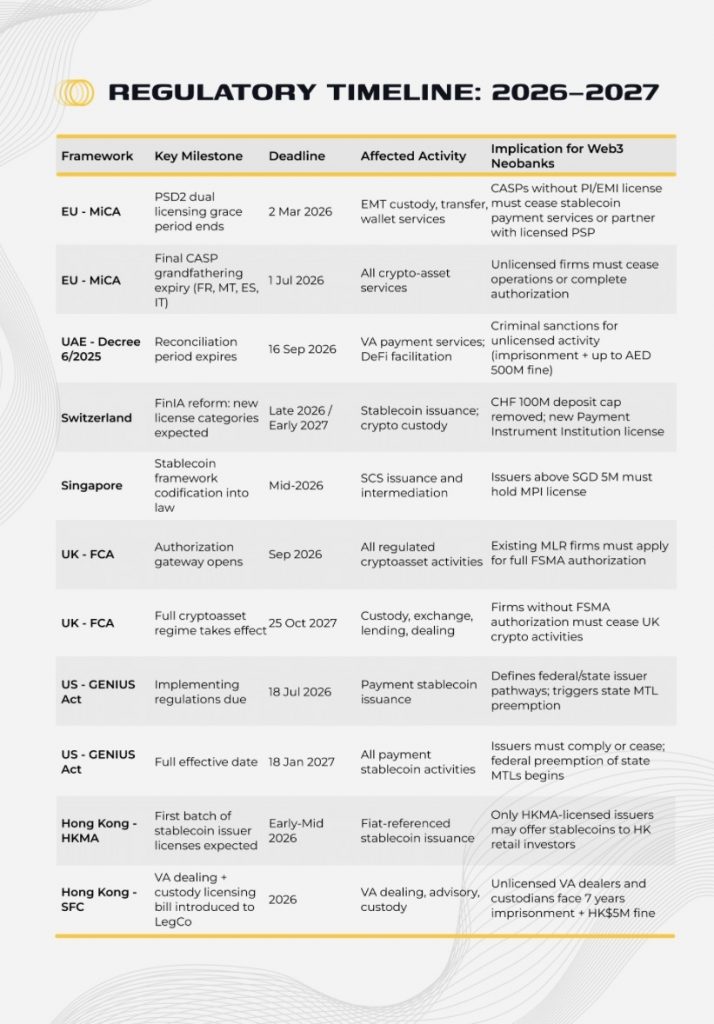
Solus Partners Releases Report On Web3 Neobanks, Mapping Infrastructure, Licensing, And Regulatory Risks Solus Partners Releases Report On Web3 Neobanks, Mapping Infrastructure, Licensing, And Regulatory RisksScreenshot

Six-Layer Infrastructure Anatomy

A major contribution of the report is its six-layer infrastructure framework, which analyzes vendor landscapes, pricing, and build-vs-buy decisions at each layer. Every Web3 neobank assembles a stack comprising:

  • Card Issuance – Crypto-native principals like Rain and Reap hold direct Visa or Mastercard memberships, while traditional BIN sponsors such as Monavate, Unlimit, and Marqeta intermediate between card networks and fintech programs. Costs vary widely, with in-house builds taking 12–24 months and $2–10M+, while buying takes 3–6 months for $100–500K.
  • KYC/AML – Identity verification, transaction monitoring, and FATF Travel Rule compliance are managed through vendors such as Sumsub, Jumio, Onfido, Chainalysis, TRM Labs, and Notabene. Costs range from $1–2.50 per verification, with annual analytics subscriptions exceeding $50K. Most platforms purchase these services rather than building in-house.
  • Custody – Crypto safekeeping varies between third-party custodial (Fireblocks, BitGo, Copper), MPC/TSS semi-custodial solutions (Dfns, Fordefi), and self-custodial wallets. Self-custody is the highest owned ratio among layers, with compliance influenced by MiCA Art. 75 and Recital 83.
  • Fiat On/Off-Ramp – Platforms integrate with providers like Transak, MoonPay, Ramp Network, and Onramper, or operate in-house EMIs such as Fiat24 and Deblock. Transaction costs range from 0.25%–5%, with internalization requiring $350K–1M+ capital.
  • Core Banking Ledger – Account state and transaction management may be handled via BaaS providers (Column-Unit, Treasury Prime) or on-chain solutions (GP, Fiat24). Costs include SaaS fees ($100K+/yr) or minimal gas fees ($0.001–0.01 per transaction).
  • Blockchain Settlement / Chain Selection – Platforms choose L1 and L2 chains such as Gnosis Chain, Arbitrum, Base, and Solana, supporting multi-chain operations, account abstraction (ERC-4337), and gas abstraction. Transaction costs vary from $0.00025 on Solana to $0.02 on Base.

Platform Profiles And Cross-Platform Analysis

The report includes detailed profiles of 19 platforms, reverse-engineering their infrastructure stacks, licensing status, and regulatory runway under MiCA and related 2026–2027 rules. Companies analyzed include Gnosis Pay, Fiat24, Ether.Fi Cash, Kast, Wirex, Deblock, Tria, Tuyo, IN1, CYPHER, Avici, Allscale, Holyheld, Nexo, Minipay, Reap, Rain, Nordark, and Stakestone.

A cross-platform analysis examines license clustering, infrastructure concentration, and regulatory divergence, highlighting potential risks such as vendor dependency and gaps in CASP authorization. The report identifies strategic build-vs-buy inflection points that could determine the long-term survival of these neobanks.

The full report is available here. Contributors include Rektonomist, Frigg, Brey, Temmy, and Defizard.

The post Solus Partners Releases Report On Web3 Neobanks, Mapping Infrastructure, Licensing, And Regulatory Risks appeared first on Metaverse Post.


Disclaimer: The articles reposted on this site are sourced from public platforms and are provided for informational purposes only. They do not necessarily reflect the views of MEXC. All rights remain with the original authors. If you believe any content infringes on third-party rights, please contact [email protected] for removal. MEXC makes no guarantees regarding the accuracy, completeness, or timeliness of the content and is not responsible for any actions taken based on the information provided. The content does not constitute financial, legal, or other professional advice, nor should it be considered a recommendation or endorsement by MEXC.

You May Also Like

Tether Backs Ark Labs’ $5.2 Million Bet on Bitcoin’s Stablecoin Revival

Tether Backs Ark Labs’ $5.2 Million Bet on Bitcoin’s Stablecoin Revival

The post Tether Backs Ark Labs’ $5.2 Million Bet on Bitcoin’s Stablecoin Revival appeared on BitcoinEthereumNews.com. In brief Ark Labs secured backing from Tether
Share
BitcoinEthereumNews2026/03/12 21:44
Summarize Any Stock’s Earnings Call in Seconds Using FMP API

Summarize Any Stock’s Earnings Call in Seconds Using FMP API

Turn lengthy earnings call transcripts into one-page insights using the Financial Modeling Prep APIPhoto by Bich Tran Earnings calls are packed with insights. They tell you how a company performed, what management expects in the future, and what analysts are worried about. The challenge is that these transcripts often stretch across dozens of pages, making it tough to separate the key takeaways from the noise. With the right tools, you don’t need to spend hours reading every line. By combining the Financial Modeling Prep (FMP) API with Groq’s lightning-fast LLMs, you can transform any earnings call into a concise summary in seconds. The FMP API provides reliable access to complete transcripts, while Groq handles the heavy lifting of distilling them into clear, actionable highlights. In this article, we’ll build a Python workflow that brings these two together. You’ll see how to fetch transcripts for any stock, prepare the text, and instantly generate a one-page summary. Whether you’re tracking Apple, NVIDIA, or your favorite growth stock, the process works the same — fast, accurate, and ready whenever you are. Fetching Earnings Transcripts with FMP API The first step is to pull the raw transcript data. FMP makes this simple with dedicated endpoints for earnings calls. If you want the latest transcripts across the market, you can use the stable endpoint /stable/earning-call-transcript-latest. For a specific stock, the v3 endpoint lets you request transcripts by symbol, quarter, and year using the pattern: https://financialmodelingprep.com/api/v3/earning_call_transcript/{symbol}?quarter={q}&year={y}&apikey=YOUR_API_KEY here’s how you can fetch NVIDIA’s transcript for a given quarter: import requestsAPI_KEY = "your_api_key"symbol = "NVDA"quarter = 2year = 2024url = f"https://financialmodelingprep.com/api/v3/earning_call_transcript/{symbol}?quarter={quarter}&year={year}&apikey={API_KEY}"response = requests.get(url)data = response.json()# Inspect the keysprint(data.keys())# Access transcript contentif "content" in data[0]: transcript_text = data[0]["content"] print(transcript_text[:500]) # preview first 500 characters The response typically includes details like the company symbol, quarter, year, and the full transcript text. If you aren’t sure which quarter to query, the “latest transcripts” endpoint is the quickest way to always stay up to date. Cleaning and Preparing Transcript Data Raw transcripts from the API often include long paragraphs, speaker tags, and formatting artifacts. Before sending them to an LLM, it helps to organize the text into a cleaner structure. Most transcripts follow a pattern: prepared remarks from executives first, followed by a Q&A session with analysts. Separating these sections gives better control when prompting the model. In Python, you can parse the transcript and strip out unnecessary characters. A simple way is to split by markers such as “Operator” or “Question-and-Answer.” Once separated, you can create two blocks — Prepared Remarks and Q&A — that will later be summarized independently. This ensures the model handles each section within context and avoids missing important details. Here’s a small example of how you might start preparing the data: import re# Example: using the transcript_text we fetched earliertext = transcript_text# Remove extra spaces and line breaksclean_text = re.sub(r'\s+', ' ', text).strip()# Split sections (this is a heuristic; real-world transcripts vary slightly)if "Question-and-Answer" in clean_text: prepared, qna = clean_text.split("Question-and-Answer", 1)else: prepared, qna = clean_text, ""print("Prepared Remarks Preview:\n", prepared[:500])print("\nQ&A Preview:\n", qna[:500]) With the transcript cleaned and divided, you’re ready to feed it into Groq’s LLM. Chunking may be necessary if the text is very long. A good approach is to break it into segments of a few thousand tokens, summarize each part, and then merge the summaries in a final pass. Summarizing with Groq LLM Now that the transcript is clean and split into Prepared Remarks and Q&A, we’ll use Groq to generate a crisp one-pager. The idea is simple: summarize each section separately (for focus and accuracy), then synthesize a final brief. Prompt design (concise and factual) Use a short, repeatable template that pushes for neutral, investor-ready language: You are an equity research analyst. Summarize the following earnings call sectionfor {symbol} ({quarter} {year}). Be factual and concise.Return:1) TL;DR (3–5 bullets)2) Results vs. guidance (what improved/worsened)3) Forward outlook (specific statements)4) Risks / watch-outs5) Q&A takeaways (if present)Text:<<<{section_text}>>> Python: calling Groq and getting a clean summary Groq provides an OpenAI-compatible API. Set your GROQ_API_KEY and pick a fast, high-quality model (e.g., a Llama-3.1 70B variant). We’ll write a helper to summarize any text block, then run it for both sections and merge. import osimport textwrapimport requestsGROQ_API_KEY = os.environ.get("GROQ_API_KEY") or "your_groq_api_key"GROQ_BASE_URL = "https://api.groq.com/openai/v1" # OpenAI-compatibleMODEL = "llama-3.1-70b" # choose your preferred Groq modeldef call_groq(prompt, temperature=0.2, max_tokens=1200): url = f"{GROQ_BASE_URL}/chat/completions" headers = { "Authorization": f"Bearer {GROQ_API_KEY}", "Content-Type": "application/json", } payload = { "model": MODEL, "messages": [ {"role": "system", "content": "You are a precise, neutral equity research analyst."}, {"role": "user", "content": prompt}, ], "temperature": temperature, "max_tokens": max_tokens, } r = requests.post(url, headers=headers, json=payload, timeout=60) r.raise_for_status() return r.json()["choices"][0]["message"]["content"].strip()def build_prompt(section_text, symbol, quarter, year): template = """ You are an equity research analyst. Summarize the following earnings call section for {symbol} ({quarter} {year}). Be factual and concise. Return: 1) TL;DR (3–5 bullets) 2) Results vs. guidance (what improved/worsened) 3) Forward outlook (specific statements) 4) Risks / watch-outs 5) Q&A takeaways (if present) Text: <<< {section_text} >>> """ return textwrap.dedent(template).format( symbol=symbol, quarter=quarter, year=year, section_text=section_text )def summarize_section(section_text, symbol="NVDA", quarter="Q2", year="2024"): if not section_text or section_text.strip() == "": return "(No content found for this section.)" prompt = build_prompt(section_text, symbol, quarter, year) return call_groq(prompt)# Example usage with the cleaned splits from Section 3prepared_summary = summarize_section(prepared, symbol="NVDA", quarter="Q2", year="2024")qna_summary = summarize_section(qna, symbol="NVDA", quarter="Q2", year="2024")final_one_pager = f"""# {symbol} Earnings One-Pager — {quarter} {year}## Prepared Remarks — Key Points{prepared_summary}## Q&A Highlights{qna_summary}""".strip()print(final_one_pager[:1200]) # preview Tips that keep quality high: Keep temperature low (≈0.2) for factual tone. If a section is extremely long, chunk at ~5–8k tokens, summarize each chunk with the same prompt, then ask the model to merge chunk summaries into one section summary before producing the final one-pager. If you also fetched headline numbers (EPS/revenue, guidance) earlier, prepend them to the prompt as brief context to help the model anchor on the right outcomes. Building the End-to-End Pipeline At this point, we have all the building blocks: the FMP API to fetch transcripts, a cleaning step to structure the data, and Groq LLM to generate concise summaries. The final step is to connect everything into a single workflow that can take any ticker and return a one-page earnings call summary. The flow looks like this: Input a stock ticker (for example, NVDA). Use FMP to fetch the latest transcript. Clean and split the text into Prepared Remarks and Q&A. Send each section to Groq for summarization. Merge the outputs into a neatly formatted earnings one-pager. Here’s how it comes together in Python: def summarize_earnings_call(symbol, quarter, year, api_key, groq_key): # Step 1: Fetch transcript from FMP url = f"https://financialmodelingprep.com/api/v3/earning_call_transcript/{symbol}?quarter={quarter}&year={year}&apikey={api_key}" resp = requests.get(url) resp.raise_for_status() data = resp.json() if not data or "content" not in data[0]: return f"No transcript found for {symbol} {quarter} {year}" text = data[0]["content"] # Step 2: Clean and split clean_text = re.sub(r'\s+', ' ', text).strip() if "Question-and-Answer" in clean_text: prepared, qna = clean_text.split("Question-and-Answer", 1) else: prepared, qna = clean_text, "" # Step 3: Summarize with Groq prepared_summary = summarize_section(prepared, symbol, quarter, year) qna_summary = summarize_section(qna, symbol, quarter, year) # Step 4: Merge into final one-pager return f"""# {symbol} Earnings One-Pager — {quarter} {year}## Prepared Remarks{prepared_summary}## Q&A Highlights{qna_summary}""".strip()# Example runprint(summarize_earnings_call("NVDA", 2, 2024, API_KEY, GROQ_API_KEY)) With this setup, generating a summary becomes as simple as calling one function with a ticker and date. You can run it inside a notebook, integrate it into a research workflow, or even schedule it to trigger after each new earnings release. Free Stock Market API and Financial Statements API... Conclusion Earnings calls no longer need to feel overwhelming. With the Financial Modeling Prep API, you can instantly access any company’s transcript, and with Groq LLM, you can turn that raw text into a sharp, actionable summary in seconds. This pipeline saves hours of reading and ensures you never miss the key results, guidance, or risks hidden in lengthy remarks. Whether you track tech giants like NVIDIA or smaller growth stocks, the process is the same — fast, reliable, and powered by the flexibility of FMP’s data. Summarize Any Stock’s Earnings Call in Seconds Using FMP API was originally published in Coinmonks on Medium, where people are continuing the conversation by highlighting and responding to this story
Share
Medium2025/09/18 14:40
PayPal USD Expands to TRON Network via LayerZero

PayPal USD Expands to TRON Network via LayerZero

The post PayPal USD Expands to TRON Network via LayerZero appeared on BitcoinEthereumNews.com. This content is provided by a sponsor. PRESS RELEASE. September 18, 2025 – Geneva, Switzerland – TRON DAO, the community-governed DAO dedicated to accelerating the decentralization of the internet through blockchain technology and decentralized applications (dApps), announced today that PayPal USD will be available on the TRON network through Stargate Hydra as a permissionless token, […] Source: https://news.bitcoin.com/paypal-usd-expands-to-tron-network-via-layerzero/
Share
BitcoinEthereumNews2025/09/18 23:12