

PA Daily News | Ripple launches $750 million share buyback program; US SEC to collaborate with CFTC on crypto policy and new product launches.
Today's top news highlights:
The U.S. SEC and CFTC signed a memorandum of understanding to collaborate on developing crypto policies and promoting the launch of new products.

Sources say Hong Kong will issue stablecoin licenses to HSBC, Standard Chartered, and OSL.
Georgia now allows companies to issue stablecoins backed by reserve assets.
Perplexity launches cloud-based AI agent service, Personal Computer.
Binance will launch the 61st HODLer airdrop project: Midnight (NIGHT).
Ripple launches a $750 million share buyback program, valuing the company at approximately $50 billion.
Coinbase has reportedly lobbied against a tax-free policy for small amounts of Bitcoin, arguing that it should only apply to stablecoins.
Strive purchased $50 million worth of Strategy perpetual preferred stock (STRC) and increased its Bitcoin holdings to 13,311.
Regulation & Macro
The U.S. SEC and CFTC signed a memorandum of understanding to collaborate on developing crypto policies and promoting the launch of new products.
According to The Block, the U.S. Securities and Exchange Commission (SEC) and the China Federation of Trade Unions (CFTC) have signed a memorandum of understanding (MOU) pledging to strengthen coordination and cooperation to support legitimate innovation, maintain market integrity, and ensure investor and customer protection. SEC Chairman Paul Atkins stated that decades of regulatory turf wars, duplicate registrations, and conflicting regulations between the two agencies have stifled innovation and pushed market participants to other jurisdictions. The two agencies stated their commitment to developing federal policies that "fit crypto-assets and other emerging technologies," and pledged in the MOU to "coordinate closely and cooperate to remove, where appropriate, barriers to the legitimate launch of crypto-asset products." While MOUs are typically non-binding, the formal commitment by the two agencies to work closely together on policy measures, including those related to crypto, is a positive sign for digital asset advocates.
Sources say Hong Kong will issue stablecoin licenses to HSBC, Standard Chartered, and OSL.
According to a report by Sing Tao Daily citing multiple sources, HSBC, Standard Chartered Bank, and the Hong Kong-based virtual asset trading platform OSL will be among the first companies to receive stablecoin licenses in Hong Kong. The report states that the list could be announced as early as next week, but it is not yet finalized and is subject to change. The Hong Kong Monetary Authority (HKMA) stated that it would not comment on market rumors.
The China Academy of Information and Communications Technology (CAICT) has launched the development of a series of standards for intelligent assistant agents (Claw).
The China Academy of Information and Communications Technology (CAICT), relying on the Software Intelligence Committee of the China Artificial Intelligence Industry Development Alliance (AIIA), has long been deeply involved in the "AI + Software" field and has released a number of international and domestic standards, including development/testing/operation intelligent agents and software intelligence maturity models. Based on this foundation, CAICT has officially launched the drafting of a series of standards for intelligent assistant agents (Claw), systematically promoting the construction of a standard system related to intelligent assistant agents.
Georgia now allows companies to issue stablecoins backed by reserve assets.
The Central Bank of Georgia has passed new regulations allowing companies registered and licensed in Georgia to issue stablecoins pegged to the fiat currency, but these must be fully backed by reserve assets. Users can redeem the stablecoins at face value at any time, and issuers must meet capital requirements and undergo rigorous audits.
According to regulations, issuing institutions must register with the central bank and obtain written permission, with a minimum regulatory capital of 500,000 Georgian Lari (approximately US$183,000). Reserve assets exceeding 15 million Georgian Lari (approximately US$5.5 million) require quarterly audits by one of the "Big Four" accounting firms. Redemption requests under 300,000 Georgian Lari must be completed within three business days, while larger amounts must be completed within five business days. The new regulations cover stablecoins pegged to the Georgian Lari, foreign currencies, or other assets, requiring 100% reserve coverage and a clear separation of assets from the issuer's own assets.
Project Updates
Perplexity launches cloud-based AI agent service, Personal Computer.
According to IT Home, Perplexity has announced the launch of its cloud-based AI agent service, Personal Computer. Leveraging the continuously running Apple Mac mini, it seamlessly integrates users' local files, applications, and cloud-based AI to provide personalized intelligent assistance 24/7.
In terms of operation, this service is similar to the "crayfish" OpenClaw solution, primarily relying on a continuously running Apple Mac mini. It deeply integrates the user's local applications with the cloud-based Perplexity AI, creating a collaborative "local + cloud" working model. To prevent the AI from abusing its privileges, the system stipulates that all instructions involving sensitive operations must be authorized by the user twice. Simultaneously, all AI operation records are stored by the system and equipped with a "one-click shutdown switch" to handle emergencies.
OpenClaw founder: Tencent SkillHub's massive scraping of ClawHub data has led to soaring server costs.
According to SnowShadow, a user on the X platform, Tencent's newly launched AI skills platform SkillHub scraped all skill data from ClawHub and imported it into its platform. In response, Peter Steinberger, founder of OpenClaw, stated that he had received complaints about insufficient scraping speed due to frequency limitations, and pointed out that Tencent was "copying/repurposing" without providing any support to the original project. Steinberger called out Tencent Hunyuan, stating that due to such high-frequency scraping, its server costs have soared to five figures in US dollars, and questioned whether Tencent was willing to provide assistance instead of continuing to drive its costs upward.
In response, Tencent stated that SkillHub is a localized skills platform built by Tencent based on the OpenClaw ecosystem. It is positioned as a local mirror of the official ClawHub and acknowledged the data source. In its first week, the platform processed 180GB of traffic (approximately 870,000 downloads) for users, while the traffic pulled from the official OpenClaw source was only 1GB (and these were non-concurrent requests). Peter Steinberger reiterated, "That's not the point. We could formalize this by synchronizing the data and download statistics. But the polite approach is to proactively inquire."
Baidu launches the world's first mobile app featuring lobster, "Redfinger Operator".
Baidu AI Cloud has released the world's first mobile app for raising lobsters – "Red Finger Operator" – allowing users to "raise lobsters" on their phones. Baidu stated that the app delivers a native OpenClaw mobile experience and combines its self-developed AI Agent capabilities to enable cross-app intelligent operations such as ride-hailing and food delivery. The Android version is currently available, and the iOS version is expected to launch in March.
The Bonk.fun team claims that hackers have hijacked their accounts and forcibly implanted cryptocurrency-stealing software into the domain.
Tom, a member of the Bonk.fun team, issued an urgent warning on the X platform, reminding users not to use the bonk.fun domain for the time being, as hackers have hijacked the team's account and forcibly implanted a cryptocurrency-stealing program into the domain.
Binance will launch the 61st HODLer airdrop project: Midnight (NIGHT).
Binance announced the listing of NIGHT, the token of the Midnight blockchain project using zero-knowledge proof technology. A total of 240 million NIGHT tokens, representing 1% of the maximum total supply, will be distributed through the 61st HODLer Airdrops to users who subscribed to Simple Earn (flexible or fixed deposit) and/or On-Chain Yields with BNB between February 16th and 18th, 2026. The announcement stated that the total maximum supply of NIGHT is 24 billion tokens, with a circulating supply of approximately 16.607 billion tokens at launch (approximately 69.19% of the total supply). Spot trading pairs with USDT, USDC, BNB, and TRY will be available on Binance on March 11th, 2026 at 15:30 (UTC), and a seed tag will be applied. An additional 240 million NIGHT tokens will be reserved for subsequent marketing activities.
OPPO plans to launch a mini version of the Claw lobster.
According to the Science and Technology Innovation Board Daily, OPPO plans to launch Claw, which is said to be able to summarize and organize recorded phone calls and collaborate with tablets across devices.
Ripple launches a $750 million share buyback program, valuing the company at approximately $50 billion.
According to Bloomberg, Ripple has launched a share buyback program of up to $750 million, valuing the company at approximately $50 billion. The offer, open to both investors and employees, is expected to continue until April.
Last November, Ripple completed a $500 million funding round at a valuation of $40 billion, with investors including Citadel Securities and Fortress Investment Group.
Investment and financing news
Bitcoin L1 smart contract platform OP_NET raises $5 million, led by Further.
According to official news, OP_NET, a Bitcoin L1 native smart contract platform, announced the completion of a $5 million funding round led by Further, with participation from ANAGRAM, Arcanum Capital, Humla Ventures, Morningstar Ventures, G20 Ventures, and UTXO Management.
According to reports, the core function of OP NET is to transform the programmability of the Bitcoin blockchain into the programmability of smart blockchains such as Ethereum, and it is scheduled to launch on the Bitcoin mainnet on March 17.
Opinions & Analysis
Coinbase has reportedly lobbied against a tax-free policy for small amounts of Bitcoin, arguing that it should only apply to stablecoins.
Cryptocurrency exchange Coinbase is accused of lobbying U.S. lawmakers behind the scenes to oppose a tax exemption for small transactions of Bitcoin, suggesting that the exemption should be limited to stablecoins. Previously, Bitcoin policy advocate Marty Bent revealed on social media that Coinbase had told lawmakers that "nobody uses Bitcoin as currency" and that a tax exemption for small transactions of Bitcoin would be a "subsidy doomed to fail."
The crypto community considers this "very worrying" if true, aligning with concerns about recent crypto legislation (such as the GENIUS Act) where some policies may be influenced by special interest groups and regulatory capture rather than genuinely promoting innovation. Policy discussions on Capitol Hill have shifted significantly in the past three months, with some proposals favoring tax exemptions only for stablecoins, excluding Bitcoin. The Bitcoin Policy Institute, an advocacy group, stated that it is still in ongoing communication with lawmakers, and limiting small-transaction tax exemptions to stablecoins would be a strategic mistake in US policy. The institute has long advocated for exempting small Bitcoin transactions from capital gains tax.
Important data
Data: As developers shift towards AI projects, code commits to crypto projects have decreased by 75%.
Artemis data shows that since the beginning of 2025, developer activity in blockchain projects has declined significantly, with weekly code commits down by approximately 75% and active developers decreasing by 56%. In stark contrast, GitHub's overall developer base increased by approximately 36 million in 2025, exceeding 180 million, and overall commit volume increased by approximately 25% year-on-year. This growth is primarily driven by artificial intelligence; GitHub now boasts over 4.3 million AI-related repositories, the number of repositories importing large language model SDKs surged by 178% to over 1.1 million, and generative AI projects attract over 1 million contributors monthly.
In the crypto space, the number of developers across major networks has generally declined. Ethereum's weekly active developers dropped 34% to 2,811, Solana's fell 40% to 942, and Base's decreased by 52% to 378. Aptos, BNB Chain, and Celo saw even larger declines. The only segment to see growth was wallet infrastructure, with weekly active developers increasing by 6% to 308. Data suggests the crypto space may be undergoing consolidation rather than a complete collapse, with the number of developers with over two years of experience increasing by 27% year-over-year, currently contributing approximately 70% of code commits. Those leaving are primarily part-time contributors and newcomers with less than 12 months of experience.
Bitcoin spot ETFs saw a total net inflow of $115 million yesterday, marking the third consecutive day of net inflows.
The Bitcoin spot ETF with the largest single-day net inflow yesterday was BlackRock ETF IBIT, with a net inflow of $115 million. IBIT's historical total net inflow has reached $62.876 billion. This was followed by Fidelity ETF FBTC, with a net inflow of $15.3685 million, bringing FBTC's historical total net inflow to $10.952 billion. The Bitcoin spot ETF with the largest single-day net outflow yesterday was Grayscale ETF GBTC, with a net outflow of $15.9676 million. GBTC's historical total net outflow has reached $25.925 billion.
Ethereum spot ETFs saw a total net inflow of $57.012 million yesterday, with none of the nine ETFs experiencing net outflows.
The Ethereum spot ETF with the largest single-day net inflow yesterday was the Fidelity ETF FETH, with a net inflow of $19.1332 million. FETH's historical total net inflow has now reached $2.333 billion. This was followed by the Grayscale Ethereum Mini Trust ETF ETH, with a single-day net inflow of $19.0788 million. ETH's historical total net inflow has now reached $1.842 billion.
Brent crude futures rose more than 9%, returning above $100 a barrel.
Strive purchased $50 million worth of Strategy perpetual preferred stock (STRC) and increased its Bitcoin holdings to 13,311.
According to The Block, Strive, a publicly traded Bitcoin treasury company, announced a 25 basis point increase in its SATA preferred stock dividend to 12.75%, and narrowed the price range from $95-$105 to $99-$101. SATA is a high-yield, perpetual preferred instrument backed by a Bitcoin treasury and traded on Nasdaq, mimicking the design of Strategy's STRC stock, which minimizes price volatility through an adjustable floating dividend yield. The company also increased its Bitcoin holdings to 13,311 (compared to 13,131.82 Bitcoins disclosed in January) and purchased $50 million worth of Strategy's perpetual preferred stock STRC (currently yielding 11.5%).
A wallet that had been dormant for two years withdrew 343 BTC from a centralized exchange in nearly two hours, equivalent to approximately $23.85 million.
According to Lookonchain monitoring, a wallet (37ije2) that had been dormant for two years withdrew 343 BTC (US$23.85 million) from Binance and Cobo in the past two hours.


You May Also Like

Tolak maklumat palsu, Hakam gesa henti stigma terhadap pelarian
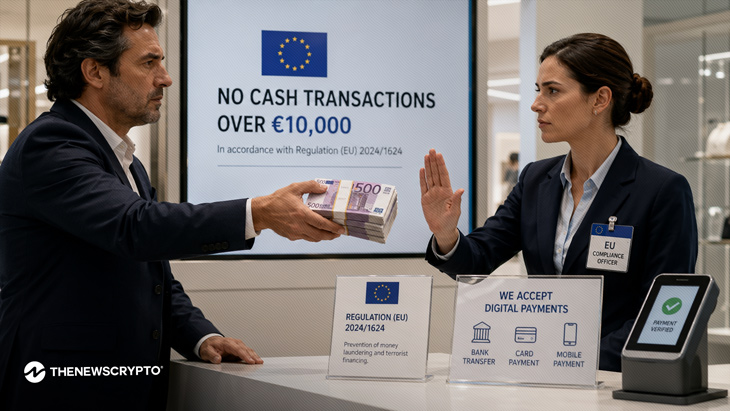
EU to Tighten Crypto KYC Requirements and Enforce €10,000 Cash Limit From 2027

Best Mobile User Retention Tools in 2026



