"Dead code" refers to parts of a codebase that are written but never executed, called, imported, or otherwise needed during the normal operation of the application. Cleaning up unused code improves clarity, performance, and long-term maintainability."Dead code" refers to parts of a codebase that are written but never executed, called, imported, or otherwise needed during the normal operation of the application. Cleaning up unused code improves clarity, performance, and long-term maintainability.

Everything You Need to Know About Dead Code

What Is "Dead Code"?

Dead code refers to parts of a codebase that are written but never executed, called, imported, or otherwise needed during the normal operation of the application.

Over time, as features are added, changed, or removed, some code becomes obsolete but is accidentally left behind. This can lead to:

  • Increased bundle size
  • Slower build times
  • Harder maintenance and onboarding
  • Potential security risks

Cleaning up unused code improves clarity, performance, and long-term maintainability.

What Is Considered "Dead Code"?

Here are the common categories of unused code:

  1. Unused Variables

    Declared but never used in any operation.

  2. Unused Functions or Methods

    Defined but never called anywhere.

  3. Unused Imports

    Imported modules or packages that are never referenced.

  4. Unused Exports

    Functions or components exported from a module but not imported elsewhere.

  5. Unused Files

    Complete files (components, modules, etc.) that are never imported or required.

  6. Unused Dependencies

    Libraries listed in your package manager (e.g., package.json) that are not imported or used in the codebase.

Some exceptions:

  • Disabled Features

    Features that are temporarily disabled or taken out, but will be used in the future.

  • Helper functions

    Utility functions that help with common tasks can be reviewed regularly to check if it needs to be removed.

Tools for Scanning Dead Code

The following tools help detect and analyze unused code, imports, functions, variables, and dependencies. Choose tools based on your tech stack:

  • ts-prune
  • Detects unused exported functions, constants, and types in TypeScript projects.
  • On Maintenance (no further update)
  • depcheck
  • Checks for unused npm dependencies and missing ones.
  • knip.dev (We are using this!)
  • Knip finds and fixes unused dependencies, exports and files in your JavaScript and TypeScript projects. Less code and dependencies lead to improved performance, less maintenance and easier refactorings.

How to Scan and Remove Unused Code with knip

Follow these steps to identify and safely remove unused code from your project using knip:

  1. Install knip (if not already installed):
   yarn add -D knip    # or    npm install -D knip 
  1. Run the analysis:
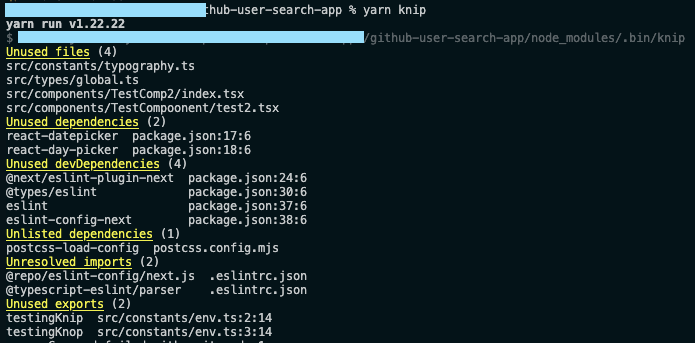
   yarn knip 

Note: Replace yarn with your preferred package manager (npm, pnpm, etc.).

\

  1. Review the list of unused files or exports:

  2. Go through the list from top-down, starting with high-level components, constants, and utilities.

  3. Search your codebase to verify whether each flagged file or export is truly unused.

    • If it's used elsewhere, skip it.
    • If it has no references, it’s safe to delete.

  4. Remove confirmed dead code

  5. Delete unused files, exports, or lines confidently after reviewing

    • Check with your teammates if the components/files is not used anymore or just temporarily not used

    • Validate your codebase:

    • Run linters and TypeScript checks to catch any issues:

        yarn lint   npx tsc --noEmit 
    • Start the development server to confirm everything still works:

        yarn dev 
    • Final step: Commit your changes with a clear message, e.g.:
   git commit -m "chore: remove unused code and dependencies" 

Getting rid of dead code might feel like a chore, but it’s totally worth it. Cleaner code means fewer headaches, faster builds, and easier debugging down the line. With the right tools and a step-by-step approach, it’s not that hard to keep your codebase in shape. If you’re working in a fast-paced company where keeping track of all the new code is challenging, making this part of your regular workflow is a must.

If you have any other better approach or just want to share your own process, feel free to share in the comment! I would love to hear your thought!

Disclaimer: The articles reposted on this site are sourced from public platforms and are provided for informational purposes only. They do not necessarily reflect the views of MEXC. All rights remain with the original authors. If you believe any content infringes on third-party rights, please contact [email protected] for removal. MEXC makes no guarantees regarding the accuracy, completeness, or timeliness of the content and is not responsible for any actions taken based on the information provided. The content does not constitute financial, legal, or other professional advice, nor should it be considered a recommendation or endorsement by MEXC.

You May Also Like

Why It Could Outperform Pepe Coin And Tron With Over $7m Already Raised

Why It Could Outperform Pepe Coin And Tron With Over $7m Already Raised

The post Why It Could Outperform Pepe Coin And Tron With Over $7m Already Raised appeared on BitcoinEthereumNews.com. Crypto News 17 September 2025 | 20:26 While meme tokens like Pepe Coin and established networks such as Tron attract headlines, many investors are now searching for projects that combine innovation, revenue-sharing and real-world utility. BlockchainFX ($BFX), currently in presale at $0.024 ahead of an expected $0.05 launch, is quickly becoming one of the best cryptos to buy today. With $7m already secured and a unique model spanning multiple asset classes, it is positioning itself as a decentralised super app and a contender to surpass older altcoins. Early Presale Pricing Creates A Rare Entry Point BlockchainFX’s presale pricing structure has been designed to reward early participants. At $0.024, buyers secure a lower entry price than later rounds, locking in a cost basis more than 50% below the projected $0.05 launch price. As sales continue to climb beyond $7m, each new stage automatically increases the token price. This built-in mechanism creates a clear advantage for early investors and explains why the project is increasingly cited in “best presales to buy now” discussions across the crypto space. High-Yield Staking Model Shares Platform Revenue Beyond its presale appeal, BlockchainFX is creating a high-yield staking model that gives holders a direct share of platform revenue. Every time a trade occurs on its platform, 70% of trading fees flow back into the $BFX ecosystem: 50% of collected fees are automatically distributed to stakers in both BFX and USDT. 20% is allocated to daily buybacks of $BFX, adding demand and price support. Half of the bought-back tokens are permanently burned, steadily reducing supply. Rewards are based on the size of each member’s BFX holdings and capped at $25,000 USDT per day to ensure sustainability. This structure transforms token ownership from a speculative bet into an income-generating position, a rare feature among today’s altcoins. A Multi-Asset Platform…
Share
BitcoinEthereumNews2025/09/18 03:35
The Contrarian Truth: Why Bitcoin and Ethereum Prices Defy Social Media Sentiment

The Contrarian Truth: Why Bitcoin and Ethereum Prices Defy Social Media Sentiment

BitcoinWorld The Contrarian Truth: Why Bitcoin and Ethereum Prices Defy Social Media Sentiment Have you ever noticed that when everyone on social media is screaming
Share
bitcoinworld2025/12/20 07:45
Record instroom Bitcoin-ETF’s – richting $120.000?

Record instroom Bitcoin-ETF’s – richting $120.000?

Connect met Like-minded Crypto Enthusiasts! Connect op Discord! Check onze Discord   De markt voor Bitcoin ETF’s laat wederom een opvallende trend zien. De afgelopen week werd de grootste instroom sinds juli geregistreerd, een ontwikkeling die de aandacht van zowel institutionele als particuliere beleggers trekt. Deze instroom zorgt voor nieuwe speculatie over de vraag of Bitcoin binnenkort de grens van 120.000 dollar kan doorbreken. Laten we dit hieronder nader bekijken. Grootste instroom sinds juli Volgens recente marktgegevens wist de Amerikaanse spot Bitcoin ETF’s een instroom te krijgen ver boven de gemiddelde niveaus van de afgelopen weken. Alleen al op 16 september werd meer dan 290 miljoen dollar netto in deze fondsen gestort. Daarmee markeert dit de zevende opeenvolgende dag met positieve instroom, een duidelijk teken dat institutionele belangstelling opnieuw toeneemt. De grootste bijdrage kwam van BlackRock’s iShares Bitcoin Trust, dat meer dan 200 miljoen dollar stortte. Ook de ETF’s van Fidelity en Ark lieten grote instroom zien. Kortom, de instroom blijft positief. U.S. spot Bitcoin ETFs Ignite with a $553M daily inflow, pushing a four-day streak to $1.7B. Ether ETFs also saw a resurgence with $113M in new funds. #Bitcoin #ETF #ETHhttps://t.co/zZiNqtKSEm — Cryptonews.com (@cryptonews) September 12, 2025 Hoe instroom prijsondersteuning biedt De sterke instroom in Bitcoin ETF’s is meer dan een mijlpaal. Het laat zien hoe de vraag naar Bitcoin groeit vanuit institutionele hoek en dat deze vraag niet voor een keer is, maar structureel is. Omdat de instroom de hoeveelheid nieuw geminde Bitcoin overtreft, ontstaat er een overschot qua vraag dat de prijs positief kan beïnvloeden. Dit verschil tussen aanbod en vraag zorgt ervoor dat het dalende risico wordt beperkt. Wanneer institutionele beleggers via ETF’s posities opbouwen, gebeurt dit bovendien vaak met een langere beleggingshorizon. Dat geeft de markt extra stabiliteit, zeker in een periode waarin onzekerheden rondom rente en macro-economie nog altijd spelen. Signaalfunctie voor beleggers Voor beleggers in de crypto markt hebben deze cijfers een signaalfunctie. Het vertrouwen dat grote institutionele spelers door miljarden te alloceren in gereguleerde beleggingsproducten bevestigt dat Bitcoin steeds meer gekocht wordt in de traditionele financiële wereld. Dit momentum werkt vaak door naar de bredere markt, omdat particuliere beleggers dit zien als bevestiging dat de trend omhoog sterker wordt. Ook technische analyse wijst op een belangrijke fase. De koers van Bitcoin beweegt rond de 118.000 dollar, een weerstandsniveau dat al meerdere keren is getest. Het momentum dat voortkomt uit de ETF instroom kan de kracht geven om dit niveau te doorbreken en een nieuwe fase van prijsstijging richting 120.000 dollar in te luiden. Op korte termijn richting de $120.000? Hoewel niemand met zekerheid kan voorspellen of Bitcoin dit niveau direct zal bereiken, biedt de huidige context sterke aanwijzingen dat de kans aanwezig is. De combinatie van record instroom, institutioneel vertrouwen en een gunstig technisch analyse vormt een krachtige mix. Beleggers doen er goed aan om rekening te houden met de invloed van externe factoren zoals beleidsbesluiten van de Federal Reserve. Best wallet - betrouwbare en anonieme wallet Best wallet - betrouwbare en anonieme wallet Meer dan 60 chains beschikbaar voor alle crypto Vroege toegang tot nieuwe projecten Hoge staking belongingen Lage transactiekosten Best wallet review Koop nu via Best Wallet Let op: cryptocurrency is een zeer volatiele en ongereguleerde investering. Doe je eigen onderzoek.   Het bericht Record instroom Bitcoin-ETF’s – richting $120.000? is geschreven door Timo Bruinsel en verscheen als eerst op Bitcoinmagazine.nl.
Share
Coinstats2025/09/18 01:31