A fresh round of XRP speculation is building around an old question: what happens if SWIFT’s modernization push ends up intersecting with infrastructure built forA fresh round of XRP speculation is building around an old question: what happens if SWIFT’s modernization push ends up intersecting with infrastructure built for

SWIFT, ISO 20022, And XRP: Is The Market Missing A Price Catalyst?

2026/03/13 09:00
4 min read
For feedback or concerns regarding this content, please contact us at [email protected]

A fresh round of XRP speculation is building around an old question: what happens if SWIFT’s modernization push ends up intersecting with infrastructure built for blockchain-based settlement? In a post on X on March 10, DropCoin developer Bird argued that the market may be underestimating how ISO 20022, tokenization, and shared-ledger infrastructure could eventually strengthen the case for the XRP Ledger in institutional finance.

Bird’s core point is not that SWIFT is about to replace its own network with XRP or the XRP Ledger. It is that the direction of travel across global payments increasingly points toward a split between messaging and settlement, with SWIFT preserving its role as the coordination layer while value moves across newer rails.

“My thoughts on SWIFT potentially utilising the XRP Ledger don’t come from random speculation,” Bird wrote. “They come from watching how the infrastructure around global payments has been evolving over the last several years. First, SWIFT themselves have repeatedly demonstrated and showcased blockchain partners involved in their experiments around cross border payments, tokenisation and interoperability.”

Could SWIFT’s Strategy Be Bullish For XRP Price?

That framing matters because Bird is not building the argument around a single rumor or one-off partnership. Instead, he points to overlap between firms appearing in SWIFT-related blockchain experiments and companies that already have ties to Ripple or infrastructure connected to the XRP Ledger. In his view, that overlap is not proof of future integration, but it is enough to keep the possibility on the table.

The second pillar of the argument is SWIFT’s ISO 20022 transition, which Bird describes as the largest upgrade in the network’s history. His reading is that modernized messaging standards are arriving just as finance moves toward tokenized assets, instant settlement, and interoperable liquidity networks. In that environment, the market may be too focused on whether SWIFT will “use XRP” directly, and not focused enough on the possibility that blockchain-based settlement layers could sit alongside SWIFT’s messaging stack.

Bird put it more bluntly in a longer passage: “SWIFT could continue acting as the secure messaging layer, while financial institutions settle value using tokenised assets on networks such as the XRP Ledger. In that model, XRP can function as a neutral bridge asset for liquidity and settlement, while SWIFT continues orchestrating the communication between banks through ISO 20022 messaging. In other words, messaging and settlement don’t have to live in the same system.”

That hybrid model is the heart of the thesis. Rather than a winner-takes-all contest between legacy finance and crypto rails, Bird sees a more incremental institutional architecture taking shape, one in which large incumbents adapt to avoid disintermediation. He argues that SWIFT has a strong incentive to do exactly that, since its historical dominance came from controlling the messaging layer while the economics of settlement are now being challenged by faster and more flexible systems.

He also points to what he views as the clearest signal in the debate: SWIFT’s recent confirmation that it is adding a blockchain-based shared ledger to its infrastructure stack to support the onchain movement of regulated tokenized value across its network of more than 11,500 financial institutions. For Bird, that does not confirm XRP’s role, but it does confirm the broader direction.

“SWIFT is clearly preparing for a world where tokenised assets move across blockchain infrastructure, while they continue operating as the global coordination and messaging layer,” he wrote. “In that kind of architecture, messaging and settlement become two separate layers of the financial system. Which means settlement could occur on specialised blockchain networks designed for liquidity and asset movement, while SWIFT continues coordinating communication between institutions.”

Bird is careful to stress that he has no insider knowledge and no visibility into the final architecture. That caveat is doing real work here. His post is not evidence of an imminent SWIFT-XRP integration. It is an argument that the industry’s incentives, the technical direction of payment infrastructure, and SWIFT’s own public moves all make the idea less far-fetched than the market may assume, in his opinion.

At press time, XRP traded at $1.3896.
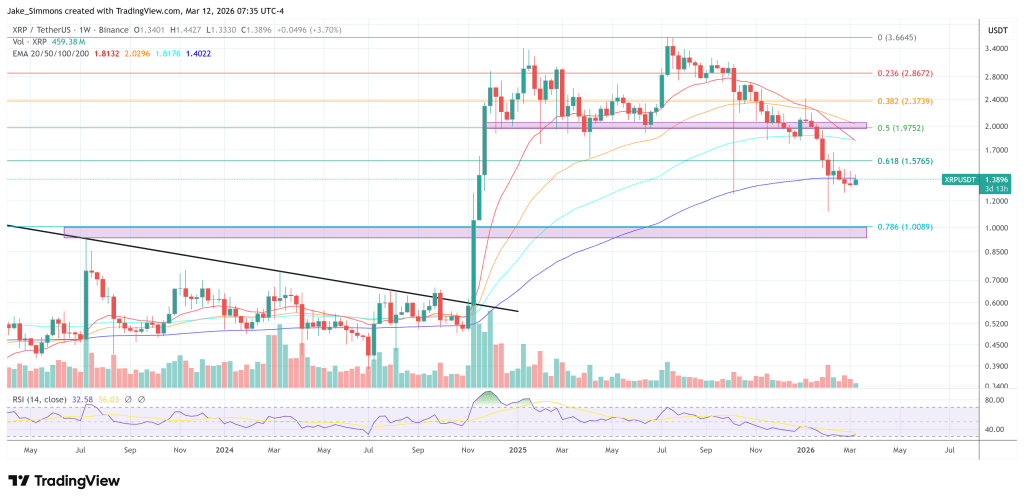
XRP price chart
Market Opportunity
XRP Logo
XRP Price(XRP)
$1.4151
$1.4151$1.4151
+2.57%
USD
XRP (XRP) Live Price Chart
Disclaimer: The articles reposted on this site are sourced from public platforms and are provided for informational purposes only. They do not necessarily reflect the views of MEXC. All rights remain with the original authors. If you believe any content infringes on third-party rights, please contact [email protected] for removal. MEXC makes no guarantees regarding the accuracy, completeness, or timeliness of the content and is not responsible for any actions taken based on the information provided. The content does not constitute financial, legal, or other professional advice, nor should it be considered a recommendation or endorsement by MEXC.

You May Also Like

TradFi Titan BlackRock Debuts Staked Ethereum ETF, Letting Investors Earn Yield Alongside ETH Exposure ⋆ ZyCrypto

TradFi Titan BlackRock Debuts Staked Ethereum ETF, Letting Investors Earn Yield Alongside ETH Exposure ⋆ ZyCrypto

The post TradFi Titan BlackRock Debuts Staked Ethereum ETF, Letting Investors Earn Yield Alongside ETH Exposure ⋆ ZyCrypto appeared on BitcoinEthereumNews.com.
Share
BitcoinEthereumNews2026/03/13 12:15
UK crypto holders brace for FCA’s expanded regulatory reach

UK crypto holders brace for FCA’s expanded regulatory reach

The post UK crypto holders brace for FCA’s expanded regulatory reach appeared on BitcoinEthereumNews.com. British crypto holders may soon face a very different landscape as the Financial Conduct Authority (FCA) moves to expand its regulatory reach in the industry. A new consultation paper outlines how the watchdog intends to apply its rulebook to crypto firms, shaping everything from asset safeguarding to trading platform operation. According to the financial regulator, these proposals would translate into clearer protections for retail investors and stricter oversight of crypto firms. UK FCA plans Until now, UK crypto users mostly encountered the FCA through rules on promotions and anti-money laundering checks. The consultation paper goes much further. It proposes direct oversight of stablecoin issuers, custodians, and crypto-asset trading platforms (CATPs). For investors, that means the wallets, exchanges, and coins they rely on could soon be subject to the same governance and resilience standards as traditional financial institutions. The regulator has also clarified that firms need official authorization before serving customers. This condition should, in theory, reduce the risk of sudden platform failures or unclear accountability. David Geale, the FCA’s executive director of payments and digital finance, said the proposals are designed to strike a balance between innovation and protection. He explained: “We want to develop a sustainable and competitive crypto sector – balancing innovation, market integrity and trust.” Geale noted that while the rules will not eliminate investment risks, they will create consistent standards, helping consumers understand what to expect from registered firms. Why does this matter for crypto holders? The UK regulatory framework shift would provide safer custody of assets, better disclosure of risks, and clearer recourse if something goes wrong. However, the regulator was also frank in its submission, arguing that no rulebook can eliminate the volatility or inherent risks of holding digital assets. Instead, the focus is on ensuring that when consumers choose to invest, they do…
Share
BitcoinEthereumNews2025/09/17 23:52
Edges higher ahead of BoC-Fed policy outcome

Edges higher ahead of BoC-Fed policy outcome

The post Edges higher ahead of BoC-Fed policy outcome appeared on BitcoinEthereumNews.com. USD/CAD gains marginally to near 1.3760 ahead of monetary policy announcements by the Fed and the BoC. Both the Fed and the BoC are expected to lower interest rates. USD/CAD forms a Head and Shoulder chart pattern. The USD/CAD pair ticks up to near 1.3760 during the late European session on Wednesday. The Loonie pair gains marginally ahead of monetary policy outcomes by the Bank of Canada (BoC) and the Federal Reserve (Fed) during New York trading hours. Both the BoC and the Fed are expected to cut interest rates amid mounting labor market conditions in their respective economies. Inflationary pressures in the Canadian economy have cooled down, emerging as another reason behind the BoC’s dovish expectations. However, the Fed is expected to start the monetary-easing campaign despite the United States (US) inflation remaining higher. Investors will closely monitor press conferences from both Fed Chair Jerome Powell and BoC Governor Tiff Macklem to get cues about whether there will be more interest rate cuts in the remainder of the year. According to analysts from Barclays, the Fed’s latest median projections for interest rates are likely to call for three interest rate cuts by 2025. Ahead of the Fed’s monetary policy, the US Dollar Index (DXY), which tracks the Greenback’s value against six major currencies, holds onto Tuesday’s losses near 96.60. USD/CAD forms a Head and Shoulder chart pattern, which indicates a bearish reversal. The neckline of the above-mentioned chart pattern is plotted near 1.3715. The near-term trend of the pair remains bearish as it stays below the 20-day Exponential Moving Average (EMA), which trades around 1.3800. The 14-day Relative Strength Index (RSI) slides to near 40.00. A fresh bearish momentum would emerge if the RSI falls below that level. Going forward, the asset could slide towards the round level of…
Share
BitcoinEthereumNews2025/09/18 01:23