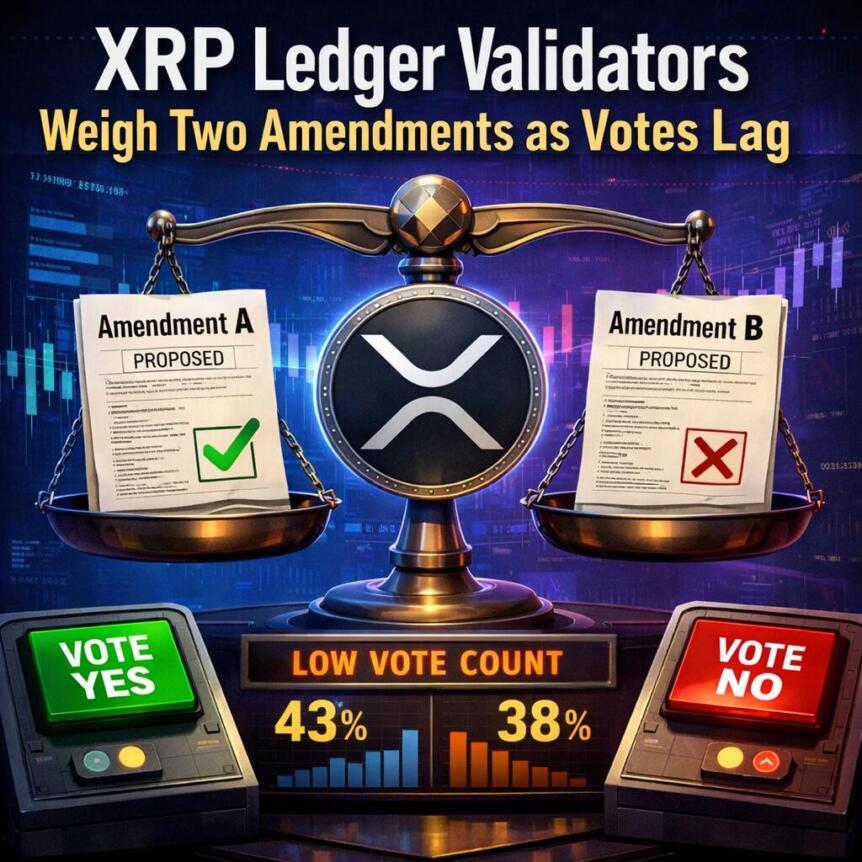
Two amendments for the XRP Ledger are up for validator votes, aiming to expand lending functions and vault infrastructure, but participation remains limited andTwo amendments for the XRP Ledger are up for validator votes, aiming to expand lending functions and vault infrastructure, but participation remains limited and

XRP Ledger Validators Weigh Two Amendments as Votes Lag
For feedback or concerns regarding this content, please contact us at [email protected]
Cb 458554 Xrp Ledger Validators Weigh Two Amendments As Votes Lag

The XRP Ledger is reviewing two proposed amendments that could expand lending functions and strengthen vault infrastructure. Validators have begun voting, yet early participation remains limited. Current results suggest the proposals still face significant hurdles before reaching activation requirements.

Data from XRPScan shows that validators have submitted only a small portion of the required votes. The network requires a strong consensus before any protocol change becomes active. Consequently, both amendments remain far from the necessary approval threshold.

The proposed changes target deeper financial functionality across the XRP ecosystem. Developers designed them to enhance lending capabilities and asset management tools. However, the current voting pace indicates that activation may take longer than expected.

SingleAssetVault Amendment

Validators are currently assessing the v3.1.0 SingleAssetVault amendment across the network. The proposal introduces vault mechanisms designed for single asset management within decentralized environments. As a result, developers expect stronger custody options for on-chain financial applications.

So far, only eight validators have recorded votes supporting the proposal. This number remains well below the required activation threshold. Therefore, the amendment currently shows limited progress toward implementation.

The XRP Ledger requires at least 28 validator approvals to activate protocol changes. This requirement represents roughly 80 percent of the network’s validator set. Without that support, the activation process automatically resets after the voting period ends.

Lending Protocol Amendment

Validators are also reviewing the v3.1.0 Lending Protocol amendment during the same voting cycle. This proposal introduces infrastructure for native lending services within the XRP Ledger ecosystem. Consequently, developers aim to expand decentralized finance capabilities directly on the network.

The amendment has gathered only six validator votes so far. That participation rate equals about 17% of the total validator pool. Therefore, the proposal remains far below the required approval threshold.

If voting participation does not accelerate, the activation timer will expire. When that happens, the amendment returns to a pending state. Validators may then reconsider the proposal during a future voting round.

Amendment Oversight and Security Context

Protocol amendments carry major consequences because they directly modify core blockchain functionality. Developers, therefore, apply strict governance rules before enabling any change. The XRP Ledger uses extended validator voting periods to confirm broad consensus.

A recent example demonstrated why careful review remains essential. Security researchers discovered a vulnerability in the proposed Batch amendment, known as XLS-56. That issue appeared during its voting phase and never reached activation.

The flaw could have allowed attackers to withdraw funds from user wallets. Notably, the exploit did not require access to private keys. Early detection prevented potential damage and reinforced the network’s review process.

Such events highlight the importance of gradual amendment adoption. Validators must carefully examine technical risks before approving protocol upgrades. Consequently, the slow progress of current proposals reflects the network’s cautious governance approach.

This article was originally published as XRP Ledger Validators Weigh Two Amendments as Votes Lag on Crypto Breaking News – your trusted source for crypto news, Bitcoin news, and blockchain updates.


Market Opportunity
XRP Logo
XRP Price(XRP)
$1.3997
$1.3997$1.3997
-0.65%
USD
XRP (XRP) Live Price Chart
Disclaimer: The articles reposted on this site are sourced from public platforms and are provided for informational purposes only. They do not necessarily reflect the views of MEXC. All rights remain with the original authors. If you believe any content infringes on third-party rights, please contact [email protected] for removal. MEXC makes no guarantees regarding the accuracy, completeness, or timeliness of the content and is not responsible for any actions taken based on the information provided. The content does not constitute financial, legal, or other professional advice, nor should it be considered a recommendation or endorsement by MEXC.

You May Also Like

The Channel Factories We’ve Been Waiting For

The Channel Factories We’ve Been Waiting For

The post The Channel Factories We’ve Been Waiting For appeared on BitcoinEthereumNews.com. Visions of future technology are often prescient about the broad strokes while flubbing the details. The tablets in “2001: A Space Odyssey” do indeed look like iPads, but you never see the astronauts paying for subscriptions or wasting hours on Candy Crush.  Channel factories are one vision that arose early in the history of the Lightning Network to address some challenges that Lightning has faced from the beginning. Despite having grown to become Bitcoin’s most successful layer-2 scaling solution, with instant and low-fee payments, Lightning’s scale is limited by its reliance on payment channels. Although Lightning shifts most transactions off-chain, each payment channel still requires an on-chain transaction to open and (usually) another to close. As adoption grows, pressure on the blockchain grows with it. The need for a more scalable approach to managing channels is clear. Channel factories were supposed to meet this need, but where are they? In 2025, subnetworks are emerging that revive the impetus of channel factories with some new details that vastly increase their potential. They are natively interoperable with Lightning and achieve greater scale by allowing a group of participants to open a shared multisig UTXO and create multiple bilateral channels, which reduces the number of on-chain transactions and improves capital efficiency. Achieving greater scale by reducing complexity, Ark and Spark perform the same function as traditional channel factories with new designs and additional capabilities based on shared UTXOs.  Channel Factories 101 Channel factories have been around since the inception of Lightning. A factory is a multiparty contract where multiple users (not just two, as in a Dryja-Poon channel) cooperatively lock funds in a single multisig UTXO. They can open, close and update channels off-chain without updating the blockchain for each operation. Only when participants leave or the factory dissolves is an on-chain transaction…
Share
BitcoinEthereumNews2025/09/18 00:09
U.S. inflation expectations diverge across March surveys

U.S. inflation expectations diverge across March surveys

The post U.S. inflation expectations diverge across March surveys appeared on BitcoinEthereumNews.com. No official source confirms 3.4% to 3.7% March shift Claims
Share
BitcoinEthereumNews2026/03/14 01:49
XRP Price Prediction Surges as Investment Products Climb 508% to $3.7 Billion in AUM Outpacing Bitcoin Ethereum and Solana While Pepeto Captures Every Institutional Dollar That XRP’s Dominance Attracts

XRP Price Prediction Surges as Investment Products Climb 508% to $3.7 Billion in AUM Outpacing Bitcoin Ethereum and Solana While Pepeto Captures Every Institutional Dollar That XRP’s Dominance Attracts

XRP investment products surged 508% in 2025 to $3.7 billion in assets under management. This outpaced inflows into Bitcoin, Ethereum, and Solana products during
Share
Techbullion2026/03/14 02:38