Polygon has restored full network stability after a software bug temporarily disrupted milestone finality and forced some nodes offline, according to an official incident report published on the project’s status page. The issue began early Wednesday when a bug affecting Bor, Polygon’s block producer, and Erigon, its data access layer, caused disruptions across parts of the ecosystem. While the blockchain itself continued to produce blocks, some Remote Procedure Call (RPC) services and validators halted, forcing providers to rewind to the last finalized block and resynchronize. Polygon Executes Emergency Hard Fork to Resolve Finality Bug Polygon engineers confirmed the bug was preventing node progress under certain configurations, though restarting affected nodes resolved the issue for several validators and RPC providers. At the time, Polygonscan, the network’s block explorer, showed no block updates for more than five hours. Polygon later explained that Polygonscan’s nodes had halted after a faulty milestone produced by Heimdall, the project’s consensus engine. A company representative said that the team was working with Polygonscan to switch to functioning nodes that had not halted, stressing that block production remained live. “Checkpoint finality is working as expected within 15 minutes,” the team said in an update at 08:52 UTC, sharing an alternative link where real-time block production could be tracked. Analysis revealed the problem stemmed from Heimdall’s finality gadget, which is responsible for producing milestones every few seconds. Although checkpoints to Ethereum were still being posted every 20 minutes, milestones, which provide faster, deterministic finality, were not being processed. This left local fast finality delayed even as the main chain continued adding blocks. To address the problem, Polygon rolled out emergency updates: Bor version 2.2.11-beta2 and Heimdall version 0.3.1, the latter requiring a hard fork. The upgrade, executed at 3 p.m. UTC, deleted the faulty milestone and purged it from node databases. Polygon confirmed soon after that the hard fork was successfully completed and that both milestones and checkpoints were once again finalizing normally.Source: Polygonscan “The hard fork has been successfully completed, and milestones are now processing normally along with state sync. Checkpoints are going through, and consensus finalization has been fully restored on Polygon PoS,” the team wrote in a statement on X. Polygon Foundation co-founder and CEO Sandeep Nailwal later explained that the disruption originated from a faulty milestone proposal that pushed some Bor nodes onto divergent forks. This triggered short-term instability not accounted for in the system. He emphasized that while checkpoint finality on Ethereum had remained active throughout, local milestone finality was delayed. “Milestones are a lightweight alternative to checkpoints, enabling faster, deterministic finality for transactions, even before a checkpoint is submitted to Ethereum,” Nailwal said. “The root cause came from a faulty milestone proposal. We rolled out fixes on both Heimdall and Bor. With these fixes now live, nodes are not stuck, and consensus is finalizing normally.” Nailwal described the event as part of the growing pains of scaling Polygon’s proof-of-stake chain but said each challenge strengthens its resilience. “There will be growing pains with any ambitious upgrade. But each one makes Polygon PoS stronger on our road to GigaGas throughput,” he said, adding that more upgrades are planned to boost capacity and reliability. Polygon engineers continue to monitor the network to ensure stability and are investigating how the faulty milestone was introduced. Despite the temporary setback, the network has resumed normal operations, with blocks, milestones, and checkpoints processing in real time Polygon’s Reliability Questioned After Finality Bug, TVL Down 87% From Peak Polygon developers have deployed a hard fork to fix a bug that temporarily halted block production on its proof-of-stake chain, restoring the network after several hours of disruption. The issue, tied to transaction finality, left exchanges and DeFi protocols unable to process deposits or withdrawals as they waited for confirmation guarantees. The outage drew criticism from Polymarket traders, who argued that a blockchain hosting one of the sector’s largest prediction markets should not face such problems. “It might have gone unnoticed because no one was using it, but this has been going on for about two hours,” one trader posted, pointing to the risk of reversals during the downtime. TokenPocket, a multichain stablecoin wallet, also paused Polygon transactions after observing that no new blocks had been finalized for over an hour. The incident comes just weeks after Polygon’s Heimdall v2 upgrade, designed to cut finality times to five seconds and improve validator coordination. That update followed the July 1 Bhilai hard fork, which raised throughput to 1,000 transactions per second and integrated Ethereum’s Pectra EIPs. Despite these efforts, network reliability remains a concern, as Polygon’s total value locked has dropped from a $9.43 billion peak in 2021 to $1.2 billion today, per DeFiLlama. The chain’s native token, POL, has fallen 3.4% on the day and is down 30% year-to-date, trading at $0.27. Meanwhile, another Ethereum Layer-2, Linea, faced a separate outage earlier today when its mainnet sequencer stalled, causing a 67-minute pause in block production. While Linea has already deployed a fix, developers are questioning whether the two disruptions are linked. Linea has not disclosed the cause of its downtime. Both events highlight the fragility of scaling networks that have become essential to Ethereum’s broader ecosystemPolygon has restored full network stability after a software bug temporarily disrupted milestone finality and forced some nodes offline, according to an official incident report published on the project’s status page. The issue began early Wednesday when a bug affecting Bor, Polygon’s block producer, and Erigon, its data access layer, caused disruptions across parts of the ecosystem. While the blockchain itself continued to produce blocks, some Remote Procedure Call (RPC) services and validators halted, forcing providers to rewind to the last finalized block and resynchronize. Polygon Executes Emergency Hard Fork to Resolve Finality Bug Polygon engineers confirmed the bug was preventing node progress under certain configurations, though restarting affected nodes resolved the issue for several validators and RPC providers. At the time, Polygonscan, the network’s block explorer, showed no block updates for more than five hours. Polygon later explained that Polygonscan’s nodes had halted after a faulty milestone produced by Heimdall, the project’s consensus engine. A company representative said that the team was working with Polygonscan to switch to functioning nodes that had not halted, stressing that block production remained live. “Checkpoint finality is working as expected within 15 minutes,” the team said in an update at 08:52 UTC, sharing an alternative link where real-time block production could be tracked. Analysis revealed the problem stemmed from Heimdall’s finality gadget, which is responsible for producing milestones every few seconds. Although checkpoints to Ethereum were still being posted every 20 minutes, milestones, which provide faster, deterministic finality, were not being processed. This left local fast finality delayed even as the main chain continued adding blocks. To address the problem, Polygon rolled out emergency updates: Bor version 2.2.11-beta2 and Heimdall version 0.3.1, the latter requiring a hard fork. The upgrade, executed at 3 p.m. UTC, deleted the faulty milestone and purged it from node databases. Polygon confirmed soon after that the hard fork was successfully completed and that both milestones and checkpoints were once again finalizing normally.Source: Polygonscan “The hard fork has been successfully completed, and milestones are now processing normally along with state sync. Checkpoints are going through, and consensus finalization has been fully restored on Polygon PoS,” the team wrote in a statement on X. Polygon Foundation co-founder and CEO Sandeep Nailwal later explained that the disruption originated from a faulty milestone proposal that pushed some Bor nodes onto divergent forks. This triggered short-term instability not accounted for in the system. He emphasized that while checkpoint finality on Ethereum had remained active throughout, local milestone finality was delayed. “Milestones are a lightweight alternative to checkpoints, enabling faster, deterministic finality for transactions, even before a checkpoint is submitted to Ethereum,” Nailwal said. “The root cause came from a faulty milestone proposal. We rolled out fixes on both Heimdall and Bor. With these fixes now live, nodes are not stuck, and consensus is finalizing normally.” Nailwal described the event as part of the growing pains of scaling Polygon’s proof-of-stake chain but said each challenge strengthens its resilience. “There will be growing pains with any ambitious upgrade. But each one makes Polygon PoS stronger on our road to GigaGas throughput,” he said, adding that more upgrades are planned to boost capacity and reliability. Polygon engineers continue to monitor the network to ensure stability and are investigating how the faulty milestone was introduced. Despite the temporary setback, the network has resumed normal operations, with blocks, milestones, and checkpoints processing in real time Polygon’s Reliability Questioned After Finality Bug, TVL Down 87% From Peak Polygon developers have deployed a hard fork to fix a bug that temporarily halted block production on its proof-of-stake chain, restoring the network after several hours of disruption. The issue, tied to transaction finality, left exchanges and DeFi protocols unable to process deposits or withdrawals as they waited for confirmation guarantees. The outage drew criticism from Polymarket traders, who argued that a blockchain hosting one of the sector’s largest prediction markets should not face such problems. “It might have gone unnoticed because no one was using it, but this has been going on for about two hours,” one trader posted, pointing to the risk of reversals during the downtime. TokenPocket, a multichain stablecoin wallet, also paused Polygon transactions after observing that no new blocks had been finalized for over an hour. The incident comes just weeks after Polygon’s Heimdall v2 upgrade, designed to cut finality times to five seconds and improve validator coordination. That update followed the July 1 Bhilai hard fork, which raised throughput to 1,000 transactions per second and integrated Ethereum’s Pectra EIPs. Despite these efforts, network reliability remains a concern, as Polygon’s total value locked has dropped from a $9.43 billion peak in 2021 to $1.2 billion today, per DeFiLlama. The chain’s native token, POL, has fallen 3.4% on the day and is down 30% year-to-date, trading at $0.27. Meanwhile, another Ethereum Layer-2, Linea, faced a separate outage earlier today when its mainnet sequencer stalled, causing a 67-minute pause in block production. While Linea has already deployed a fix, developers are questioning whether the two disruptions are linked. Linea has not disclosed the cause of its downtime. Both events highlight the fragility of scaling networks that have become essential to Ethereum’s broader ecosystem

Polygon Hard Fork Fixes Bug That Knocked Nodes Offline — Network Back Online

2025/09/11 07:59
5 min read

Polygon has restored full network stability after a software bug temporarily disrupted milestone finality and forced some nodes offline, according to an official incident report published on the project’s status page.

The issue began early Wednesday when a bug affecting Bor, Polygon’s block producer, and Erigon, its data access layer, caused disruptions across parts of the ecosystem.

While the blockchain itself continued to produce blocks, some Remote Procedure Call (RPC) services and validators halted, forcing providers to rewind to the last finalized block and resynchronize.

Polygon Executes Emergency Hard Fork to Resolve Finality Bug

Polygon engineers confirmed the bug was preventing node progress under certain configurations, though restarting affected nodes resolved the issue for several validators and RPC providers.

At the time, Polygonscan, the network’s block explorer, showed no block updates for more than five hours. Polygon later explained that Polygonscan’s nodes had halted after a faulty milestone produced by Heimdall, the project’s consensus engine.

A company representative said that the team was working with Polygonscan to switch to functioning nodes that had not halted, stressing that block production remained live.

“Checkpoint finality is working as expected within 15 minutes,” the team said in an update at 08:52 UTC, sharing an alternative link where real-time block production could be tracked.

Analysis revealed the problem stemmed from Heimdall’s finality gadget, which is responsible for producing milestones every few seconds.

Although checkpoints to Ethereum were still being posted every 20 minutes, milestones, which provide faster, deterministic finality, were not being processed. This left local fast finality delayed even as the main chain continued adding blocks.

To address the problem, Polygon rolled out emergency updates: Bor version 2.2.11-beta2 and Heimdall version 0.3.1, the latter requiring a hard fork. The upgrade, executed at 3 p.m. UTC, deleted the faulty milestone and purged it from node databases.

Polygon confirmed soon after that the hard fork was successfully completed and that both milestones and checkpoints were once again finalizing normally.
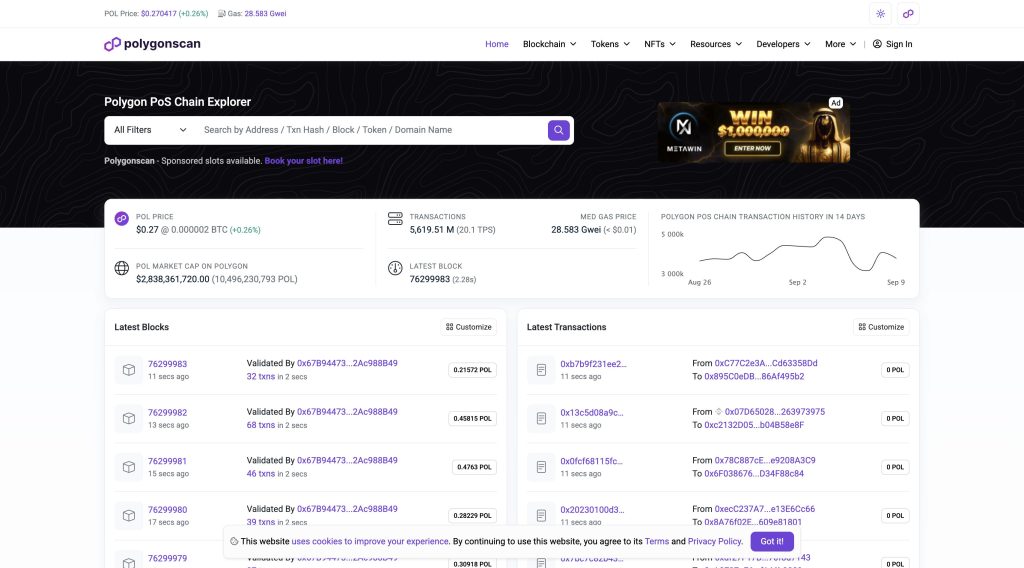
Source: Polygonscan

“The hard fork has been successfully completed, and milestones are now processing normally along with state sync. Checkpoints are going through, and consensus finalization has been fully restored on Polygon PoS,” the team wrote in a statement on X.

Polygon Foundation co-founder and CEO Sandeep Nailwal later explained that the disruption originated from a faulty milestone proposal that pushed some Bor nodes onto divergent forks. This triggered short-term instability not accounted for in the system.

He emphasized that while checkpoint finality on Ethereum had remained active throughout, local milestone finality was delayed.

“Milestones are a lightweight alternative to checkpoints, enabling faster, deterministic finality for transactions, even before a checkpoint is submitted to Ethereum,” Nailwal said. “The root cause came from a faulty milestone proposal. We rolled out fixes on both Heimdall and Bor.

With these fixes now live, nodes are not stuck, and consensus is finalizing normally.”

Nailwal described the event as part of the growing pains of scaling Polygon’s proof-of-stake chain but said each challenge strengthens its resilience. “There will be growing pains with any ambitious upgrade.

But each one makes Polygon PoS stronger on our road to GigaGas throughput,” he said, adding that more upgrades are planned to boost capacity and reliability.

Polygon engineers continue to monitor the network to ensure stability and are investigating how the faulty milestone was introduced.

Despite the temporary setback, the network has resumed normal operations, with blocks, milestones, and checkpoints processing in real time

Polygon’s Reliability Questioned After Finality Bug, TVL Down 87% From Peak

Polygon developers have deployed a hard fork to fix a bug that temporarily halted block production on its proof-of-stake chain, restoring the network after several hours of disruption.

The issue, tied to transaction finality, left exchanges and DeFi protocols unable to process deposits or withdrawals as they waited for confirmation guarantees.

The outage drew criticism from Polymarket traders, who argued that a blockchain hosting one of the sector’s largest prediction markets should not face such problems. “It might have gone unnoticed because no one was using it, but this has been going on for about two hours,” one trader posted, pointing to the risk of reversals during the downtime.

TokenPocket, a multichain stablecoin wallet, also paused Polygon transactions after observing that no new blocks had been finalized for over an hour.

The incident comes just weeks after Polygon’s Heimdall v2 upgrade, designed to cut finality times to five seconds and improve validator coordination.

That update followed the July 1 Bhilai hard fork, which raised throughput to 1,000 transactions per second and integrated Ethereum’s Pectra EIPs. Despite these efforts, network reliability remains a concern, as Polygon’s total value locked has dropped from a $9.43 billion peak in 2021 to $1.2 billion today, per DeFiLlama.

The chain’s native token, POL, has fallen 3.4% on the day and is down 30% year-to-date, trading at $0.27.

Meanwhile, another Ethereum Layer-2, Linea, faced a separate outage earlier today when its mainnet sequencer stalled, causing a 67-minute pause in block production.

While Linea has already deployed a fix, developers are questioning whether the two disruptions are linked. Linea has not disclosed the cause of its downtime.

Both events highlight the fragility of scaling networks that have become essential to Ethereum’s broader ecosystem.

Disclaimer: The articles reposted on this site are sourced from public platforms and are provided for informational purposes only. They do not necessarily reflect the views of MEXC. All rights remain with the original authors. If you believe any content infringes on third-party rights, please contact [email protected] for removal. MEXC makes no guarantees regarding the accuracy, completeness, or timeliness of the content and is not responsible for any actions taken based on the information provided. The content does not constitute financial, legal, or other professional advice, nor should it be considered a recommendation or endorsement by MEXC.
Tags:

You May Also Like

X encrypted promotions face FCA, DSA limits

X encrypted promotions face FCA, DSA limits

The post X encrypted promotions face FCA, DSA limits appeared on BitcoinEthereumNews.com. X (formerly Twitter) has reportedly lifted its ban on X encrypted promotions
Share
BitcoinEthereumNews2026/03/02 11:28
IP Hits $11.75, HYPE Climbs to $55, BlockDAG Surpasses Both with $407M Presale Surge!

IP Hits $11.75, HYPE Climbs to $55, BlockDAG Surpasses Both with $407M Presale Surge!

The post IP Hits $11.75, HYPE Climbs to $55, BlockDAG Surpasses Both with $407M Presale Surge! appeared on BitcoinEthereumNews.com. Crypto News 17 September 2025 | 18:00 Discover why BlockDAG’s upcoming Awakening Testnet launch makes it the best crypto to buy today as Story (IP) price jumps to $11.75 and Hyperliquid hits new highs. Recent crypto market numbers show strength but also some limits. The Story (IP) price jump has been sharp, fueled by big buybacks and speculation, yet critics point out that revenue still lags far behind its valuation. The Hyperliquid (HYPE) price looks solid around the mid-$50s after a new all-time high, but questions remain about sustainability once the hype around USDH proposals cools down. So the obvious question is: why chase coins that are either stretched thin or at risk of retracing when you could back a network that’s already proving itself on the ground? That’s where BlockDAG comes in. While other chains are stuck dealing with validator congestion or outages, BlockDAG’s upcoming Awakening Testnet will be stress-testing its EVM-compatible smart chain with real miners before listing. For anyone looking for the best crypto coin to buy, the choice between waiting on fixes or joining live progress feels like an easy one. BlockDAG: Smart Chain Running Before Launch Ethereum continues to wrestle with gas congestion, and Solana is still known for network freezes, yet BlockDAG is already showing a different picture. Its upcoming Awakening Testnet, set to launch on September 25, isn’t just a demo; it’s a live rollout where the chain’s base protocols are being stress-tested with miners connected globally. EVM compatibility is active, account abstraction is built in, and tools like updated vesting contracts and Stratum integration are already functional. Instead of waiting for fixes like other networks, BlockDAG is proving its infrastructure in real time. What makes this even more important is that the technology is operational before the coin even hits exchanges. That…
Share
BitcoinEthereumNews2025/09/18 00:32
Sonangol at 50 Prepares Landmark 30% Stock Market Listing

Sonangol at 50 Prepares Landmark 30% Stock Market Listing

Angola’s state oil company Sonangol is marking its 50th anniversary at a moment of strategic transition. Founded in 1976, Sonangol has long stood at the centre
Share
Furtherafrica2026/03/02 11:00