

War in the Middle East: Stock Market Bleeds $2.4 Trillion While Crypto Gains Ground
The geopolitical landscape shifted violently two weeks ago with the outbreak of a military conflict between the US and Iran. While traditional markets are reeling from the shock, the digital asset class is showing unexpected resilience. Since the start of hostilities, an estimated $2.4 trillion has been erased from the US stock market as investors flee from risk-heavy equities.
In a striking divergence, the crypto market cap has added nearly $250 billion during the same period. This decoupling suggests a shift in how institutional and retail investors perceive "digital gold" during times of extreme kinetic warfare. As oil prices surge and the Strait of Hormuz faces potential blockades, the 24/7 liquidity of $Bitcoin and other major assets is becoming a strategic refuge.
Is Crypto the New Safe Haven?
For years, analysts debated whether crypto would act as a "risk-on" asset or a "safe haven." The current conflict provides a real-time case study. While the S&P 500 and Nasdaq have suffered their worst two-week stretch since the 2025 tariff crisis, the crypto market has reclaimed significant ground.
- US Equities: $2.4 trillion in value wiped out (approx. -5.2% decline).
- Crypto Market: ~$250 billion added (over +5% increase).
Investors are navigating a world where traditional banking systems in conflict zones face outages, making borderless assets like $Ethereum and stablecoins more attractive for capital preservation and mobility.
Total Crypto Market Cap Analysis: The 5% Rebound
A closer look at the Total Crypto Market Cap (TOTAL) chart reveals a V-shaped recovery following the initial "panic sell" at the war's onset. After a brief dip to the $2.3 trillion level on February 28, the market surged back.
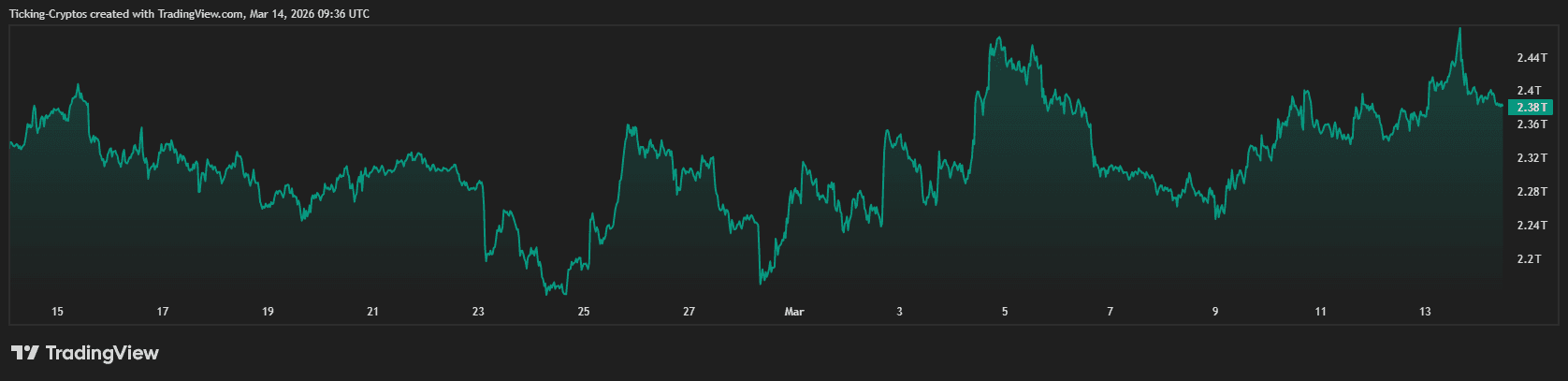 Total crypto market cap in USD
- Initial Shock: The first 48 hours saw massive liquidations as traders de-risked.
- The Rebound: As of March 14, 2026, the total market cap sits near $2.41 trillion, representing a recovery of over 5% from the local lows.
- Volume Spike: Trading volume has normalized at higher levels, indicating that the move is supported by actual accumulation rather than just a "dead cat bounce."
The Fear and Greed Index has moved from "Extreme Fear" (8/100) earlier this month toward a more neutral stance (29/100), as the market prices in a "war premium" and the potential for the Federal Reserve to pause rate hikes to maintain economic stability.
Why Stocks are Crashing While Crypto Rallies
The divergence comes down to inflationary fears and liquidity. The US-Iran war has pushed Brent crude oil prices toward $120 per barrel. In the stock market, high energy costs mean lower corporate margins and higher consumer prices, leading to a massive sell-off.
Conversely, the "debasement narrative" helps crypto. If the US government increases spending to fund military operations, the long-term outlook for the dollar weakens. Investors are preemptively moving into Bitcoin to hedge against this potential currency devaluation. Furthermore, according to reports from Morningstar, regional demand in the Middle East for non-sovereign assets has spiked as a means to move wealth across borders.


You May Also Like

‘Good luck’: Khaled responds to former Umno figures joining PAS

Bomba tangkap buaya dalam longkang di Banting

UK still discussing how much to spend on defence



