This section explores translation invariant problems as a key domain for SPIM (Statistical Physics Inspired Models) applications. Using the correlation function method, SPIMs can encode cyclic coupling matrices relevant to “realistic” spin glasses on hypercubic lattices. The Möbius ladder graph, a circulant structure, exemplifies how SPIM hardware implements such problems, modeling Ising spins with complex frustrations. Together, these insights highlight how SPIMs bridge physics, graph theory, and optimization challenges.This section explores translation invariant problems as a key domain for SPIM (Statistical Physics Inspired Models) applications. Using the correlation function method, SPIMs can encode cyclic coupling matrices relevant to “realistic” spin glasses on hypercubic lattices. The Möbius ladder graph, a circulant structure, exemplifies how SPIM hardware implements such problems, modeling Ising spins with complex frustrations. Together, these insights highlight how SPIMs bridge physics, graph theory, and optimization challenges.

How SPIMs Tackle “Realistic” Spin Glass and Möbius Ladder Graphs

I. Introduction

II. Spim Performance, Advantages and Generality

III. Inherently Low Rank Problems

A. Properties of Low Rank Graphs

B. Weakly NP-Complete Problems and Hardware Precision Limitation

C. Limitation of Low Rank Matrix Mapping

IV. Low Rank Approximation

A. Decomposition of Target Coupling Matrix

B. How Fields Influence Ran

C. Low Rank Approximation of Coupling Matrices

D. Low-Rank Approximation of Random Coupling Matrices

E. Low Rank Approximation for Portfolio Optimization

F. Low-Rank Matrices in Restricted Boltzmann Machines

V. Constrained Number Partitioning Problem

A. Definition and Characteristics of the Constrained Number Partitioning Problem

B. Computational Hardness of Random CNP Instances

VI. Translation Invariant Problems

A. “Realistic” Spin Glass

B. Circulant Graphs

VII. Conclusions, Acknowledgements, and References

VI. TRANSLATION INVARIANT PROBLEMS

Beyond low-rank and constrained problems, translation invariant problems offer another interesting domain for SPIM applications. This section investigates how these problems can be effectively represented and solved using SPIMs.

A. “Realistic” Spin Glass

The correlation function method enables SPIM to encode translation invariant (or cyclic) coupling matrices. This type is important, and the hard problem is “realistic” spin glasses that live on an almost hypercubic lattice in d dimensions [62, 63]. The modified Mattis-type matrix encoding these problems is of the form given by Eq. (3), where

\
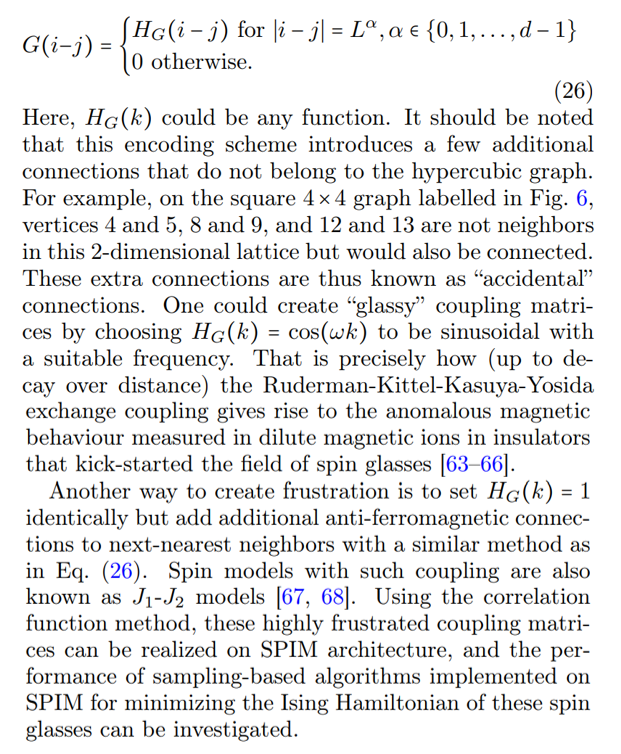
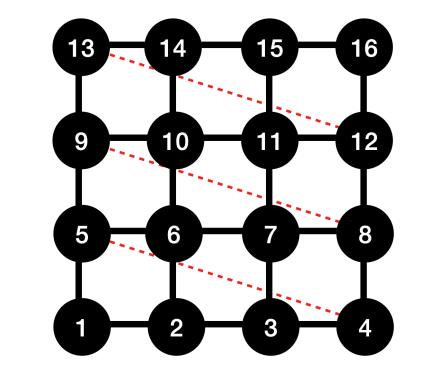
\ Figure 6. Connections on the 4 × 4 square lattice created by the correlation function method with G(i − j) as in Eq. (26). Intended connections are shown as black solid lines, while accidental connections are shown as red dashed lines.
\

B. Circulant Graphs

\

\ \ \

\ \ \
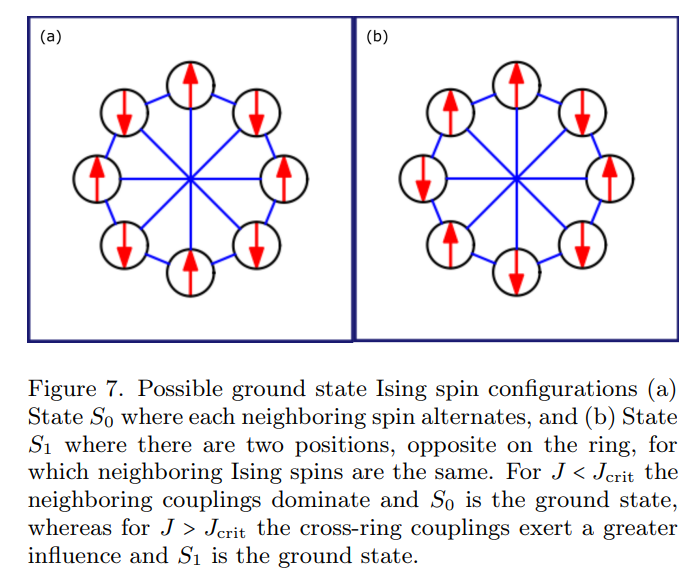
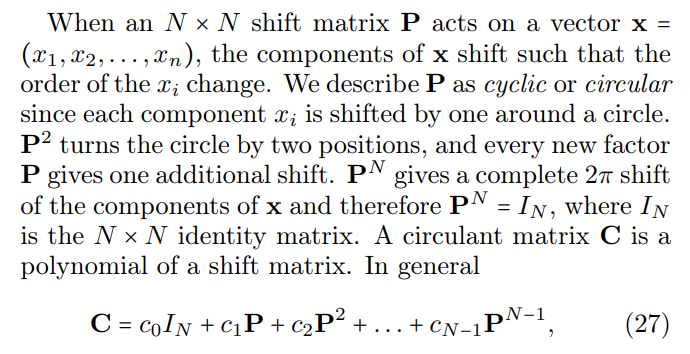
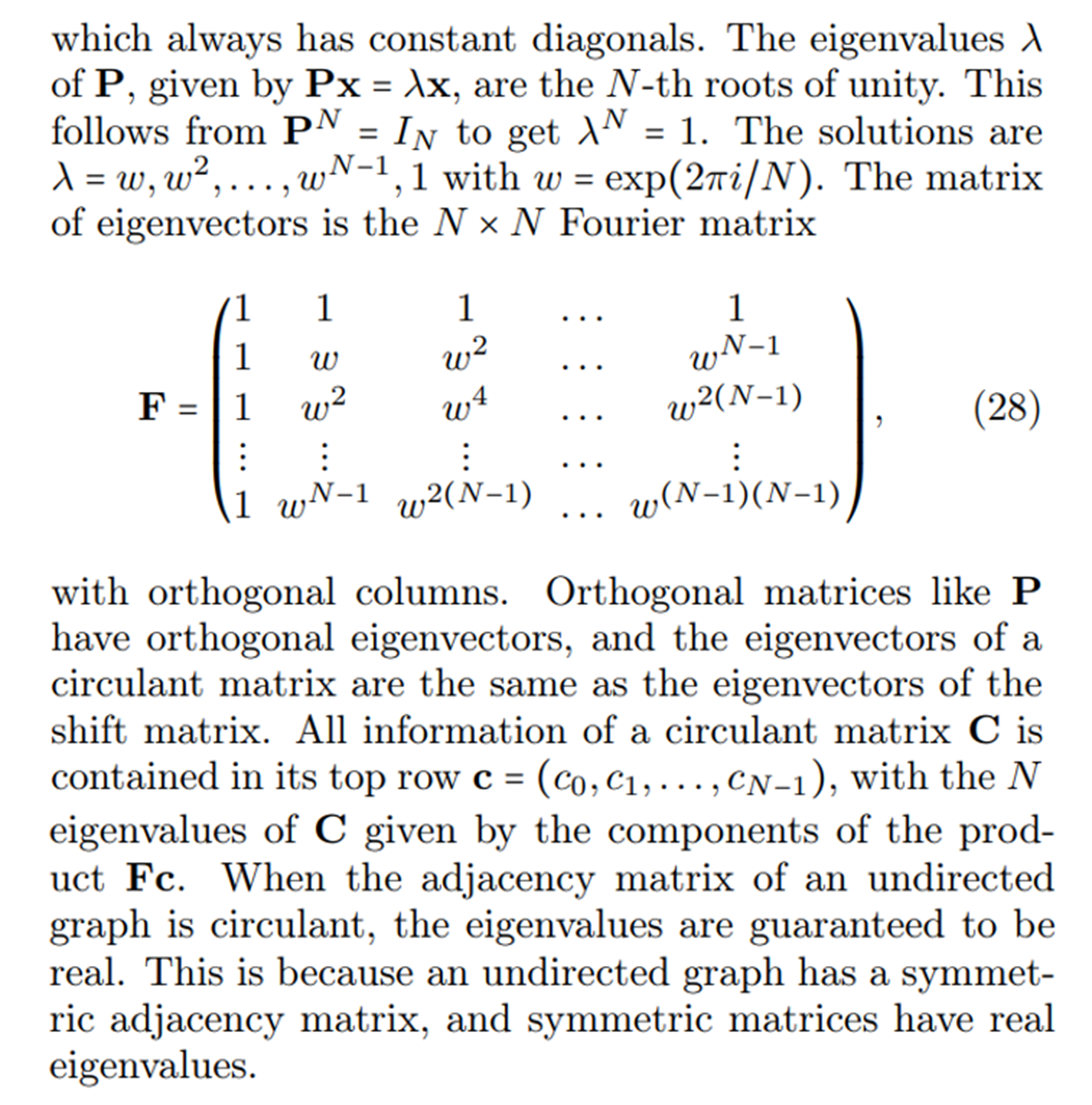
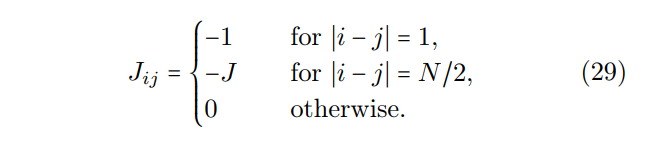
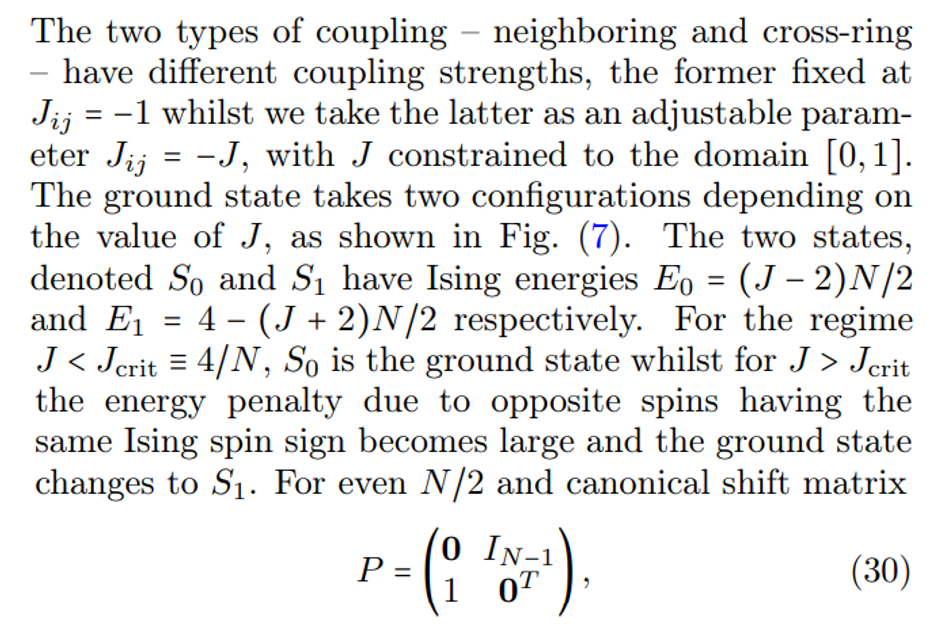
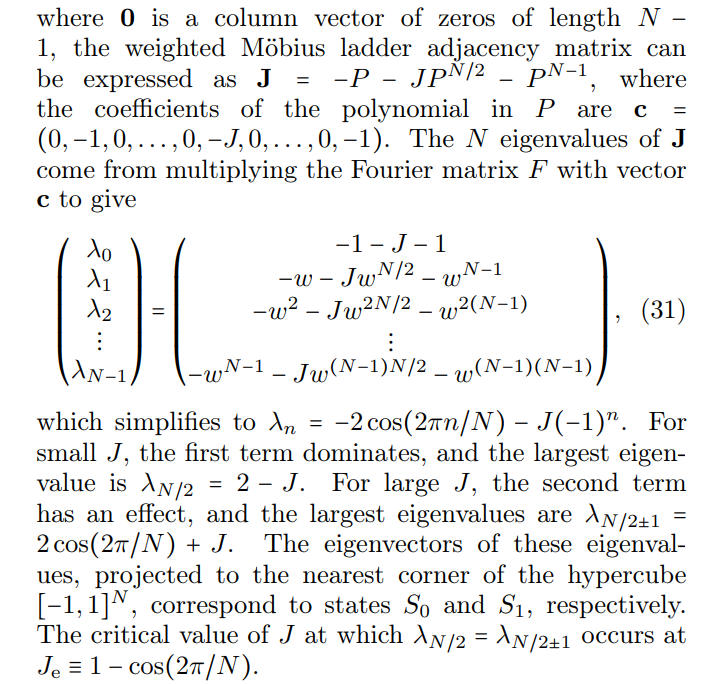
\ \ An example of a graph structure with a circulant adjacency matrix is a Möbius ladder graph. This 3-regular graph with even number of vertices N is invariant to cyclic permutations and can be implemented on SPIM hardware with each vertex of the Möbius ladder graph representing an Ising spin. The Ising spins are coupled antiferromagnetically according to the 3N/2 edges of the Möbius ladder graph. Each vertex is connected to two neighboring vertices arranged in a ring, and a cross-ring connection to the vertex that is diametrically opposite, as illustrated in Fig. (7). When N/2 is even, and for large cross-ring coupling, no configuration exists where all coupled Ising spins have opposite signs, and thus, frustrations must arise. The Ising Hamiltonian we seek to minimize is given by Eq. (1) with no external magnetic field and a coupling matrix J given by the Möbius ladder weighted adjacency matrix. The correlation function method can encode the weights of any circulant graph, which for Möbius ladders is given by

\ \
\ \ \
\ \ \
\ \ \
\ \ \

:::info Authors:

(1) Richard Zhipeng Wang, Department of Applied Mathematics and Theoretical Physics, University of Cambridge, Wilberforce Road, Cambridge CB3 0WA, United Kingdom;

(2) James S. Cummins, Department of Applied Mathematics and Theoretical Physics, University of Cambridge, Wilberforce Road, Cambridge CB3 0WA, United Kingdom;

(3) Marvin Syed, Department of Applied Mathematics and Theoretical Physics, University of Cambridge, Wilberforce Road, Cambridge CB3 0WA, United Kingdom;

(4) Nikita Stroev, Department of Physics of Complex Systems, Weizmann Institute of Science, Rehovot 76100, Israel;

(5) George Pastras, QUBITECH, Thessalias 8, Chalandri, GR 15231 Athens, Greece;

(6) Jason Sakellariou, QUBITECH, Thessalias 8, Chalandri, GR 15231 Athens, Greece;

(7) Symeon Tsintzos, QUBITECH, Thessalias 8, Chalandri, GR 15231 Athens, Greece and UBITECH ltd, 95B Archiepiskopou Makariou, CY 3020 Limassol, Cyprus;

(8) Alexis Askitopoulos, QUBITECH, Thessalias 8, Chalandri, GR 15231 Athens, Greece and UBITECH ltd, 95B Archiepiskopou Makariou, CY 3020 Limassol, Cyprus;

(9) Daniele Veraldi, Department of Physics, University Sapienza, Piazzale Aldo Moro 5, Rome 00185, Italy;

(10) Marcello Calvanese Strinati, Research Center Enrico Fermi, Via Panisperna 89A, 00185 Rome, Italy;

(11) Silvia Gentilini, Institute for Complex Systems, National Research Council (ISC-CNR), Via dei Taurini 19, 00185 Rome, Italy;

(12) Calvanese Strinati, Research Center Enrico Fermi, Via Panisperna 89A, 00185 Rome, Italy

(13) Davide Pierangeli, Institute for Complex Systems, National Research Council (ISC-CNR), Via dei Taurini 19, 00185 Rome, Italy;

(14) Claudio Conti, Department of Physics, University Sapienza, Piazzale Aldo Moro 5, Rome 00185, Italy;

(15) Natalia G. Berlof, Department of Applied Mathematics and Theoretical Physics, University of Cambridge, Wilberforce Road, Cambridge CB3 0WA, United Kingdom ([email protected]).

:::


:::info This paper is available on arxiv under CC BY 4.0 DEED license.

:::

\

Disclaimer: The articles reposted on this site are sourced from public platforms and are provided for informational purposes only. They do not necessarily reflect the views of MEXC. All rights remain with the original authors. If you believe any content infringes on third-party rights, please contact [email protected] for removal. MEXC makes no guarantees regarding the accuracy, completeness, or timeliness of the content and is not responsible for any actions taken based on the information provided. The content does not constitute financial, legal, or other professional advice, nor should it be considered a recommendation or endorsement by MEXC.

You May Also Like

DBS, Franklin Templeton, and Ripple partner to launch trading and lending solutions powered by tokenized money market funds and more

DBS, Franklin Templeton, and Ripple partner to launch trading and lending solutions powered by tokenized money market funds and more

PANews reported on September 18 that according to Cointelegraph, DBS Bank, Franklin Templeton and Ripple have partnered to launch trading and lending solutions supported by tokenized money market funds and RLUSD stablecoins.
Share
PANews2025/09/18 10:04
Zero Knowledge Proof Auction Limits Large Buyers to $50K: Experts Forecast 200x to 10,000x ROI

Zero Knowledge Proof Auction Limits Large Buyers to $50K: Experts Forecast 200x to 10,000x ROI

In most token sales, the fastest and richest participants win. Large buyers jump in early, take most of the supply, and control the market before regular people
Share
LiveBitcoinNews2026/01/19 08:00
IP Hits $11.75, HYPE Climbs to $55, BlockDAG Surpasses Both with $407M Presale Surge!

IP Hits $11.75, HYPE Climbs to $55, BlockDAG Surpasses Both with $407M Presale Surge!

The post IP Hits $11.75, HYPE Climbs to $55, BlockDAG Surpasses Both with $407M Presale Surge! appeared on BitcoinEthereumNews.com. Crypto News 17 September 2025 | 18:00 Discover why BlockDAG’s upcoming Awakening Testnet launch makes it the best crypto to buy today as Story (IP) price jumps to $11.75 and Hyperliquid hits new highs. Recent crypto market numbers show strength but also some limits. The Story (IP) price jump has been sharp, fueled by big buybacks and speculation, yet critics point out that revenue still lags far behind its valuation. The Hyperliquid (HYPE) price looks solid around the mid-$50s after a new all-time high, but questions remain about sustainability once the hype around USDH proposals cools down. So the obvious question is: why chase coins that are either stretched thin or at risk of retracing when you could back a network that’s already proving itself on the ground? That’s where BlockDAG comes in. While other chains are stuck dealing with validator congestion or outages, BlockDAG’s upcoming Awakening Testnet will be stress-testing its EVM-compatible smart chain with real miners before listing. For anyone looking for the best crypto coin to buy, the choice between waiting on fixes or joining live progress feels like an easy one. BlockDAG: Smart Chain Running Before Launch Ethereum continues to wrestle with gas congestion, and Solana is still known for network freezes, yet BlockDAG is already showing a different picture. Its upcoming Awakening Testnet, set to launch on September 25, isn’t just a demo; it’s a live rollout where the chain’s base protocols are being stress-tested with miners connected globally. EVM compatibility is active, account abstraction is built in, and tools like updated vesting contracts and Stratum integration are already functional. Instead of waiting for fixes like other networks, BlockDAG is proving its infrastructure in real time. What makes this even more important is that the technology is operational before the coin even hits exchanges. That…
Share
BitcoinEthereumNews2025/09/18 00:32