

Travel Insurance Industry Statistics 2026: Hidden Trends Now
Imagine you’ve planned the perfect vacation: destination set, tickets booked, itinerary ready. But what if something unexpected happens, an injury, a flight cancellation, or lost luggage? This is where travel insurance becomes crucial, offering a safety net that can transform travel mishaps into manageable inconveniences rather than expensive disasters.
In recent years, as travel becomes more accessible and global challenges such as the pandemic underscore the importance of health and safety, travel insurance has evolved from an optional luxury to an essential item for many travelers. This article explores the current state of the travel insurance industry, diving into key trends, market size, and consumer behaviors that shape this booming sector.
Editor’s Choice
- The global travel insurance market value is projected to reach $35.97 billion in 2026, growing at about 16.7% CAGR through 2030.
- Comprehensive travel insurance costs about $204 on average for a $5,000 trip, with premiums varying significantly by age and coverage tier.
- Typical annual travel insurance plans range roughly from $62 to about $722 per year, depending on trip cancellation limits and coverage levels.
- Basic single-trip travel insurance plans average around $125, while premium options can reach roughly $345 for a $5,000 trip.
- Europe remains the largest regional market, accounting for about 51.7% of global travel insurance share in 2025 and continuing to lead into 2026.
Recent Developments
- Expected growth to $140.78 billion by 2034 at 18.7% CAGR.
- 50% of Americans now purchase travel insurance.
- Insurtech market hits $27.6 billion.
- Zurich P&C gross written premiums reach $50.4 billion.
- Seven Corners rated 4.38/5 in satisfaction, top 10 providers.
- Travelex Ultimate plan offers up to $250,000 medical coverage.
- AXA Platinum provides up to $250,000 emergency medical.
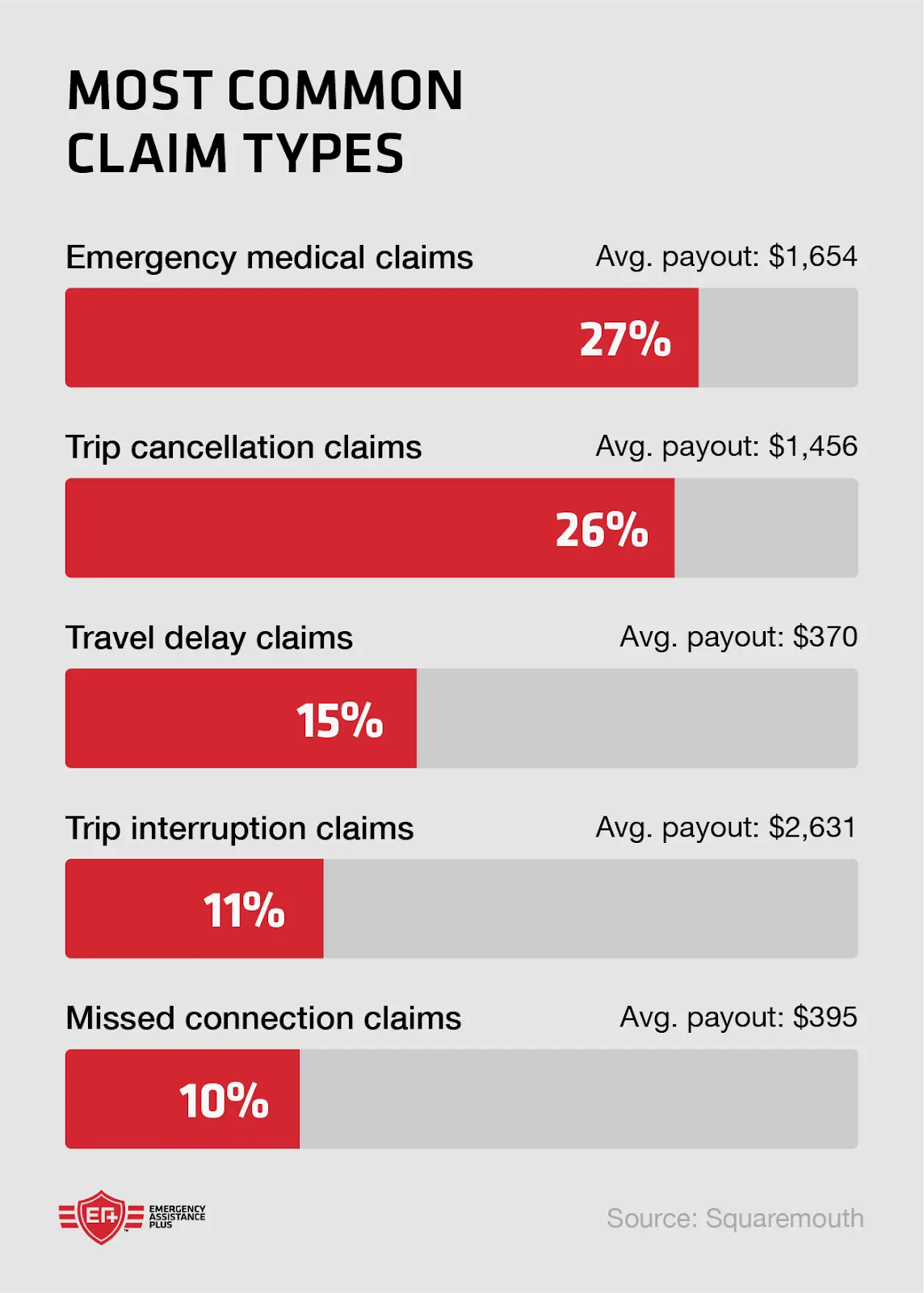
Most Common Travel Insurance Claim Types
- Emergency medical claims account for 27% of all travel insurance claims, with an average payout of $1,654, making it the most common claim type among travelers.
- Trip cancellation claims represent 26% of claims, and insurers pay an average of $1,456 per approved claim.
- Travel delay claims make up 15% of total claims, but the average payout is lower at $370 compared to other claim types.
- Trip interruption claims account for 11% of claims and have the highest average payout of $2,631, reflecting the higher costs when a trip stops midway.
- Missed connection claims represent 10% of travel insurance claims, with an average payout of $395 to cover rebooking and related travel expenses.
 (Reference: Emergency Assistance Plus)
Consumer Behavior and Trends
- 95% of IMG survey respondents purchased coverage for international trips.
- 27% increase in CFAR demand since early March.
- 50% of US outbound leisure travelers opt for insurance.
- 60% of Gen Z and 54% of Millennials buy travel insurance.
- 70% of US travel insurance is purchased via digital platforms.
- 18% of US policies include a CFAR add-on.
- 41% cite financial-loss protection as the primary reason.
- 65% pandemic-specific coverage in policies.
By End User
- Individual travelers hold 60% of policies.
- Family policies account for 25% of sales.
- Senior travelers represent 15% of policies.
- Student travel insurance comprises 10% of policies.
- Corporate travel policies make up 18% of the market.
- Group travel insurance covers 6% of policies.
- Annual multi-trip policies hold 12% of the market.
- Family travelers accounted for 34.84% share.
- The mid-aged group dominates with the highest revenue share.
Technological Innovations in Travel Insurance
- AI cuts claims resolution time by 75%, from 30 to 7.5 days.
- Underwriting timelines reduced from 3 days to 3 minutes.
- Straight-through processing rates jump to 70-90%.
- AI fraud detection improves by over 30%.
- 22% of insurers fully deploy AI solutions.
- AI-powered virtual agents handle 70-80% of claims inquiries.
- Claims cycle times cut by 40-60% via automation.
- The on-demand insurance market reaches $115.99 billion.
- Data accuracy rates near 98-99.5% with document AI.
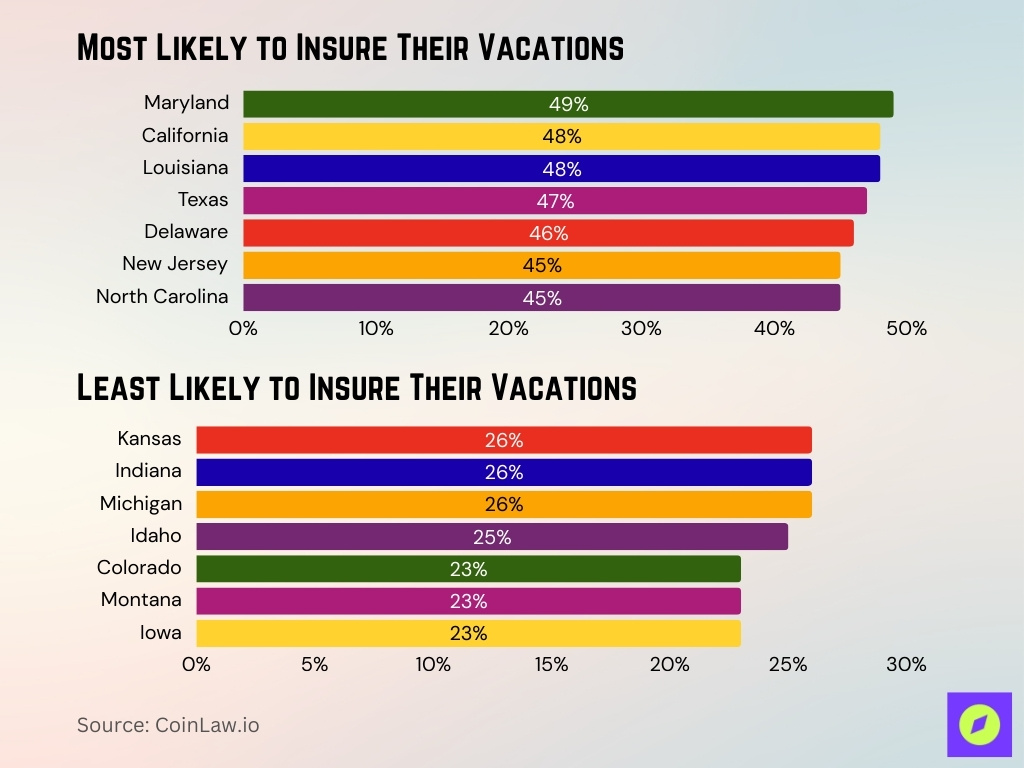
U.S. States Most and Least Likely to Buy Travel Insurance
- Maryland leads the country, with 49% of travelers choosing to insure their vacations, the highest rate among all states.
- California and Louisiana follow closely, with 48% of travelers in each state purchasing travel insurance for their trips.
- Texas ranks next, where 47% of travelers choose to protect their vacations with insurance.
- Delaware records a 46% travel insurance rate, showing strong adoption among travelers in the state.
- New Jersey and North Carolina each report 45%, meaning nearly half of travelers in these states buy travel insurance coverage.
- On the lower end, Kansas, Indiana, and Michigan each report 26%, showing much lower travel insurance adoption.
- Idaho records 25%, meaning only one in four travelers in the state insure their trips.
- Colorado, Montana, and Iowa report the lowest rates at 23%, indicating fewer travelers purchase travel insurance in these states.
 (Reference: Emergency Assistance Plus)
Top Impacting Factors
- Pandemic concerns drive 65% of corporate and leisure demand.
- 20% rise in bleisure travel boosts specialized coverage.
- 15% year-over-year increase in average claim amounts.
- 70% of costs are recoverable via parametric insurance.
- Seniors over 60 pay an average of $40 per day for comprehensive plans.
- 55% of travelers take steps for sustainable holidays.
- The sustainable tourism industry is projected at $374.2 billion by 2028.
- 1.3 million travelers donated $4 million to green projects.
- Flight delays and cancellations fuel 87,943 canceled flights.
- Elder tourists drive medical coverage growth amid high costs.
By Insurance Cover
- Medical expenses coverage leads with 41% market share.
- Single-trip insurance holds 69.2% of the market.
- CFAR reaches record 10% of bookings.
- Trip cancellation and interruption insurance dominate subsegments.
- Medical & accident insurance commands the highest revenue share.
- Trip insurance witnesses the highest growth rate.
- Baggage loss coverage is key in domestic policies.
- Emergency medical evacuation is standard in 90% policies.
Key Players in the Travel Insurance Market
- Allianz SE ranks as the leading global travel insurer, with brand value up 22% to $60.7 billion.
- Zurich becomes one of the largest travel insurers worldwide, serving over 20 million customers across 200 partners.
- Zurich Cover-More taps a global market worth about $20 billion in gross written premiums.
- Market expected to grow to $66.67 billion by 2030 at 16.7% CAGR.
- Asia-Pacific travel insurance revenue hit $8,055.6 million in 2024.
- Global market forecast to reach around $98.74 billion by 2034 at 15.43% CAGR.
- UK travel insurance market is projected at $5.68 billion by 2026, and Germany at $5.09 billion.
- Market led by giants Allianz, Zurich, AXA, Chubb, and Generali, alongside specialists like Berkshire Hathaway and Manulife.
- Key players listed include Allianz SE, AXA SA, AIG, Generali, Seven Corners Inc., and Zurich Insurance Group Ltd.
Frequently Asked Questions (FAQs)
Europe holds about 51.70% of the global market in 2025, while North America contributes roughly 34.4% of incremental growth.
The global travel insurance market is estimated to reach at $35.97 billion in 2026.
Another analysis projects the market could reach about $106.8 billion by 2032, growing at a 20.1% CAGR from $16.8 billion in 2023.
Conclusion
In a world where travel presents both endless opportunities and potential risks, travel insurance has become a cornerstone of smart planning. From covering medical emergencies and cancellations to responding to global trends like sustainable travel, the industry has adapted to meet evolving demands.
As technology shapes the industry through AI and blockchain, and new types of coverage emerge for eco-friendly and flexible travelers, the travel insurance market is set for dynamic growth. Whether it’s a family vacation, a solo adventure, or a business trip, securing the right coverage can make all the difference in navigating the unexpected on your journey.
The post Travel Insurance Industry Statistics 2026: Hidden Trends Now appeared first on CoinLaw.
You May Also Like

Trump-linked WLFI passes proposal letting $5 million stakers buy ‘direct access’ to team

WIF Price Prediction: Targets $0.40 by April as Technical Indicators Signal Mixed Outlook
