

Syndicated Loan Industry Statistics 2026: Big Insights
The syndicated loan market, with its intricate web of investors, borrowers, and financial institutions, represents a crucial sector in global finance. These loans, which bring together a group of lenders to fund a single borrower, are often used by large corporations, governments, and institutions seeking capital for expansive projects or acquisitions.
In recent years, this market has experienced significant fluctuations. Economic shifts, regulatory changes, and digital innovations have shaped a dynamic landscape, and stakeholders are keen to understand where the market is heading today. In this article, we delve into the most current syndicated loan statistics and trends, offering a comprehensive view of a market primed for growth and transformation.
Editor’s Choice
- The global syndicated loans market is projected to grow from $891.5 billion in 2026 to about $1.53 trillion by 2030.
- U.S. leveraged loan issuance so far in 2026 totals $77 billion across 54 deals, alongside $22.6 billion in high-yield bonds across 20 deals.
- Full-year 2025 U.S. leveraged loans priced $825.9 billion across 745 deals, setting a high base for 2026 issuance momentum.
- For full-year 2025, U.S. BSL CLO issuance reached $472.02 billion across 1,045 deals, while U.S. private credit CLOs totaled $84.73 billion across 145 deals.
- About $422 billion of U.S. CLOs backed by broadly syndicated loans exit non-call periods in 2026, with $330 billion in the money at a 130 bps AAA spread.
Recent Developments
- BSL CLO issuance reached $472 billion across 1,045 transactions in full-year 2025.
- U.S. BSL CLO reset volume hit $183.68 billion across 395 deals, exceeding new-issue volume.
- U.S. private credit CLO issuance totaled $84.73 billion across 145 transactions last year.
- Private credit assets under management are estimated at about $2.28 trillion in 2025 and are expected to nearly double to roughly $4.50 trillion by 2030, underscoring the asset class’s rapid expansion alongside syndicated lending.
- Private credit default rate climbed to 5.8% as of January amid persistent inflation pressures.
- Leveraged loans priced at $77 billion among 54 deals so far in early 2026.
- Private credit AUM forecasted to double to $4.5 trillion by 2030 from current levels.
- U.S. CLO issuance projected at $220 billion in 2026, up 10% from 2025 estimate.
- Banks’ lending to private credit providers neared $300 billion by mid-2025.
Global Syndicated Loans Market Size Forecast
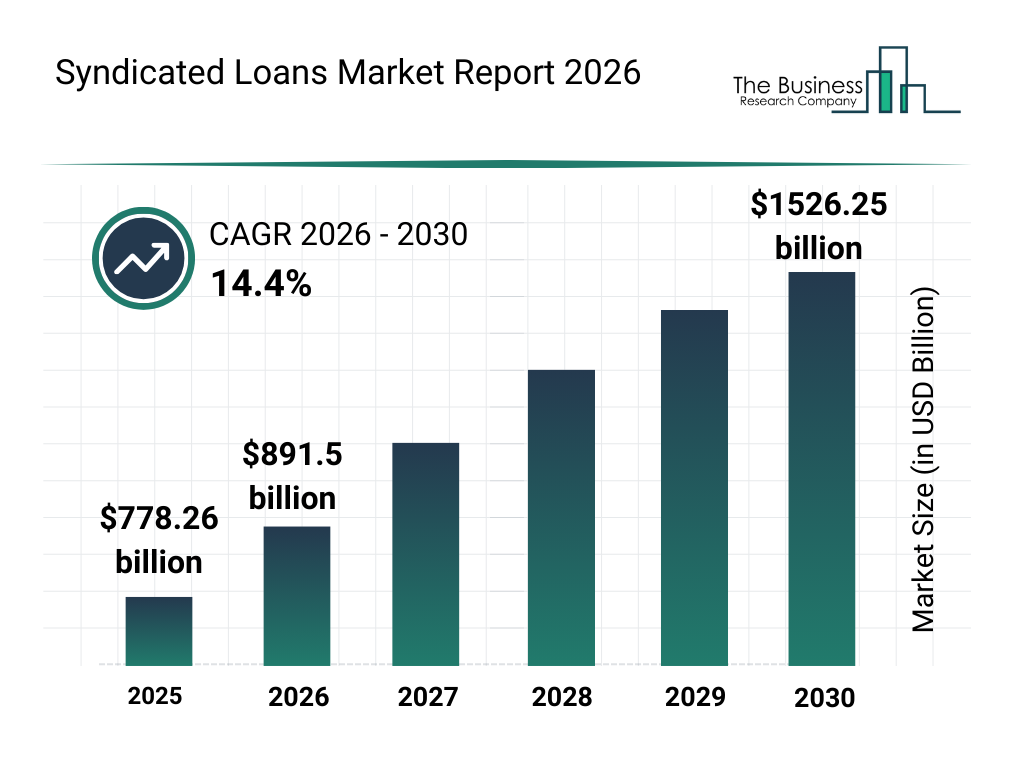
- The global syndicated loans market is expected to grow to $891.5 billion in 2026, showing steady expansion as corporations continue to rely on syndicated funding.
- By 2027, the market size is projected to reach $1,018.66 billion, crossing the $1 trillion milestone for the first time.
- The syndicated loan market could rise to $1,164.34 billion in 2028, driven by increased corporate borrowing and infrastructure financing.
- In 2029, the market is forecast to grow further to $1,330.18 billion, supported by rising global investment activity.
- By 2030, the market could reach $1,526.25 billion, highlighting strong long-term demand for syndicated lending.
- Overall, the syndicated loans market is expected to grow at a compound annual growth rate (CAGR) of 14.4% from 2026 to 2030, indicating rapid expansion in global loan syndication activity.
 (Reference: The Business Research Company)
Syndicated Loans Market Segment Insights
- The investment-grade segment holds 58% of the total market volume.
- Leveraged loans priced $77 billion among 54 deals in the early year.
- Green and sustainability-linked loans continue strong ESG demand.
- Direct lending comprises 52% of private credit AUM.
- High-yield supply forecasted to expand 11% amid lower rates.
- Financial sponsor syndicated loans valued at $9.48 billion.
- Cross-border lending faces regulatory shifts from CRD VI.
- Leveraged loan refi activity hit a record $422 billion, with CLOs exiting NC.
- M&A volumes surged 41% year-over-year, driving issuance.
Key Players and Market Share
- Bank of America commands 18.2% of U.S. syndicated loan volume.
- Citi manages 15.7% share among top global loan arrangers.
- Deutsche Bank captures 12.8% of Europe’s syndicated loan market.
- HSBC secures 9.3% of European syndicated loan volume.
- MUFG leads Asia-Pacific with 8.1% syndicated loan market share.
- SMBC holds 7.5% share in Asia-Pacific syndications.
- China Construction Bank arranged $238 billion in syndicated loans.
Loan Types and Regional Breakdown
- Revolving credit facilities comprise 42% of syndicated loan structures.
- Term loans account for 33% of total syndicated lending.
- Bridge loan leverage stretches to 70-75% loan-to-value.
- North America dominates as the largest syndicated loans region.
- Asset-based loans represent 22% of European syndications.
- Cross-border syndicated loans in Asia up 10.5%.
- The healthcare sector captures 17% of North America’s syndicated loans.
- Latin America green syndicated loans at 14% total volume.
Top Impacting Factors
- Base rates increased by 3%, impacting loan pricing and terms.
- M&A volumes surged 41%, driving loan demand.
- ESG compliance influences syndication terms scrutiny.
- Geopolitical tensions create market volatility.
- Sustainable loans reduce borrowing costs 10-25 bps.
Industry Adoption Across Sectors
- Healthcare and pharmaceuticals account for 21% of syndicated loans.
- Technology firms represent 19.5% of global syndicated loans.
- Real estate development absorbs 14% of syndicated financing.
- The manufacturing sector rose 12% in syndicated loans.
- Transportation and logistics hold 9% of the loan market share.
- Financial services maintain 26% of syndicated loan volume.
- Consumer goods companies account for 13.4% of syndicated loans.
- Automotive sector loans rose by 5.6%.
- Media and telecom loans grew by 7.2%.
Key Benefits for Stakeholders
- Borrowers access larger capital sums at more favorable terms.
- Lenders diversify portfolios, reducing single borrower exposure risk.
- Institutional investors gain higher returns in leveraged segments.
- Floating-rate loans forecast 5-6% total returns.
- Green loans show a 1.1-1.2% operating income rise.
- Syndicated volumes are expected to increase by 5-20% annually.
- Private equity funds buyouts via flexible structured terms.
Technological Innovations and Digital Platforms
- Blockchain reduces syndicated loan transaction times by up to 30%.
- RPA reduces loan processing times by 25%.
- AI-driven credit assessment tools enhance underwriting efficiency.
- Digital platforms streamline syndication, reducing timelines significantly.
- Blockchain smart contracts reduce administrative costs by 20%.
- Fintech partnerships improve loan distribution to smaller investors.
- Machine learning predicts defaults in real-time portfolio monitoring.
Risk of Bad Debts
- Syndicated loan default rates steady at 2.1%.
- Leveraged loans default rate forecasted 4.5%-5.0%.
- High-yield bond default rate projected 2.5%-3.0%.
- US leveraged loan payment default rate 1.38%.
- Private credit default rate 5.8% as of January.
- Leveraged loan defaults closed at 2.87%.
- Dual default rate 3.54% for US loans.
- Distress ratio for loans 6.43%.
- Direct lending default rate projected 2%.
- Private credit defaults are expected to increase by 3 percentage points.
Regulatory and Compliance Landscape
- Dodd-Frank 1071 Tier 1 compliance deadline July 1, 2026.
- FinCEN AML rule effective March 1, 2026, for non-financed deals.
- Green loans hit $246 billion under ESG standards.
- EU syndicated transaction raised €9 billion of EU bonds.
- Vietnam CG Code 2026 updates governance for syndicated loans.
- EU-Bonds issuance totals €594.4 billion under unified funding.
- Syndicated loan volumes projected a 5-20% annual increase.
- Compliance points and fees are capped at 3% for loans over $137,958.
- AML verification layers intensified globally for participants.
- GDPR requires DPIA for high-risk financial data processing.
Frequently Asked Questions (FAQs)
More than 60% of experts predict a 5-20% annual increase in syndicated loan volumes.
Gulf borrowers raised a record $15.8 billion in syndicated loans across the Asia Pacific.
The market reflects a 14.4% CAGR from 2024 to $1,342.3 billion by 2029.
Conclusion
As the syndicated loan industry continues to evolve, the trends in technological innovation, sustainability, and regional growth are shaping a dynamic market poised for further expansion. Lenders and borrowers alike are adapting to new regulatory landscapes, embracing digital platforms, and meeting investor demands for transparency and compliance. With global economic uncertainties and shifting investor preferences, the syndicated loan market remains an essential tool for large-scale financing.
The post Syndicated Loan Industry Statistics 2026: Big Insights appeared first on CoinLaw.
You May Also Like

Trump-linked WLFI passes proposal letting $5 million stakers buy ‘direct access’ to team

WIF Price Prediction: Targets $0.40 by April as Technical Indicators Signal Mixed Outlook

