

Claude AI Predicts the Price of Kaspa and Cardano If the Clarity Acts Passes in 2026
The proposed Digital Asset Market Structure and Investor Protection Act, called the Clarity Act, is still facing delays in the United States Senate as of March 2026.
It should be noted that the proposed bill aims to provide clear guidelines with regard to how digital assets are regulated in the U.S., specifically with regard to which digital assets belong to the U.S. Securities and Exchange Commission and which ones belong to the U.S. Commodity Futures Trading Commission.
Progress has slowed because lawmakers cannot agree on how stablecoin “rewards” should be treated. Some banking groups argue these rewards function like interest on savings accounts and should therefore be regulated more strictly.
As a result of this disagreement, the bill is unlikely to meet the deadline for compromise and might not pass through the Senate Banking Committee before April.
Industry analysts predict that if the bill does not pass through this stage soon, the prospects for the bill to pass in 2026 could significantly decline.
Lawmakers are attempting to distinguish between passive yields and incentives based on activities in order to revive negotiations on the bill. Interestingly, prediction market platform Polymarket shows about a 61% probability that the Clarity Act will be signed into law in 2026, highlighting growing market interest in the legislation’s potential impact.
Although the outcome is still uncertain, the bill has already sparked discussions on how regulatory clarity could influence some of the most important crypto assets, such as Cardano and Kaspa.
Cardano (ADA) Price Outlook if the Clarity Act Passes
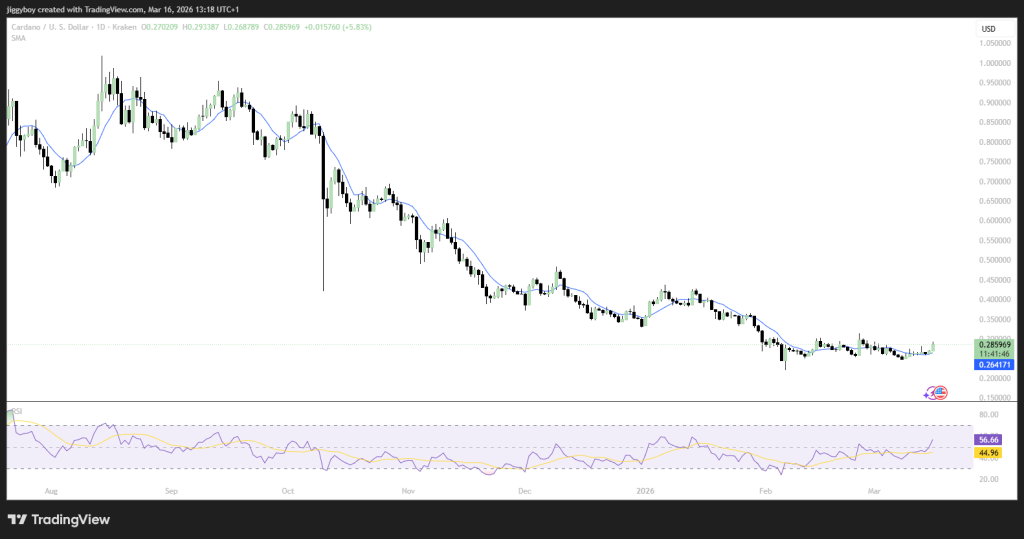
The chart illustrates the movement of Cardano in the market. It has been in a decline but trading in a range of $0.28 and $0.29.
The price of Cardano was trading at $0.2859. It rose to a high of $0.2933 and a low of $0.2688.
From the technical indicators, it is evident that there is a gradual movement in the market after months of selling pressure. The Relative Strength Index (RSI) is rising to reach the 50% mark, indicating that buying pressure is building up in the market.
 Source: TradingView.com
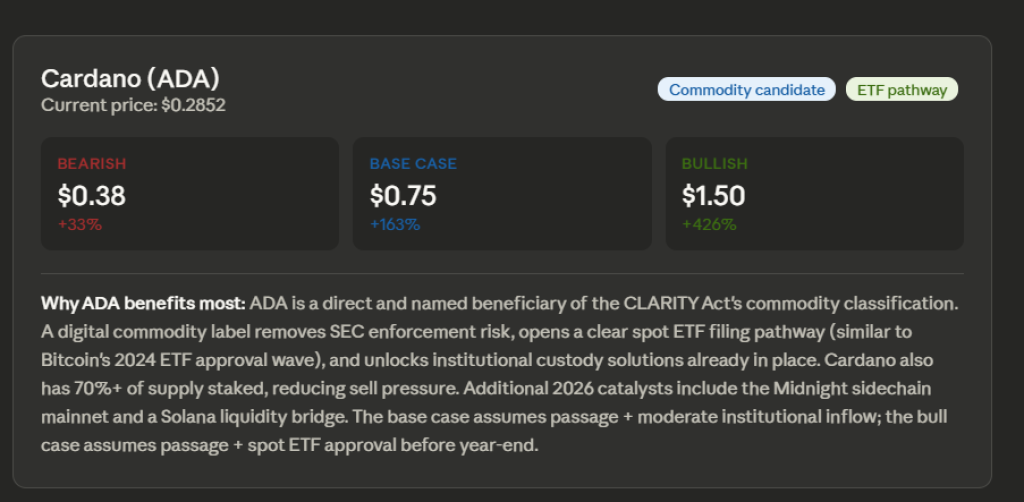
Claude AI predicts that the Cardano price could see notable upside if the Clarity Act becomes law because ADA is often considered a strong candidate for classification as a digital commodity under the proposed framework.
This may remove regulatory uncertainty and pave the way for institutional products similar to the Bitcoin spot ETF approvals seen in 2024.
With the ADA price at $0.2852, a conservative market reaction may propel ADA to $0.38. A moderate institutional inflow and ETF interest may propel ADA to $0.75. A strong institutional inflow coupled with regulatory certainty may propel ADA to $1.50.
The Cardano network may greatly benefit from this legislation, given that over 70% of its supply is staked. Other ADA catalysts in 2026 include the Midnight sidechain launch and the planned liquidity bridge to Solana.
 Source: X/ClaudeAi
Kaspa (KAS) Price Outlook if the Clarity Act Passes
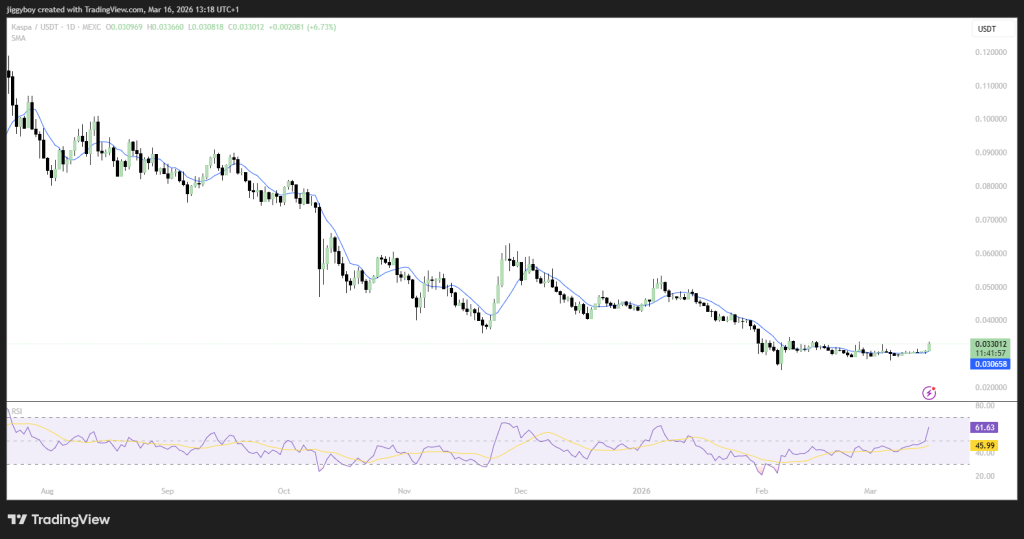
The chart for Kaspa shows a similar pattern of consolidation after a steep correction from earlier highs. was trading at $0.03301, having hit a high of $0.03366 and a low of $0.03081.
The momentum indicators show that the market is slowly stabilizing, with the RSI now in the low 60s, which is usually a sign of improving buying interest after a long period of decline.
 Source; TradingView.com
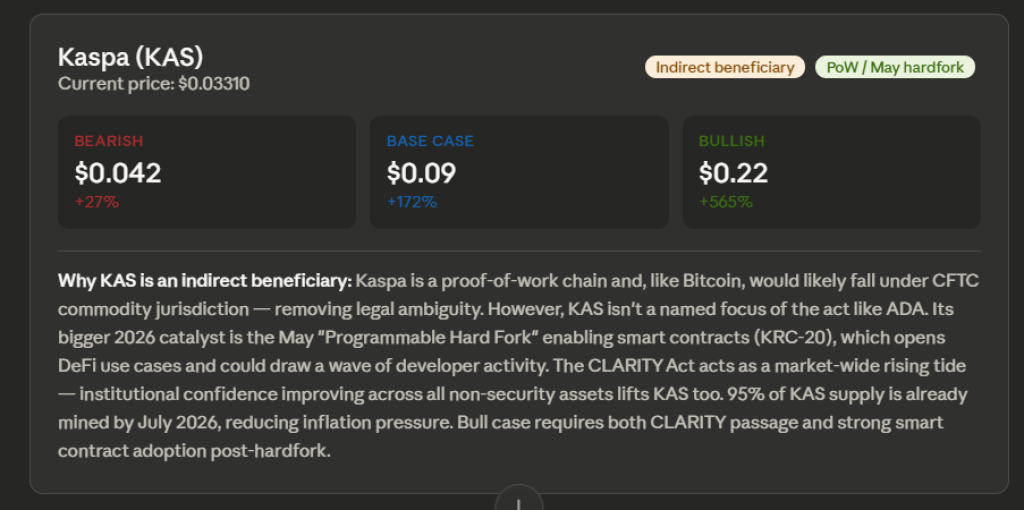
Unlike Cardano, Kaspa is not directly mentioned in the Clarity Act, but analysts believe it could still benefit indirectly from broader regulatory clarity. As a proof-of-work network, KAS would likely fall under commodity oversight similar to Bitcoin, reducing legal uncertainty for investors and exchanges.
Claude AI projects that if regulatory clarity is combined with its technological upgrades, KAS could rise from its current price of $0.03310 to $0.042 in a cautious scenario.
With stronger adoption, the KAS price could reach $0.09, while a bullish scenario including both Clarity Act passage and strong smart contract adoption after the May hard fork could lift it to $0.22.
Kaspa’s May hard fork will introduce programmable smart contracts (KRC-20), enabling DeFi applications on the network. By mid-2026, roughly 95% of KAS supply will be mined, reducing inflationary pressure and supporting potential price growth.
The Clarity Act, combined with this upgrade, could provide a rising tide that lifts KAS along with other non-security digital assets.
Read Also: Virtuals Protocol (VIRTUAL) Shows AI Agents Can Thrive Off Ethereum – Here’s What That Means
 Source: ClaudeAI
What Regulatory Clarity Could Mean for Crypto Markets
If the Clarity Act passes, it could have a significant impact on the digital asset market as a whole, not just this particular project.
For Cardano and Kaspa, it could provide greater legal clarity and increase investor confidence. Although it is unclear when this legislation may be passed, it is clear that even talk of it is impacting the crypto market and how it relates to policy in Washington.
It should be noted that Cardano and Kaspa are in consolidation phases, but it could have a significant impact on the next market cycle for both of these assets.
Subscribe to our YouTube channel for daily crypto updates, market insights, and expert analysis.
The post Claude AI Predicts the Price of Kaspa and Cardano If the Clarity Acts Passes in 2026 appeared first on CaptainAltcoin.


You May Also Like

Ripple CEO Tells Bloomberg: What Are Working Daily to Take Over SWIFT

Citigroup boosts Bitcoin exposure with $41.2M in Strategy shares




