Cardano price set to crash as key DeFi metric plunges 45%
Cardano price continued rising on Friday, Sept. 12, coinciding with the ongoing crypto market comeback.
- Cardano price has formed a rising wedge pattern on the daily chart.
- It has also formed a bearish divergence pattern.
- The total value locked in the DeFi ecosystem has plunged by 45% since December.
Cardano (ADA) token rose to $0.90, its highest point in two weeks and about 80% above its lowest level in June. Still, technical analysis points to an upcoming crash as a key decentralized finance metric plunges.
Cardano price chart points to a plunge
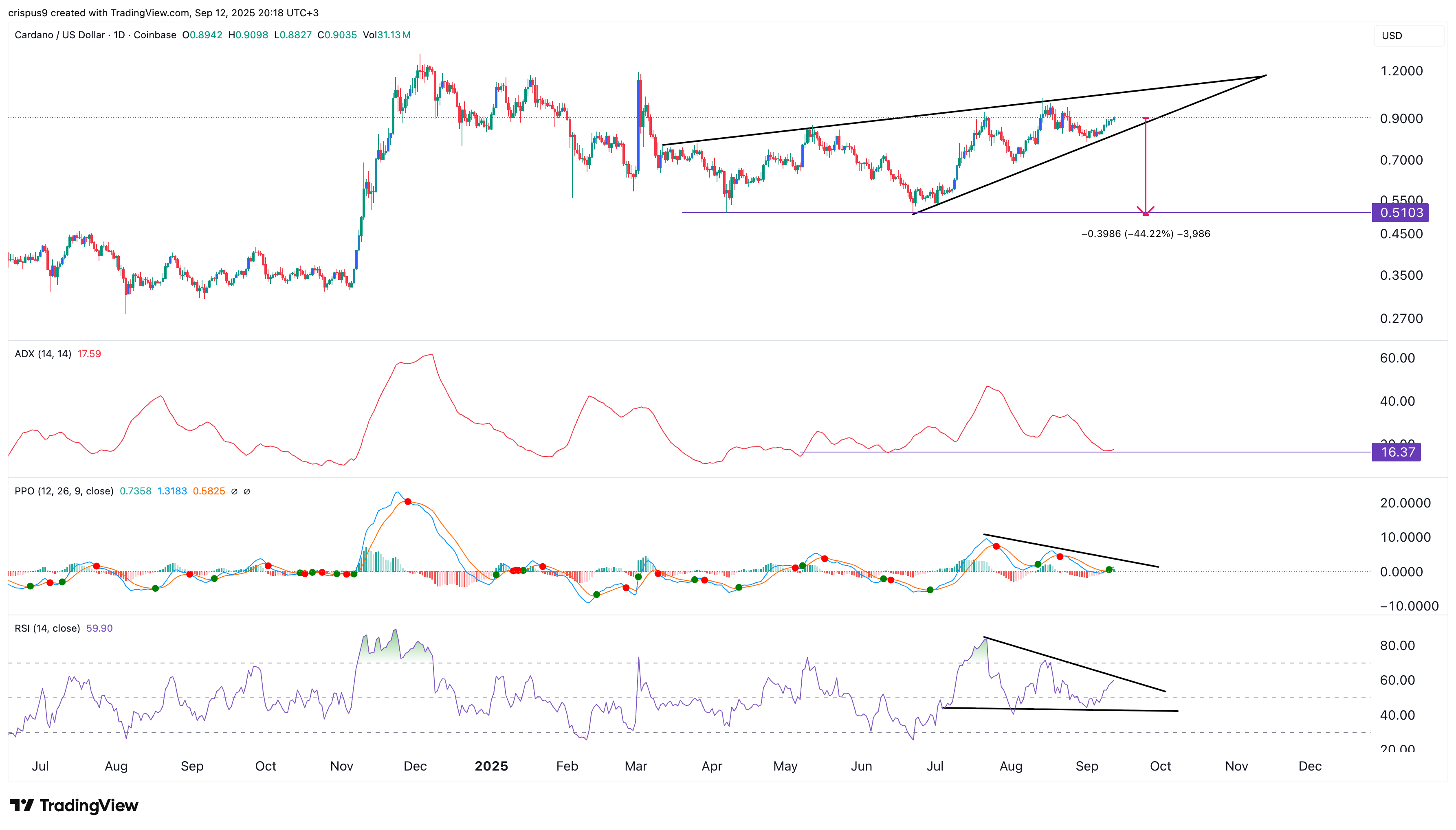
The daily timeframe chart shows that the Cardano price is rising and slowly approaching the important resistance point at $1. However, there are signs that the ongoing rally will be short-lived.
ADA is slowly forming a highly bearish rising wedge pattern. The upper side of this pattern links the highest levels since March this year. On the other hand, the lower line connects the lowest swings since June.
The two lines are now nearing their confluence level, which may lead to a crash in the near term.
Technical indicators also point to a reversal. The Average Directional Index has dropped to 16, its lowest level since May 8 and much lower than the July high of 47.
Additionally, the Percentage Price Oscillator and the Relative Strength Index have continued moving downward. Therefore, the most likely outlook is a plunge to key support at $0.51, its lowest swing in June, about 45% below the current level.
This bearish outlook will become invalid if the coin rises above the important resistance level at $1.20.
Cardano DeFi TVL has plunged
There are three main reasons why the Cardano price may have a bearish breakout in the near term. First, the total value locked in its ecosystem has dropped sharply in the past few months. Its TVL has dropped by 45% from $720 million in December to $383 million today.
Second, the upcoming Federal Reserve interest rate cuts may become a “sell-the-news” event. This is a situation where an asset rises ahead of a major event and then drops when it happens.
Further, there are concerns about Cardano’s ecosystem as other chains have left it behind. For example, the amount of stablecoins in the network stands at $40 million, a tiny amount for an industry worth over $287 billion in assets.


You May Also Like
US Government Transfers Seized Bitcoin Linked to Steroid Probe to Coinbase Prime

RAVE Price Surges by 85% as Liquidations Spike Across Crypto Markets