Customer Trust Infrastructure: Why CX Leaders Must Engineer Trust, Not Just Measure Experience
Customer experience investments are rising—but trust is falling. A new framework, Customer Trust Infrastructure, explains why. It shifts focus from touchpoints to systems, revealing how consistency, response, and friction shape trust—and why CX leaders must rethink how trust is designed, measured, and operationalized.
Trust Isn’t Earned. It’s Engineered.
For years, customer experience leaders have operated under a powerful assumption: improve the experience, and trust will follow. Yet across industries, even as investments in CX design, personalization, and digital transformation have accelerated, trust has continued to decline.
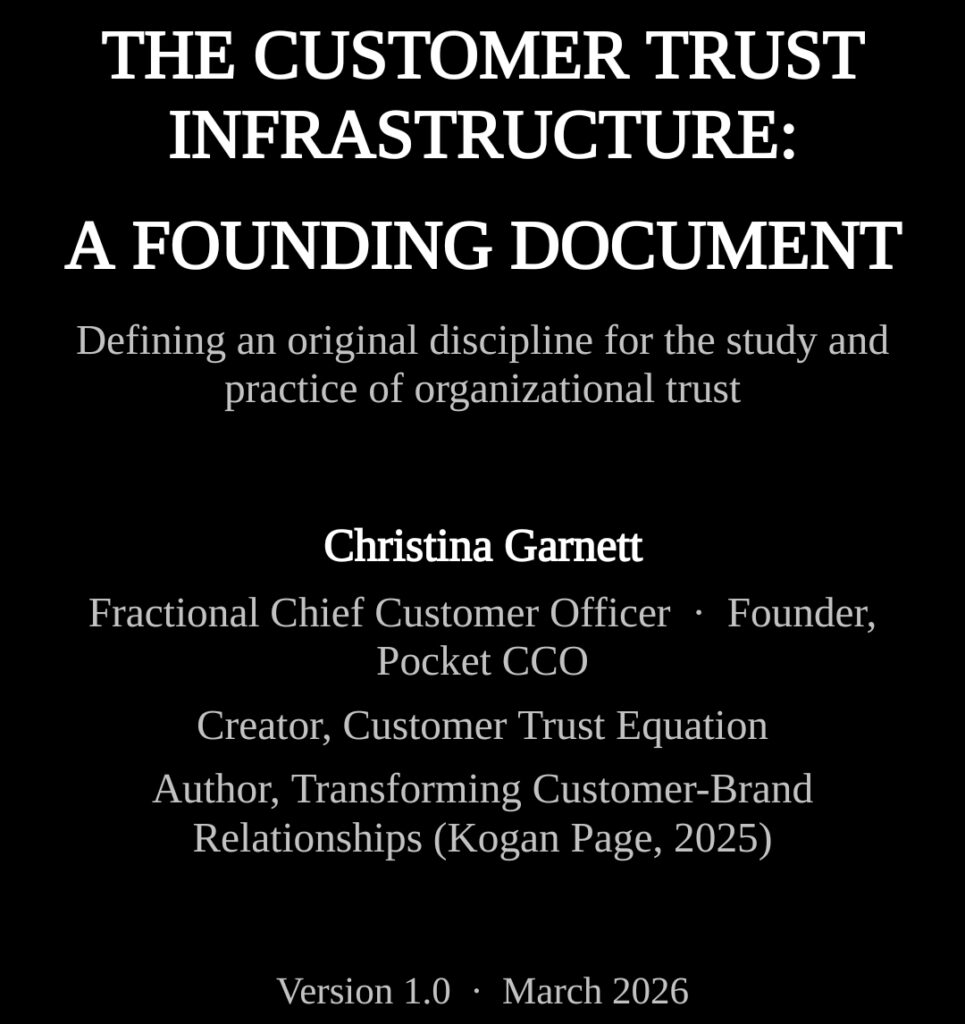
This paradox is precisely what Customer Trust Infrastructure (CTI), introduced by Christina Garnett, Founder Pocket CCO, seeks to resolve. It reframes trust not as a byproduct of good experiences, but as the outcome of deliberate system design. In doing so, it challenges the very foundation of how organizations approach customer relationships.
From Experience Design to Trust Engineering
Traditional CX has largely focused on optimizing touchpoints—the visible moments where customers interact with a brand. These include service interactions, digital journeys, onboarding flows, and support experiences. While important, CTI argues that these moments are only symptoms of deeper structural realities.
A broken experience is rarely just a frontline failure. It is usually the result of:
- fragmented processes
- conflicting incentives
- poorly designed policies
- disconnected systems
CTI shifts the focus from what customers experience to what creates those experiences. It introduces a systems-level lens, emphasizing that trust is built—or eroded—not in isolated interactions, but through the consistency and reliability of the underlying architecture.
The Trust Equation as an Operational Lens
At the heart of CTI lies the Customer Trust Equation:
Trust = Consistency + Response + Connection + Value – Friction
Each component represents a distinct organizational capability:
- Consistency ensures predictability across channels and interactions
- Response reflects how effectively organizations address issues and feedback
- Connection captures the human dimension of relationships
- Value defines the perceived benefit beyond transactions
- Friction represents the cumulative burden placed on the customer
The inclusion of friction as a subtractive force is particularly significant. It reframes inefficiencies—not as minor inconveniences—but as active destroyers of trust.
This equation transforms trust from an abstract concept into something measurable, diagnosable, and actionable. It allows organizations to identify precisely where trust is being built—and where it is quietly being lost.
The Customer Impact: Predictability Over Perfection
From the customer’s perspective, trust is less about extraordinary experiences and more about reliability.
Customers do not expect perfection. They expect:
- not to repeat themselves
- not to encounter conflicting information
- not to navigate opaque processes
When these expectations are consistently met, trust accumulates. When they are violated, even occasionally, trust erodes disproportionately.
This explains a critical dynamic in modern CX: why organizations that deliver moments of delight can still struggle with loyalty. Without consistency, excellence becomes unpredictable—and unpredictability undermines trust.
CTI highlights that the true goal of CX is not to create isolated moments of brilliance, but to establish a dependable relationship customers can rely on.
Strategic and Operational Implications
For organizations, adopting a trust infrastructure mindset requires a fundamental shift in how CX is governed and executed.
First, it demands cross-functional alignment. Trust is not owned by the CX team alone. It is shaped by decisions in product design, operations, legal policy, and technology architecture. Without coordination across these domains, consistency becomes impossible.
Second, it requires rethinking metrics. Traditional indicators like NPS, CSAT, and Customer Effort Score provide useful signals, but they do not measure trust itself. They capture perception at a moment in time, not the structural conditions that produce it.
Organizations must begin developing metrics that align with the components of trust—measuring consistency, responsiveness, and friction at a system level.
Third, it exposes the limitations of current digital transformation efforts. Many organizations have optimized for speed, scale, and efficiency through automation and AI. However, in doing so, they have often introduced new forms of friction:
- complex self-service journeys
- lack of human escalation paths
- opaque decision-making by algorithms
CTI does not reject digital transformation—it reframes it. The question is no longer whether systems are efficient, but whether they are trustworthy.
The Industry Context: A Maturity Shift in CX
The emergence of Customer Trust Infrastructure signals a broader evolution in the CX discipline.
The first phase of CX focused on service quality.
The second emphasized journey design and experience orchestration.
The third introduced data-driven personalization and omnichannel engagement.
CTI represents the next phase: systemic trust management.
This evolution reflects a deeper reality. As markets become more competitive and switching costs decrease, customers are less tolerant of inconsistency and friction. At the same time, widespread digitization has made experiences faster—but not necessarily more reliable.
In this environment, trust becomes the ultimate differentiator.
Organizations that can deliver consistent, low-friction, high-value experiences at scale will not just satisfy customers—they will retain them.
Trust, Technology, and the Road Ahead
Technology will play a central role in enabling Customer Trust Infrastructure, but not in the way many organizations expect.
Artificial intelligence and advanced analytics can:
- identify friction patterns across journeys
- predict trust breakdowns before they escalate
- enable more responsive and personalized interactions
However, technology alone cannot create trust. It can only amplify the systems it operates within. If those systems are inconsistent or misaligned, technology will scale those flaws.
This places a new responsibility on CX leaders: to ensure that technology investments are guided by trust principles, not just efficiency goals.
A New Mandate for CX Leadership
Perhaps the most important implication of CTI is how it redefines the role of CX leaders.
Historically, CX leaders have focused on advocacy—representing the voice of the customer within the organization. While this remains essential, it is no longer sufficient.
The new mandate is to:
- influence system design
- align cross-functional decision-making
- embed trust into operational frameworks
In other words, CX leaders must evolve from experience designers to trust architects.
This requires not only new tools and frameworks, but also greater organizational authority and integration with business strategy.
The Future of Customer Relationships
Customer Trust Infrastructure arrives at a moment when organizations can no longer rely on brand reputation or product quality alone to sustain relationships.
Customers today operate in an environment of choice, transparency, and heightened expectations. They evaluate brands not just on what they promise, but on how reliably they deliver.
In this context, trust is not a soft metric. It is a structural asset—one that directly influences revenue, retention, and long-term growth.
The organizations that recognize this shift will begin to design their systems differently. They will prioritize consistency over complexity, clarity over convenience, and reliability over short-term optimization.
Because ultimately, the question customers are asking is not:
“Was this a good experience?”
It is:
“Can I trust you to get this right—every time?”
The companies that can answer that question with confidence—through their systems, not just their messaging—will define the next era of customer experience.
Key Takeaways for CX Leaders
- Trust must be engineered, not assumed
Trust is the outcome of how systems operate—not how experiences feel in isolation. CX leaders must influence process, policy, and design decisions. - Friction is the most critical (and overlooked) CX metric
Every unnecessary step, delay, or inconsistency erodes trust faster than positive moments can build it. - Consistency drives loyalty more than excellence
Customers value predictability over occasional standout experiences. Reliability is the foundation of trust. - Current CX metrics are insufficient
NPS, CSAT, and CES measure perception—not trust. Organizations need new measurement models aligned to trust drivers. - Trust is a cross-functional responsibility
It cannot be owned by CX alone. Operations, product, legal, and technology all shape trust outcomes. - Digital transformation must include trust design
Automation and AI should reduce friction and increase transparency—not create confusion or detachment. - The future of CX leadership is trust architecture
CX leaders must evolve from journey designers to system-level influencers who build and sustain trust at scale.
The post Customer Trust Infrastructure: Why CX Leaders Must Engineer Trust, Not Just Measure Experience appeared first on CX Quest.


You May Also Like

Republicans deploy ground troops in the states to execute 'the plan'

GOP Senate hopeful under fire over ties to church rocked by child sex abuse scandal