TLDR Quadruple witching on Friday will see trillions in stock and index derivatives expire at the same time Bitcoin dropped below $70,000 on Thursday, strugglingTLDR Quadruple witching on Friday will see trillions in stock and index derivatives expire at the same time Bitcoin dropped below $70,000 on Thursday, struggling

Bitcoin and Stocks Brace for Quadruple Witching as Crypto Tests $70K

2026/03/20 16:48
3 min read
For feedback or concerns regarding this content, please contact us at [email protected]

TLDR

  • Quadruple witching on Friday will see trillions in stock and index derivatives expire at the same time
  • Bitcoin dropped below $70,000 on Thursday, struggling to hold key support levels
  • Bitcoin’s past quadruple witching days showed flat price action followed by weeks of weakness
  • Futures traders, not spot buyers, are driving the current sell-off in crypto markets
  • A separate $13.5 billion crypto derivatives expiry is set for March 27 on Deribit

Bitcoin fell below $70,000 Thursday as global markets prepared for one of the biggest quarterly derivatives events in traditional finance.
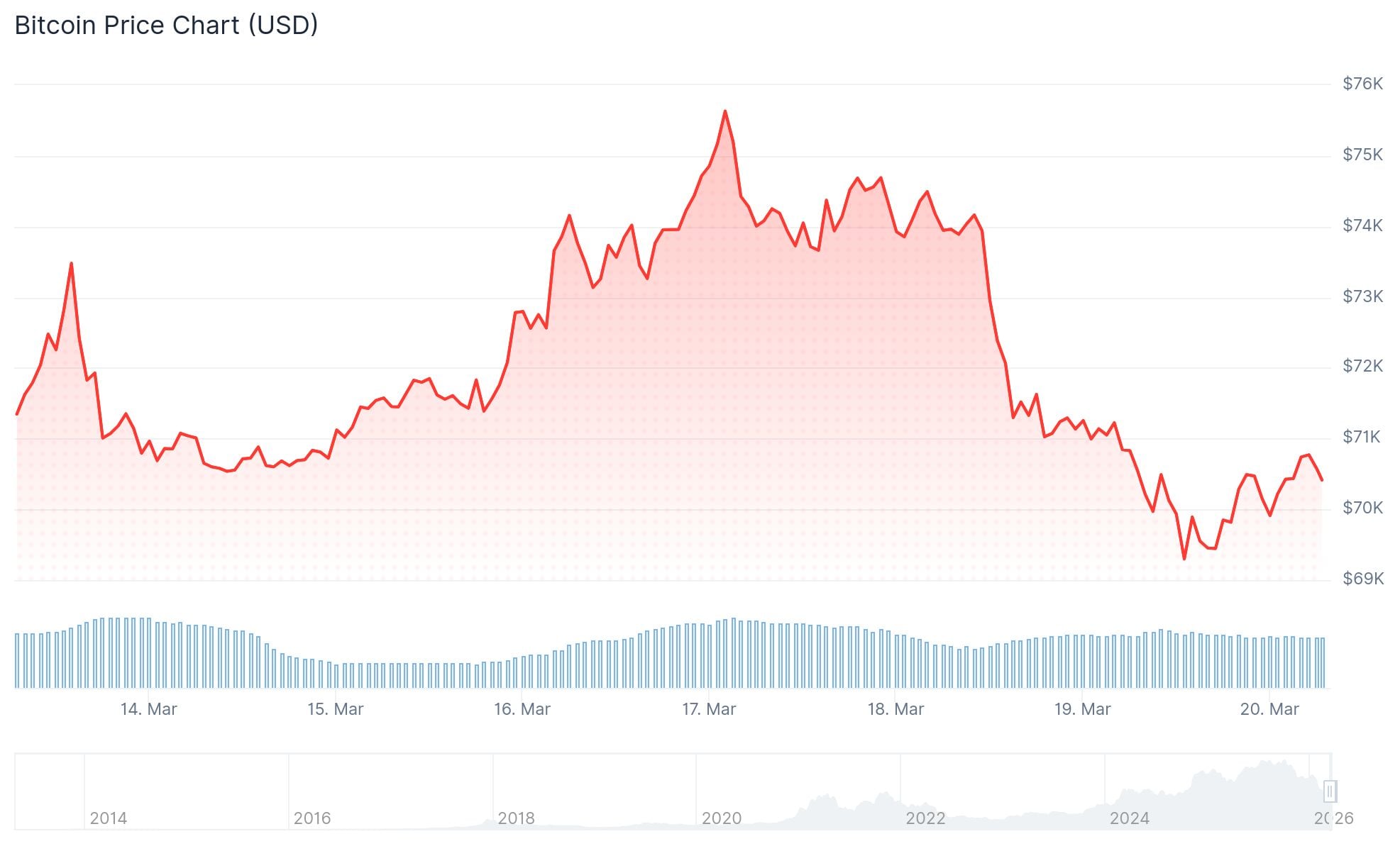
Bitcoin (BTC) PriceBitcoin (BTC) Price

Quadruple witching happens four times a year — on the third Friday of March, June, September, and December. It marks the simultaneous expiry of stock index futures, stock index options, single-stock options, and single-stock futures.

https://twitter.com/preetkailon/status/2034744017238598013?s=20

The scale of the event is large. In March 2025, around $4.7 trillion worth of equity and index derivatives expired during the same session. That day recorded the highest S&P 500 trading volume of the entire year, according to TradeStation.

Figures for the March 2026 expiry have not yet been published.

During these events, institutions are forced to close, roll over, or settle positions at the same time. Trading activity tends to spike, and price swings can get sharper, especially in the final hour of trading.

How Bitcoin Has Reacted to Past Witching Days

Looking back at 2025, Bitcoin’s price moves on the actual day of quadruple witching were mostly flat. The bigger drops came in the days and weeks after.

On March 21, 2025, Bitcoin was slightly lower on the day but later bottomed near $76,000 after the market reacted to President Trump’s “Liberation Day” tariffs. On June 20, it dropped 1.5% and hit a local low near $98,000 just two days later.

On September 19, Bitcoin fell over 1% but then dropped sharply from $177,000 to $108,000 in the following week. On December 19, it finished up around 3% at $85,000 but remained in a broader downtrend.

The pattern is consistent: muted moves on the day, followed by weakness over the coming days or weeks.

What Is Driving the Current Sell-Off

Data shows the current Bitcoin drop is being driven more by futures traders than by spot market buyers. The Coinbase premium gap turned negative, suggesting U.S. investor demand has cooled.

Crypto analyst IT Tech noted that while spot selling fell by around $40 million, selling in the perpetual futures market was far larger at $506.75 million. That points to leveraged traders as the main force behind the decline.

Some traders see a potential short-term recovery. If Bitcoin can reclaim $70,000 quickly, the next target is $76,000. But if the price drops below $68,300, the next support levels are $65,000 and $62,000.

Beyond crypto, the broader environment is adding pressure. Oil prices have risen toward $120 per barrel, the VIX volatility index jumped above 35 last week — its highest in a year — and gold slipped below $4,600.

Looking ahead, a separate $13.5 billion crypto derivatives expiry is set for March 27 on Deribit. Positioning in that market points to demand for volatility strategies rather than strong directional bets.

The post Bitcoin and Stocks Brace for Quadruple Witching as Crypto Tests $70K appeared first on CoinCentral.


Market Opportunity
Notcoin Logo
Notcoin Price(NOT)
$0.0004012
$0.0004012$0.0004012
+0.14%
USD
Notcoin (NOT) Live Price Chart
Disclaimer: The articles reposted on this site are sourced from public platforms and are provided for informational purposes only. They do not necessarily reflect the views of MEXC. All rights remain with the original authors. If you believe any content infringes on third-party rights, please contact [email protected] for removal. MEXC makes no guarantees regarding the accuracy, completeness, or timeliness of the content and is not responsible for any actions taken based on the information provided. The content does not constitute financial, legal, or other professional advice, nor should it be considered a recommendation or endorsement by MEXC.

You May Also Like

The Channel Factories We’ve Been Waiting For

The Channel Factories We’ve Been Waiting For

The post The Channel Factories We’ve Been Waiting For appeared on BitcoinEthereumNews.com. Visions of future technology are often prescient about the broad strokes while flubbing the details. The tablets in “2001: A Space Odyssey” do indeed look like iPads, but you never see the astronauts paying for subscriptions or wasting hours on Candy Crush.  Channel factories are one vision that arose early in the history of the Lightning Network to address some challenges that Lightning has faced from the beginning. Despite having grown to become Bitcoin’s most successful layer-2 scaling solution, with instant and low-fee payments, Lightning’s scale is limited by its reliance on payment channels. Although Lightning shifts most transactions off-chain, each payment channel still requires an on-chain transaction to open and (usually) another to close. As adoption grows, pressure on the blockchain grows with it. The need for a more scalable approach to managing channels is clear. Channel factories were supposed to meet this need, but where are they? In 2025, subnetworks are emerging that revive the impetus of channel factories with some new details that vastly increase their potential. They are natively interoperable with Lightning and achieve greater scale by allowing a group of participants to open a shared multisig UTXO and create multiple bilateral channels, which reduces the number of on-chain transactions and improves capital efficiency. Achieving greater scale by reducing complexity, Ark and Spark perform the same function as traditional channel factories with new designs and additional capabilities based on shared UTXOs.  Channel Factories 101 Channel factories have been around since the inception of Lightning. A factory is a multiparty contract where multiple users (not just two, as in a Dryja-Poon channel) cooperatively lock funds in a single multisig UTXO. They can open, close and update channels off-chain without updating the blockchain for each operation. Only when participants leave or the factory dissolves is an on-chain transaction…
Share
BitcoinEthereumNews2025/09/18 00:09
Gold continues to hit new highs. How to invest in gold in the crypto market?

Gold continues to hit new highs. How to invest in gold in the crypto market?

As Bitcoin encounters a "value winter", real-world gold is recasting the iron curtain of value on the blockchain.
Share
PANews2025/04/14 17:12
XRP Multi-Year Accumulation Signals Potential 1000% Breakout

XRP Multi-Year Accumulation Signals Potential 1000% Breakout

The post XRP Multi-Year Accumulation Signals Potential 1000% Breakout appeared on BitcoinEthereumNews.com. XRP Builds Multi-Year Base as Whales Accumulate and Volume
Share
BitcoinEthereumNews2026/03/21 00:04