TLDR Brent crude oil peaked at $119/barrel this week after Israeli strikes on Iran’s South Pars gas field, then pulled back to around $108. Qatar says its gas exportTLDR Brent crude oil peaked at $119/barrel this week after Israeli strikes on Iran’s South Pars gas field, then pulled back to around $108. Qatar says its gas export

Oil Hit $119 This Week — Here’s Why It Could Go to $180 If the Iran War Drags On

2026/03/20 20:48
3 min read
For feedback or concerns regarding this content, please contact us at [email protected]

TLDR

  • Brent crude oil peaked at $119/barrel this week after Israeli strikes on Iran’s South Pars gas field, then pulled back to around $108.
  • Qatar says its gas export capacity is down 17% and could take five years to repair after Iranian strikes.
  • Saudi Arabia warns oil could hit $180/barrel if disruptions last until late April.
  • U.S. Treasury Secretary Bessent floated releasing ~140 million barrels of sanctioned Iranian oil to cool prices.
  • Israel’s PM Netanyahu says the war will end “a lot faster than people think,” which helped ease crude slightly on Friday.

Oil prices surged to their highest levels in years this week as the conflict between Israel and Iran escalated, hitting energy infrastructure across the Middle East and rattling global markets.

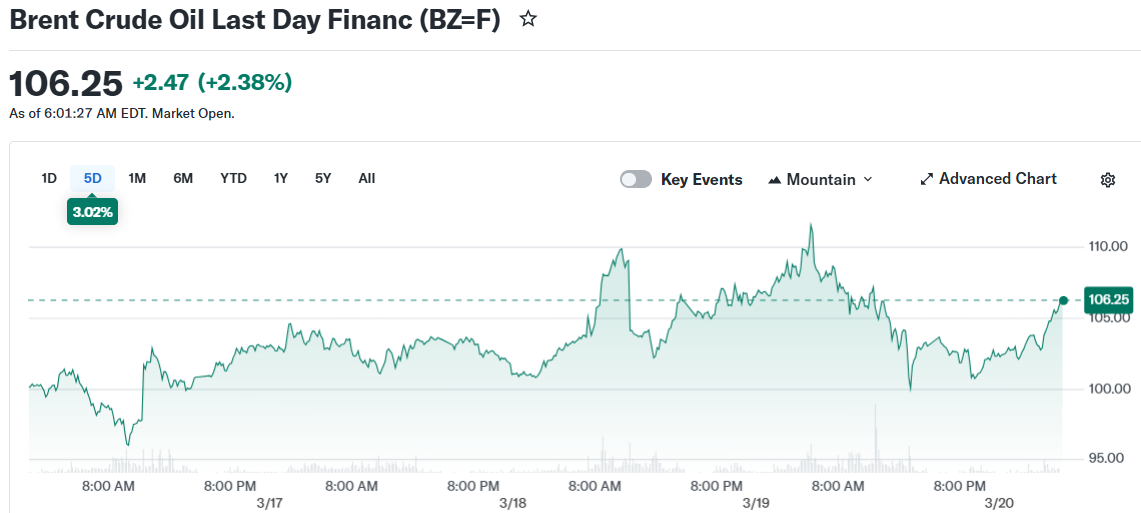
Brent crude futures hit $119 per barrel earlier in the week after Israeli forces struck Iran’s South Pars gas field, one of the world’s largest natural gas sites. Prices pulled back to around $107.87 by Friday morning, with West Texas Intermediate falling to $94.46 a barrel, down 1.2%.
Brent Crude Oil Last Day Financ (BZ=F)Brent Crude Oil Last Day Financ (BZ=F)

The gap between Brent and WTI prices reflects the different situations facing global and U.S. oil supplies. American oil infrastructure has not been directly hit, and there is talk of the Trump administration potentially banning U.S. crude exports to keep domestic prices lower.

Iran launched retaliatory strikes across the region in response to the Israeli attacks. Countries allied with the United States reported incoming drones and missiles. Israel then targeted Tehran after missile alarms went off in Jerusalem and northern Israel.

Qatar, one of the world’s biggest natural gas exporters, confirmed that its Ras Laffan facility was hit in the strikes. The country said its export capacity has been cut by 17% and warned repairs could take up to five years. Europe, which depends heavily on Qatari gas, has seen its regional natural gas benchmark surge as a result.

What Could Bring Prices Down

The White House is working to calm energy markets. Treasury Secretary Scott Bessent said the U.S. could “unsanction” Iranian oil already at sea, which would add roughly 140 million barrels to global supply. He also raised the possibility of releasing more emergency oil reserves.

U.S. and allied forces have been escalating efforts to reopen the Strait of Hormuz, the narrow waterway through which a large share of the world’s oil passes. American warships may escort vessels through the strait if Iranian attack risks are reduced. But analysts at Vital Knowledge noted that a full reopening still requires either a major military escalation or a diplomatic deal.

Trump told reporters he would do what was needed to end the crisis, but said he had no plans to send ground troops. He added that the Pentagon had requested $200 billion in war funding from the White House.

How High Could Oil Go?

Saudi Arabia’s oil officials told the Wall Street Journal that prices could top $180 a barrel if the conflict and supply disruptions continue into late April. That is the scenario markets are currently trying to price in.

WTI futures are down nearly 5% over the past five trading sessions, reflecting some optimism that a resolution is possible. But analysts warn that even if the Strait of Hormuz is reopened, the physical damage to production facilities could keep supply tight for years.

The post Oil Hit $119 This Week — Here’s Why It Could Go to $180 If the Iran War Drags On appeared first on CoinCentral.


Market Opportunity
Overtake Logo
Overtake Price(TAKE)
$0.01816
$0.01816$0.01816
-0.54%
USD
Overtake (TAKE) Live Price Chart
Disclaimer: The articles reposted on this site are sourced from public platforms and are provided for informational purposes only. They do not necessarily reflect the views of MEXC. All rights remain with the original authors. If you believe any content infringes on third-party rights, please contact [email protected] for removal. MEXC makes no guarantees regarding the accuracy, completeness, or timeliness of the content and is not responsible for any actions taken based on the information provided. The content does not constitute financial, legal, or other professional advice, nor should it be considered a recommendation or endorsement by MEXC.

You May Also Like

The Channel Factories We’ve Been Waiting For

The Channel Factories We’ve Been Waiting For

The post The Channel Factories We’ve Been Waiting For appeared on BitcoinEthereumNews.com. Visions of future technology are often prescient about the broad strokes while flubbing the details. The tablets in “2001: A Space Odyssey” do indeed look like iPads, but you never see the astronauts paying for subscriptions or wasting hours on Candy Crush.  Channel factories are one vision that arose early in the history of the Lightning Network to address some challenges that Lightning has faced from the beginning. Despite having grown to become Bitcoin’s most successful layer-2 scaling solution, with instant and low-fee payments, Lightning’s scale is limited by its reliance on payment channels. Although Lightning shifts most transactions off-chain, each payment channel still requires an on-chain transaction to open and (usually) another to close. As adoption grows, pressure on the blockchain grows with it. The need for a more scalable approach to managing channels is clear. Channel factories were supposed to meet this need, but where are they? In 2025, subnetworks are emerging that revive the impetus of channel factories with some new details that vastly increase their potential. They are natively interoperable with Lightning and achieve greater scale by allowing a group of participants to open a shared multisig UTXO and create multiple bilateral channels, which reduces the number of on-chain transactions and improves capital efficiency. Achieving greater scale by reducing complexity, Ark and Spark perform the same function as traditional channel factories with new designs and additional capabilities based on shared UTXOs.  Channel Factories 101 Channel factories have been around since the inception of Lightning. A factory is a multiparty contract where multiple users (not just two, as in a Dryja-Poon channel) cooperatively lock funds in a single multisig UTXO. They can open, close and update channels off-chain without updating the blockchain for each operation. Only when participants leave or the factory dissolves is an on-chain transaction…
Share
BitcoinEthereumNews2025/09/18 00:09
Gold continues to hit new highs. How to invest in gold in the crypto market?

Gold continues to hit new highs. How to invest in gold in the crypto market?

As Bitcoin encounters a "value winter", real-world gold is recasting the iron curtain of value on the blockchain.
Share
PANews2025/04/14 17:12
XRP Multi-Year Accumulation Signals Potential 1000% Breakout

XRP Multi-Year Accumulation Signals Potential 1000% Breakout

The post XRP Multi-Year Accumulation Signals Potential 1000% Breakout appeared on BitcoinEthereumNews.com. XRP Builds Multi-Year Base as Whales Accumulate and Volume
Share
BitcoinEthereumNews2026/03/21 00:04