

Treasury Yields Rise: What It Means for Bitcoin and Stock Markets
TLDR
- Bitcoin crashed from ~$90,000 to nearly $60,000 in early 2026, while stocks held steady — until now.
- Since the Iran war began Feb. 28, Treasury yields have spiked, dragging Nasdaq and S&P 500 futures to September lows.
- The 10-year Treasury yield hit 4.41%, its highest since August 1, up 48 basis points since the conflict began.
- Bitcoin and stock market fear indexes have both entered “extreme fear” territory in the final week of March.
- 52% of retail investors are now bearish on the next six months — the highest reading since May 2025.
Bitcoin dropped sharply at the start of 2026, falling from around $90,000 to nearly $60,000 in just five weeks. At the time, U.S. stock markets barely moved, trading near record highs.
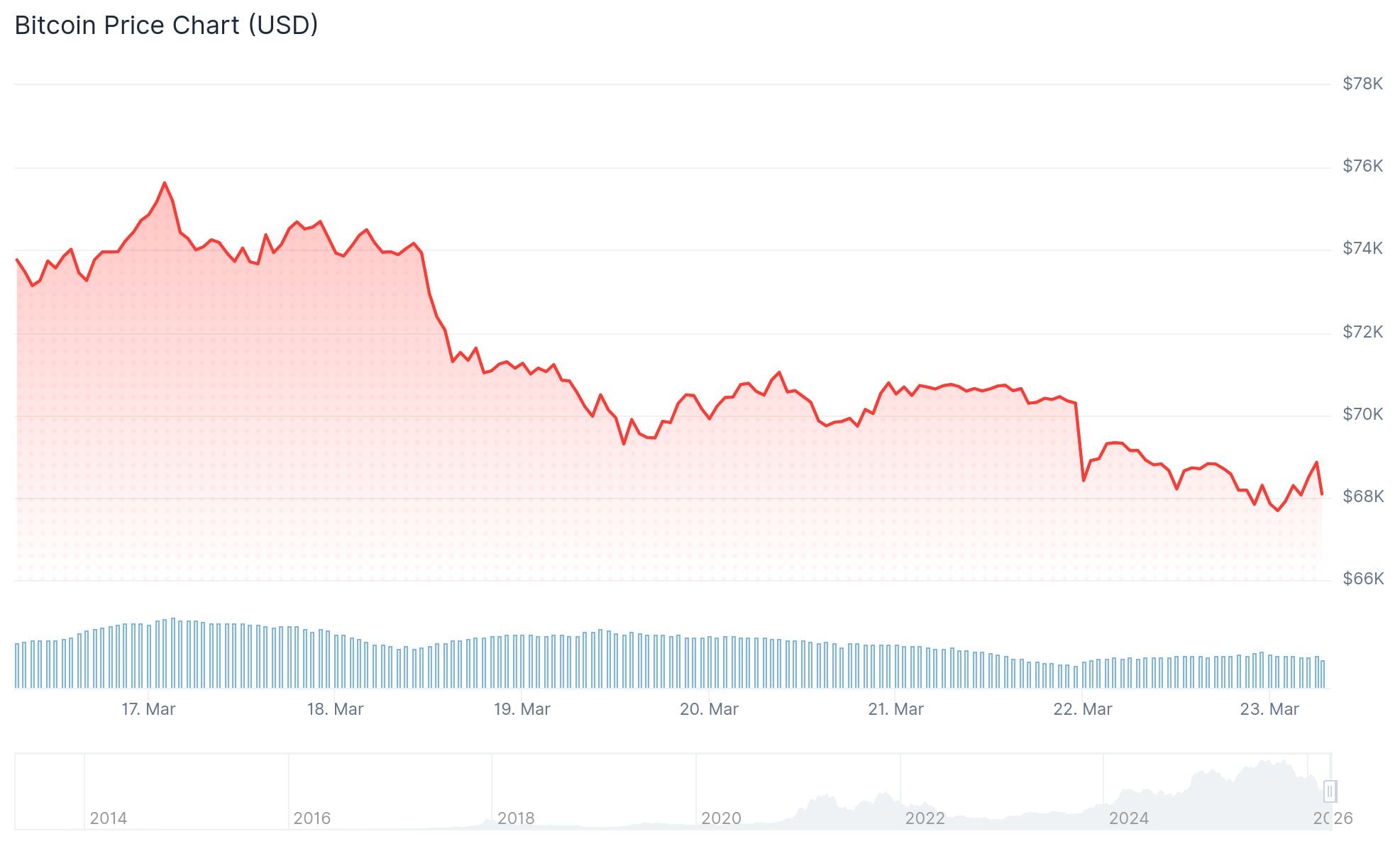 Bitcoin (BTC) Price
That gap is now closing — but not in a good way.
Since the Iran war started on February 28, fears over inflation and fading expectations for Federal Reserve rate cuts have sent U.S. Treasury yields climbing. That has begun to pull equities lower, catching up with the weakness bitcoin already showed weeks earlier.
The yield on the 10-year U.S. Treasury note rose to 4.41% early Monday, the highest level since August 1. It has climbed 48 basis points since the start of the Iran conflict. The two-year Treasury yield has jumped 57 basis points to 3.94%.
Higher yields matter because they push up borrowing costs across the economy — from mortgages to corporate loans. That tends to reduce risk appetite in stock markets.
Nasdaq futures fell to 23,890 points early Monday, the lowest since September 11. S&P 500 e-mini futures dropped to 6,505 points, also the lowest since September.
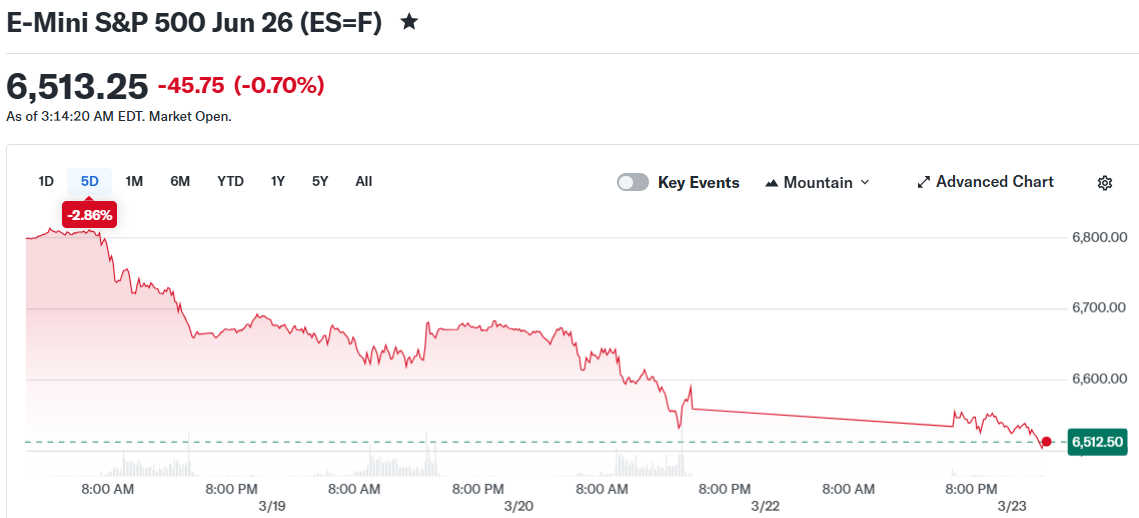 E-Mini S&P 500 Jun 26 (ES=F)
Bitcoin as a Leading Indicator
Analysts have long watched bitcoin as an early signal for broader market risk appetite. Its early 2026 decline may have been a preview of what stocks are now experiencing.
Bitcoin itself has been relatively stable in recent weeks, trading between $65,000 and $75,000. As of Monday morning it sat near $68,790. But options market data shows deep concern, with a record tilt toward put options — contracts used to hedge against further price drops.
Fear Spreading Across Both Markets
Sentiment data shows fear is now widespread. The Crypto Fear & Greed Index has returned to “extreme fear.” A parallel index for stocks has also dropped sharply.
On-chain data platform Alphractal describes the convergence of fear across both markets as a rare signal, warning investors to stay cautious.
A survey by the American Association of Individual Investors shows 52% of retail investors hold a bearish outlook for the next six months. That is the highest reading since May 2025.
Donald Trump’s 48-hour ultimatum regarding the Strait of Hormuz is still counting down, adding to market tension.
Analyst Tony Severino points to a historical pattern where bitcoin’s correlation with the S&P 500 drops to -0.5 and then sharply reverses upward — a pattern he says often precedes a stock market crash. That correlation has now turned positive again.
Markets are now pricing in a small probability that the Federal Reserve could raise interest rates rather than cut them.
The post Treasury Yields Rise: What It Means for Bitcoin and Stock Markets appeared first on CoinCentral.


You May Also Like

XRP ETFs See Biggest Inflows Since January as Ripple Momentum Builds

Q2 Market Insights: Bitcoin regains dominance in risk-averse environment, ETFs remain critical to market structure




