

Runway Monitoring: Rethinking Airport Operations
Autonomous Runway Monitoring Signals Shift in Aviation CX Strategy
Skylark Labs has deployed a fixed Foreign Object Debris (FOD) detection system at major commercial airports, marking a shift toward continuous, AI-driven runway monitoring. The system replaces traditional vehicle-based inspection models with stationary infrastructure capable of operating autonomously around the clock.
The announcement reflects a broader transformation underway in aviation, where operational resilience is increasingly tied to customer experience outcomes. As passenger volumes rise and airline schedules tighten, even minor inefficiencies in ground operations can ripple across the travel journey.
This operational reality underscores why airports are re-evaluating legacy processes that introduce variability into runway availability and safety management.
The Evolving Role of Operations in Customer Experience
Customer expectations in aviation have shifted toward predictability and seamlessness. Passengers expect on-time departures, minimal waiting, and consistent service delivery. Airlines, in turn, rely on tightly coordinated ground operations to maintain schedules and optimize fleet utilization.
Historically, runway safety checks have depended on scheduled vehicle patrols. While necessary, these processes introduce constraints—ranging from manpower dependency to temporary runway disruptions during inspections.
As digital transformation accelerates, airports are adopting AI-driven systems that provide continuous visibility into operations. These systems reduce reliance on manual interventions and enable real-time decision-making.
In this context, technologies that enhance uptime and reduce uncertainty are becoming central to CX strategy, not just operational improvement.
Strategic Positioning Through Networked Intelligence
The deployment of fixed FOD detection systems aligns with Skylark Labs’ broader strategy of building adaptive, edge-based AI platforms for critical infrastructure. By extending its existing Runway Monitoring Intelligence Layer from mobile vehicles to fixed installations, the company is moving toward a more comprehensive, networked intelligence model.
This approach reflects a shift from standalone solutions to interconnected ecosystems. Each deployment contributes to a shared pool of intelligence, enabling systems to learn collectively across geographies.
Such a model offers two strategic advantages. First, it improves detection accuracy over time by incorporating diverse operational data. Second, it creates a cumulative knowledge base that strengthens the company’s competitive positioning in the aviation technology space.
For airport operators, this translates into access to continuously improving systems that benefit from global insights without requiring localized reinvention.
How the Technology Works
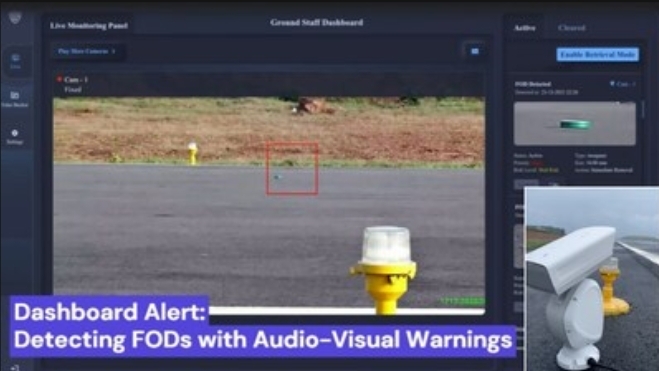
At its core, the fixed FOD detection system uses adaptive optical AI to monitor runway surfaces continuously. Unlike periodic inspections, it provides real-time detection and classification of debris, ensuring that potential hazards are identified as soon as they appear.
When debris is detected, the system transmits precise coordinates to ground operations and air traffic control. This enables rapid response without the need to deploy inspection vehicles or disrupt ongoing operations.
A key differentiator is the system’s ability to learn from its environment. By analyzing patterns such as false positives, surface anomalies, and recurring debris types, it refines its detection models over time.
In addition, the system builds longitudinal safety profiles of runway conditions. These profiles help identify high-risk zones and support predictive maintenance strategies, allowing operators to address issues proactively.
The integration with a broader intelligence network further amplifies its value, as insights from one airport can be applied across others in near real time.
Implications for Customer Experience
Although runway monitoring operates behind the scenes, its impact on customer experience is direct and measurable. Delays caused by debris detection, inspections, or runway closures can disrupt tightly scheduled operations, leading to missed connections and passenger dissatisfaction.
By enabling continuous monitoring without interrupting runway usage, the system reduces the likelihood of such disruptions. Faster detection and response times further mitigate the impact when issues do arise.
From a CX standpoint, the benefits are clear: improved on-time performance, reduced uncertainty, and greater consistency in service delivery. These factors contribute to higher levels of passenger trust and satisfaction.
Moreover, predictive maintenance capabilities help prevent unexpected failures, ensuring a more stable operational environment. This stability is critical in an industry where even small disruptions can have outsized effects on customer perception.
Broader Industry Implications
The adoption of fixed, AI-driven monitoring systems signals a broader transition toward autonomous infrastructure in aviation. As airports modernize, the focus is shifting from reactive processes to predictive, always-on systems that enhance both safety and efficiency.
This shift has competitive implications. Airports that invest in such technologies are likely to achieve higher levels of operational reliability, positioning themselves as preferred hubs for airlines and passengers alike.
At the same time, the emergence of shared intelligence ecosystems may accelerate industry-wide learning, raising the baseline for safety and performance standards.
Over time, these technologies could become integral to airport operations, much like radar and air traffic control systems today.
The Future of CX in Aviation
Looking ahead, the convergence of AI, automation, and infrastructure management will play a defining role in shaping aviation customer experience. As systems become more autonomous and interconnected, the distinction between operational efficiency and CX will continue to blur.
For CX leaders, this evolution presents both an opportunity and a challenge. Delivering superior experiences will increasingly depend on the ability to influence and integrate with backend systems that are not traditionally within the CX domain.
The deployment of fixed FOD detection systems illustrates how targeted technological innovation can address both operational and experiential priorities. By reducing friction, enhancing reliability, and enabling predictive decision-making, such solutions contribute to a more seamless travel ecosystem.
Ultimately, the future of aviation CX will be defined not only by what passengers see, but by the intelligence embedded in the systems that keep operations running smoothly.
KEY TAKEAWAYS
- Operational reliability is central to CX: Backend efficiency directly shapes passenger experience outcomes.
- Autonomous monitoring reduces disruption: Always-on systems minimize delays and improve response times.
- AI-driven insights enable predictive operations: Data-led maintenance reduces unexpected failures.
- Shared intelligence creates compounding value: Networked systems improve continuously across deployments.
- CX leaders must look beyond touchpoints: Infrastructure and operations are now critical components of experience strategy.
The post Runway Monitoring: Rethinking Airport Operations appeared first on CX Quest.


You May Also Like

Prediction markets get CFTC relief as legal battles widen

Metaplanet Stock: How a 24% Bitcoin Drop Erased Strong Operating Gains




