Shiba Inu is doing that thing again where it quietly grinds higher while nobody’s watching. World Of Charts just pointed out that SHIB is retesting a key level,Shiba Inu is doing that thing again where it quietly grinds higher while nobody’s watching. World Of Charts just pointed out that SHIB is retesting a key level,

Is Shiba Inu (SHIB) About to Break Its Months-Long Downtrend? The Chart Shows What’s Next

2026/03/24 06:30
3 min read
For feedback or concerns regarding this content, please contact us at [email protected]

Shiba Inu is doing that thing again where it quietly grinds higher while nobody’s watching. World Of Charts just pointed out that SHIB is retesting a key level, and he’s expecting a move toward the descending trendline. 

The SHIB price has been in this slow, grinding downtrend since the 2024 highs, and every time it tries to bounce, it hits that descending trendline and rolls over. But this time feels a little different.

What the SHIB Chart Is Showing

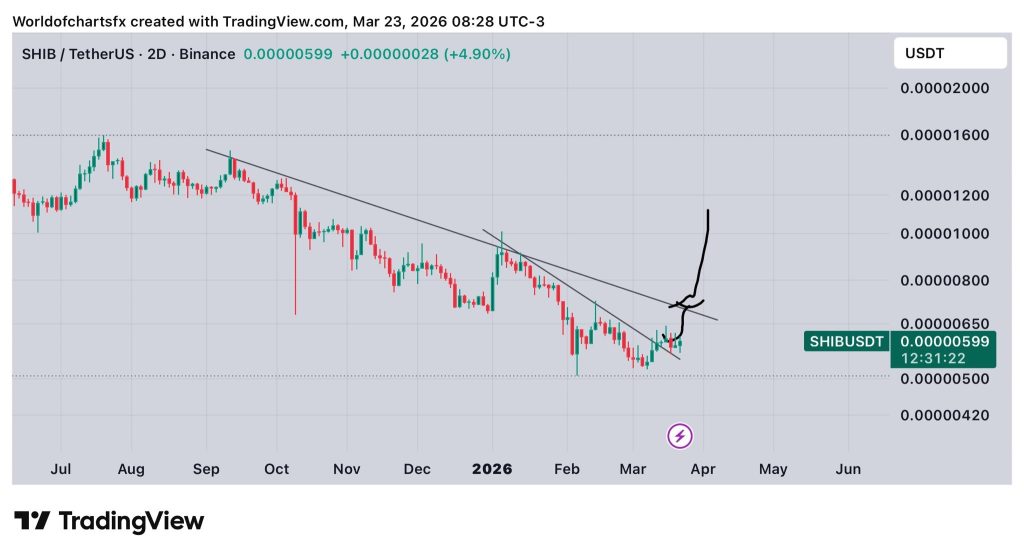
We took a look at the 2-day chart, and the structure is pretty clear. The SHIB price is currently sitting around $0.00000599, up about 4.9% on this candle. It’s been bouncing from the lows near $0.00000420 and working its way higher, and now it’s retesting an area that’s been a pivot point in the past.
Source: X/@Worldofcharts1

The descending trendline is the main event here. It’s been connecting the lower highs since the peak, and every time SHIB gets close, it gets rejected. World Of Charts is watching to see if this time is different. He’s expecting a move toward that trendline, which means we could see SHIB grind higher from here.

The chart shows the SHIB price has been forming a series of higher lows since the February bottom. That’s important because it means the downtrend might be losing steam. When you start seeing higher lows, it usually means sellers are getting exhausted and buyers are slowly stepping in.

What Retesting Means and The Levels That Matter

When an analyst says SHIB is “retesting,” it means the price is coming back to a level that’s been significant in the past. Sometimes it’s support. Sometimes it’s resistance. In this case, SHIB is retesting the area that previously acted as a launching pad for moves higher.

World Of Charts isn’t calling a moonshot here. What he’s saying is the next logical move is toward that descending trendline. That move would take SHIB from where it is now up to somewhere in the $0.000007 to $0.000008 range. That’s a 20%-30% move, which is actually pretty solid for a coin that’s been stuck in consolidation forever.

The level to watch is $0.00000550. If SHIB can hold above that, the path stays open. First stop is around $0.00000650, and then you’ve got the trendline itself, probably sitting somewhere in that $0.000007 to $0.000008 zone. Pretty simple roadmap. Now it’s just about whether SHIB can actually follow it.

On the downside, if SHIB loses $0.00000500, the setup changes. That would mean the higher lows pattern is broken, and we could be looking at a retest of the lows near $0.00000420. That’s not the expected move, but it’s the invalidation level to watch.

Read Also: ChatGPT Predicts the Price of XRP and Pi Coin By the End of 2026

What Comes Next for SHIB

SHIB is bouncing off support, making higher lows, and slowly working its way toward resistance. World Of Charts sees this as a retest, and he’s expecting a move toward the descending trendline.

That doesn’t mean it’s going to happen overnight. These things take time. But the structure is there. The pattern is clear. And if SHIB can finally break that descending trendline, that’s when things could get really interesting. 

Subscribe to our YouTube channel for daily crypto updates, market insights, and expert analysis.

The post Is Shiba Inu (SHIB) About to Break Its Months-Long Downtrend? The Chart Shows What’s Next appeared first on CaptainAltcoin.


Market Opportunity
SHIBAINU Logo
SHIBAINU Price(SHIB)
$0.000006026
$0.000006026$0.000006026
-0.79%
USD
SHIBAINU (SHIB) Live Price Chart
Disclaimer: The articles reposted on this site are sourced from public platforms and are provided for informational purposes only. They do not necessarily reflect the views of MEXC. All rights remain with the original authors. If you believe any content infringes on third-party rights, please contact [email protected] for removal. MEXC makes no guarantees regarding the accuracy, completeness, or timeliness of the content and is not responsible for any actions taken based on the information provided. The content does not constitute financial, legal, or other professional advice, nor should it be considered a recommendation or endorsement by MEXC.

You May Also Like

The Channel Factories We’ve Been Waiting For

The Channel Factories We’ve Been Waiting For

The post The Channel Factories We’ve Been Waiting For appeared on BitcoinEthereumNews.com. Visions of future technology are often prescient about the broad strokes while flubbing the details. The tablets in “2001: A Space Odyssey” do indeed look like iPads, but you never see the astronauts paying for subscriptions or wasting hours on Candy Crush.  Channel factories are one vision that arose early in the history of the Lightning Network to address some challenges that Lightning has faced from the beginning. Despite having grown to become Bitcoin’s most successful layer-2 scaling solution, with instant and low-fee payments, Lightning’s scale is limited by its reliance on payment channels. Although Lightning shifts most transactions off-chain, each payment channel still requires an on-chain transaction to open and (usually) another to close. As adoption grows, pressure on the blockchain grows with it. The need for a more scalable approach to managing channels is clear. Channel factories were supposed to meet this need, but where are they? In 2025, subnetworks are emerging that revive the impetus of channel factories with some new details that vastly increase their potential. They are natively interoperable with Lightning and achieve greater scale by allowing a group of participants to open a shared multisig UTXO and create multiple bilateral channels, which reduces the number of on-chain transactions and improves capital efficiency. Achieving greater scale by reducing complexity, Ark and Spark perform the same function as traditional channel factories with new designs and additional capabilities based on shared UTXOs.  Channel Factories 101 Channel factories have been around since the inception of Lightning. A factory is a multiparty contract where multiple users (not just two, as in a Dryja-Poon channel) cooperatively lock funds in a single multisig UTXO. They can open, close and update channels off-chain without updating the blockchain for each operation. Only when participants leave or the factory dissolves is an on-chain transaction…
Share
BitcoinEthereumNews2025/09/18 00:09
Stabull’s Expansive Role in the DeFi Ecosystem

Stabull’s Expansive Role in the DeFi Ecosystem

The post Stabull’s Expansive Role in the DeFi Ecosystem appeared on BitcoinEthereumNews.com. A detailed examination of the Stabull protocol reveals its reach extends
Share
BitcoinEthereumNews2026/03/24 07:28
Stablecoin yield in crypto Clarity Act won’t allow rewards on balances, latest text says

Stablecoin yield in crypto Clarity Act won’t allow rewards on balances, latest text says

The post Stablecoin yield in crypto Clarity Act won’t allow rewards on balances, latest text says appeared on BitcoinEthereumNews.com. Crypto industry insiders
Share
BitcoinEthereumNews2026/03/24 06:58