Loopring (LRC) Price Prediction 2026, 2027-2030: Is LRC Heading for Recovery or Collapse?
The post Loopring (LRC) Price Prediction 2026, 2027-2030: Is LRC Heading for Recovery or Collapse? appeared first on Coinpedia Fintech News
Story Highlights
- The live price of Loopring is $ 0.02297305.
- Loopring (LRC) faces 2026 challenges after Binance and Upbit delistings; Layer-3 adoption will determine if LRC stabilizes or drops further.
- LRC shifts focus from Layer-2 hype to infrastructure; successful Layer-3 rollout across networks could drive long-term recovery and token demand.
Loopring is no longer fighting for hype; it’s fighting for survival.
Loopring (LRC) is a Layer 2 network built on the Ethereum blockchain. It helps make crypto trading and payments faster and cheaper, especially on decentralized exchanges.
Loopring uses a technology called ZK-Rollups, which groups many transactions together before sending them to Ethereum. This allows the network to process over 2,000 transactions per second with very low fees, while still using Ethereum’s security.
However, recent news about the Loopring wallet shutting down and a major exchange update related to LRC has made investors nervous weather this LRC token will survive in the future.
So let’s explore CoinPedia’s Loopring’s (LRC) Price Prediction 2026, 2027 – 2030.
Loopring Price Today
| Cryptocurrency | Loopring |
| Token | LRC |
| Price | $0.0230  -1.93% -1.93% |
| Market Cap | $ 31,434,918.02 |
| 24h Volume | $ 10,247,658.2728 |
| Circulating Supply | 1,368,338,773.1852 |
| Total Supply | 1,373,873,397.4425 |
| All-Time High | $ 3.8272 on 10 November 2021 |
| All-Time Low | $ 0.0199 on 18 December 2019 |
Table of contents
- Loopring (LRC) Price Targets For April 2026
- Technical Analysis
- Loopring (LRC) Price Prediction 2026
- Loopring Price Prediction 2026 – 2030
- Loopring (LRC) Price Prediction 2026
- Loopring Price Prediction 2027
- Loopring Price Forecast 2028
- LRC Price Prediction 2029
- Loopring (LRC) Price Prediction 2030
- What Does The Market Say?
- CoinPedia’s Loopring (LRC) Price Prediction
- FAQs
Loopring (LRC) Price Targets For April 2026
April 2026 could be a very volatile month for Loopring (LRC). Two big exchange delistings are happening close together. Upbit delisted LRC in March 2026, and Binance is scheduled to delist LRC on April 1, 2026.
These exchanges used to handle a large part of the LRC trading volume. When big exchanges remove a token, it usually reduces trading activity, investor access, and overall market liquidity.
Because of this, prices can become very unstable and may move down quickly, especially for smaller market cap tokens like LRC.
Despite this, if markets interpret this pivot positively, LRC could stabilize after the delisting shock. Otherwise, continued liquidity drain could push prices lower.
| Month | Potential Low ($) | Potential Average ($) | Potential High ($) |
| Loopring Price Prediction April 2026 | $0.012 | $0.026 | $0.035 |
Technical Analysis
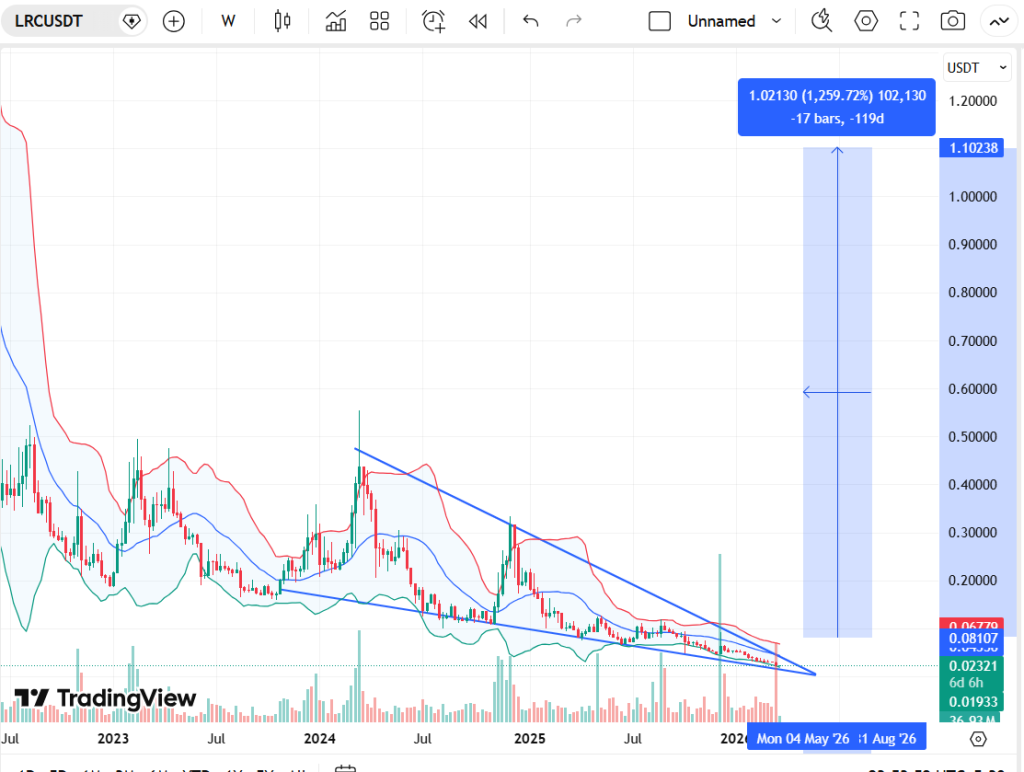
Looking at the Loopring (LRC) weekly chart, it is still trading inside a long-term downtrend, forming lower highs and lower lows inside a falling wedge.
The key support sits around $0.06 as the Price is holding this zone, suggesting accumulation. A weekly close below $0.06 would invalidate the bullish setup and may trigger another leg down.
On the upside, the first resistance is near $0.18, followed by $0.30, where the previous breakdown occurred. A confirmed breakout above the descending trendline could start a strong reversal.
If a breakout happens with volume, LRC could move toward $0.75 over time.
Loopring (LRC) Price Prediction 2026
The year 2026 is not about growth for Loopring; it’s about staying relevant. Loopring’s future now depends on whether its zkRollup technology can still provide value in a market dominated by other Layer-2 solutions like zkSync, Starknet, Base, Arbitrum, and Scroll.
To compete, Loopring is shifting its focus to Layer-3 deployments. Instead of fighting directly with other Layer-2 networks, it aims to build specialized trading and infrastructure layers on top of them. This approach turns Loopring into a technology provider rather than a consumer-facing platform.
If this plan works, Loopring will establish itself as key infrastructure, the LRC token will gain real use through protocol activity, and demand for LRC could stabilize.
| Year | Potential Low ($) | Potential Average ($) | Potential High ($) |
| Loopring Price Prediction 2026 | $0.010 | $0.045 | $0.75 |
Loopring Price Prediction 2026 – 2030
| Year | Potential Low ($) | Potential Average ($) | Potential High ($) |
| 2026 | $0.010 | $0.045 | $0.75 |
| 2027 | $0.078 | $0.52 | $1 |
| 2028 | $0.13 | $0.0.87 | $1.87 |
| 2029 | $0.45 | $1.22 | $2.21 |
| 2030 | $0.59 | $1.76 | $2.97 |
Loopring (LRC) Price Prediction 2026
Following exchange delistings and restructuring, LRC could trade between $0.01 and $0.75, depending on the adoption of its Layer-3 rollout.
Loopring Price Prediction 2027
If Loopring successfully deploys on multiple networks like Arbitrum and Base, LRC could recover toward $1.
Loopring Price Forecast 2028
If Loopring successfully deploys on multiple networks like Arbitrum and Base, LRC could recover toward $1.87.
LRC Price Prediction 2029
With sustained usage across Layer-3 deployments, LRC could approach $2.21.
Loopring (LRC) Price Prediction 2030
If Loopring becomes a modular trading layer across networks, LRC could target $2.97.
What Does The Market Say?
| Year | 2026 | 2027 | 2030 |
| Changelly | $0.110 | $0.144 | $ 0.654 |
| CoinCodeX | $0.169 | $0.1064 | $0.039341 |
| Digitalcoinprice | $0.1077 | $0.113 | $0.1375 |
CoinPedia’s Loopring (LRC) Price Prediction
Loopring is no longer a fast-growing Layer-2; it is now a lean infrastructure experiment.
The success of this pivot depends entirely on L3 deployments, developer adoption, and DEX infrastructure demand.
Although the Binance and Upbit delistings create short-term pressure, the long-term outlook depends on whether the zkRollup engine still finds users.
If Loopring successfully integrates across multiple L2 ecosystems, LRC could stabilize and recover.
| Year | Potential Low ($) | Potential Average ($) | Potential High ($) |
| 2026 | $0.010 | $0.045 | $0.75 |
Never Miss a Beat in the Crypto World!
Stay ahead with breaking news, expert analysis, and real-time updates on the latest trends in Bitcoin, altcoins, DeFi, NFTs, and more.
 Subscribe to Price Prediction
FAQs
Loopring is a Layer-2 Ethereum network using zkRollups to speed up trading and payments with low fees while keeping Ethereum’s security.
After delistings, LRC could trade between $0.01 and $0.75, depending on adoption of its Layer-3 deployments.
If Loopring becomes a key Layer-3 infrastructure across networks, LRC could reach around $2.97 by 2030.
Long-term, if Loopring remains a modular trading layer, LRC could target $5–$6 by 2040, based on network adoption and usage.
LRC may appeal to investors focused on infrastructure growth, but short-term volatility is high due to delistings and competition.


You May Also Like

Q2 Market Insights: Bitcoin regains dominance in risk-averse environment, ETFs remain critical to market structure

Nebius Revenue Skyrockets 684%: Why the "Pennsylvania AI Factory" Is the New Frontier for AI Infrastructure