

Equinix Drives Global Workforce Development to Address AI-Era Talent Gaps
Equinix Drives Global Workforce Development as a Strategic Response to Infrastructure-Driven CX Demands
The announcement that Equinix Drives Global Workforce Development comes at a pivotal moment when digital infrastructure has become inseparable from customer experience delivery. As enterprises scale AI deployments and digital services become deeply embedded in everyday interactions, the tolerance for latency, downtime, or inconsistency has effectively disappeared.
Equinix’s move signals recognition of a less visible but increasingly critical constraint: the shortage of skilled technical talent required to operate complex, high-density data center environments. While much of the industry’s focus remains on capacity expansion and technological innovation, Equinix is addressing the human layer that ultimately determines whether these systems deliver reliably.
This initiative reframes workforce development as a strategic enabler of customer experience rather than a peripheral operational concern.
Infrastructure Pressure Is Redefining CX Expectations
Customer expectations have evolved toward real-time responsiveness, uninterrupted access, and seamless digital interactions across geographies. Whether it is cloud computing, financial services, or AI-driven applications, the expectation is consistent: services must be always available and instantly responsive.
This expectation places unprecedented operational pressure on data centers, which now serve as the backbone of nearly every digital interaction. However, maintaining these environments requires highly specialized skills—ranging from electrical systems management to thermal optimization and network reliability.
The rapid rise of AI workloads further complicates this landscape. High-performance computing environments demand precision in power distribution and cooling, increasing both the technical complexity and the margin for error.
For CX leaders, this creates a structural dependency where infrastructure performance directly shapes customer perception, satisfaction, and trust.
A Strategic Shift from Hiring to Talent Creation
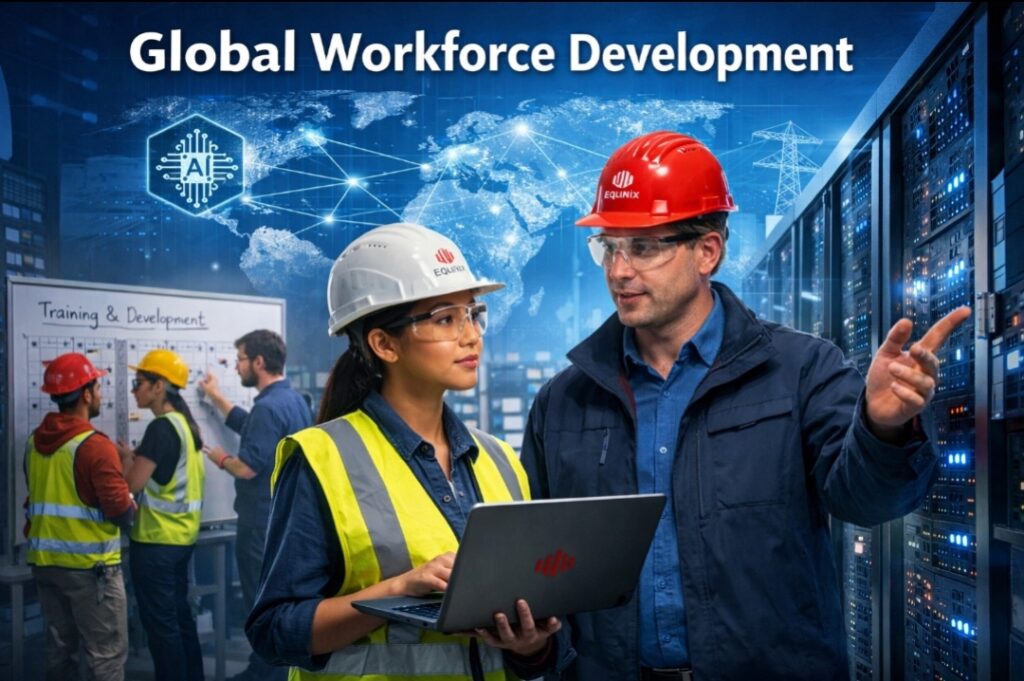
At its core, Equinix Drives Global Workforce Development reflects a deliberate shift from traditional hiring models to proactive talent creation. The company is moving upstream in the talent lifecycle—engaging students early, structuring career pathways, and aligning training directly with operational needs.
Programs such as Pathways to Tech introduce students to data center environments at an early stage, while apprenticeships and Learning Labs provide structured, hands-on training. The inclusion of global coalitions and partnerships extends this model beyond organizational boundaries, creating a shared ecosystem approach.
This strategy serves multiple purposes:
- It reduces dependency on increasingly constrained labor markets
- It ensures that skills are aligned with real-world operational requirements
- It builds a predictable and scalable workforce pipeline
Rather than reacting to talent shortages, Equinix is positioning itself to mitigate them structurally.
Workforce Development as an Operational System
Although framed as workforce initiatives, the programs under Equinix Drives Global Workforce Development function as a cohesive operational system designed to support infrastructure reliability.
The model is layered:
- Early engagement through educational programs
- Skill development via apprenticeships and training labs
- Industry alignment through multi-employer coalitions
This integrated approach contrasts with legacy models where training is fragmented or occurs post-hiring. By standardizing learning pathways and aligning them with operational requirements, Equinix creates consistency in skill levels across geographies.
The result is not just a larger workforce, but a more predictable and performance-aligned one—critical for maintaining service quality at scale.
Translating Workforce Investment into CX Outcomes
The most compelling dimension of Equinix Drives Global Workforce Development is its direct, though often overlooked, impact on customer experience.
A skilled workforce reduces operational errors, improves response times to incidents, and ensures that systems are maintained proactively rather than reactively. This leads to measurable improvements in uptime and performance—two of the most critical determinants of digital experience quality.
Faster onboarding of trained technicians also enables quicker infrastructure deployment, allowing organizations to scale services in response to demand without compromising performance.
Standardized training ensures consistency in operations, which translates into consistent customer experiences across regions and platforms.
For customers, these operational improvements manifest as:
- Reduced service disruptions
- Faster response times
- Stable and predictable performance
- Greater trust in digital platforms
In this context, workforce development becomes a foundational lever for delivering reliable and scalable customer experiences.
Industry-Wide Implications of Workforce-Led Strategy
The broader implications of Equinix Drives Global Workforce Development extend across the digital infrastructure landscape. It highlights a structural shift where workforce capability is emerging as a key differentiator alongside technology and capital investment.
As AI adoption accelerates, the demand for specialized technical skills will continue to outpace supply. Organizations that rely solely on traditional hiring models will face increasing operational risks, including delays, inefficiencies, and service disruptions.
This is likely to drive a wave of similar initiatives across the industry, with companies investing in partnerships, training ecosystems, and early talent engagement.
The emergence of collaborative training coalitions also signals a recognition that the talent challenge is systemic and requires collective action.
The Future of CX Lies in Invisible Infrastructure Excellence
Looking ahead, the trajectory established by Equinix Drives Global Workforce Development points toward a future where the quality of customer experience is determined by the effectiveness of invisible infrastructure layers.
As technologies such as AI, edge computing, and interconnection continue to evolve, the complexity of managing these systems will increase. This will elevate the importance of skilled professionals who can operate, maintain, and optimize these environments.
Equinix’s approach suggests that the next phase of digital transformation will not be defined solely by technological advancement, but by the ability to align human capability with system complexity.
For CX leaders, this underscores a critical shift: delivering superior customer experiences increasingly requires investment in areas traditionally considered outside the CX domain.
Key Takeaways
- Workforce capability is now a core determinant of customer experience reliability and consistency
- Talent shortages in digital infrastructure pose direct risks to uptime and service quality
- Proactive talent creation is replacing reactive hiring as a strategic necessity
- Standardized training models enable consistent global service delivery
- Ecosystem collaboration is emerging as the most effective approach to solving industry-wide skill gaps
The post Equinix Drives Global Workforce Development to Address AI-Era Talent Gaps appeared first on CX Quest.


You May Also Like

Prediction markets get CFTC relief as legal battles widen

Metaplanet Stock: How a 24% Bitcoin Drop Erased Strong Operating Gains




