

9 High Speed Business WiFi Providers Ranked for Reliability & Real-World Speed
Picture your point-of-sale screens freezing during lunch rush. Phones keep ringing while the cloud CRM stays blank. Every silent minute can bleed up to $50,000 an hour from a typical small business. In 2026, “good enough” internet isn’t good enough. Fiber now pushes multi-gig speeds, Wi-Fi 6E floods offices, and 5 G or low-orbit satellites fill the gaps. Providers boast 99.9 percent uptime and gigabit tiers—yet the Tuesday-morning reality often disappoints. So we pulled thousands of speed tests, SLA fine print, reviews, and price sheets to rank the nine fastest options and help you choose with confidence.
Here’s what you’ll get as you read:
- A quick look at the criteria behind our rankings, so you can trust the list.
- A side-by-side comparison table for instant scanning.
- Short, punchy profiles that spell out strengths, drawbacks, and the kind of business each service fits best.
- A closing playbook that helps you match the right connection to your budget, location, and risk tolerance.
Ready to cut through the marketing noise and find an internet service that works as hard as you do? Let’s dive in.
Our ranking criteria & methodology
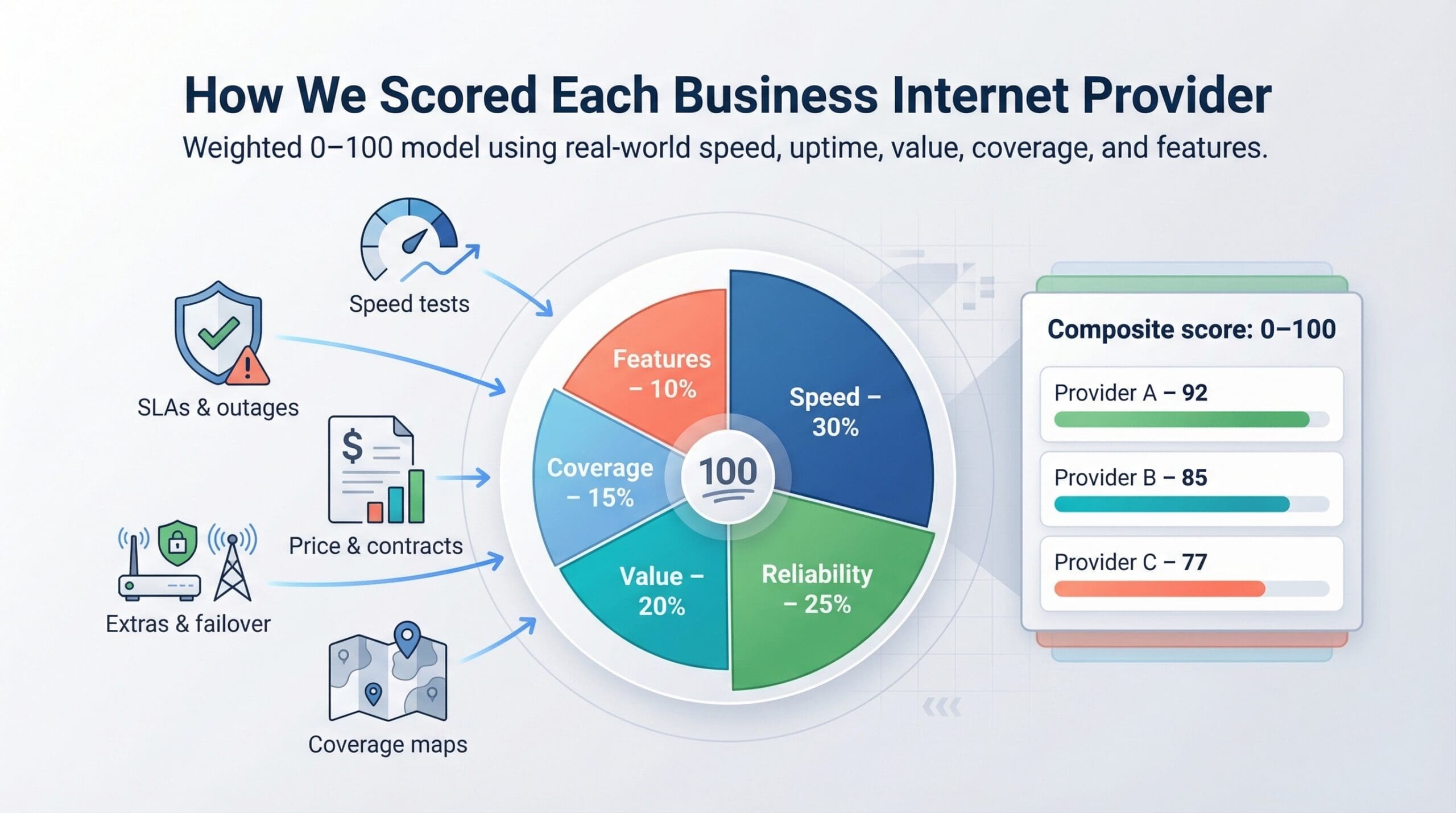
How we built our scorecard
We started with a blunt question: Which providers actually deliver the speed, reliability, and value they advertise? To answer it, we treated every ISP like a candidate in a rigorous job interview.
First, we pulled thousands of consumer and enterprise speed-test samples from public datasets such as Ookla Speedtest Intelligence and Opensignal. That told us how fast each network runs at nine on a Monday, not just in a glossy brochure.
Next, we examined published Service Level Agreements, outage logs, and backup-connectivity options to judge staying power. A provider that shrugs during a fiber cut never makes it past this round.
Price sheets came third. We compared cost per megabit at common tiers (200 Mbps, 1 Gbps, 2 Gbps), then adjusted for hidden fees, contract lock-ins, and promotional cliffs. Raw dollars matter, but surprise charges matter more.
Coverage maps and expansion plans followed. After all, the “best” service is useless if it stops five blocks short of your office.
Finally, we weighed bonus features: managed Wi-Fi, static IPs, cybersecurity suites, and 4G/5G failover. Extra tools that reduce your to-do list scored meaningful points.
Every data point fed a weighted model (speed 30 percent, reliability 25 percent, value 20 percent, coverage 15 percent, features 10 percent) to produce a clean zero-to-100 score. Only the nine providers with the highest composite ratings survived to the list you are about to explore.
 Scan the field at a glance
You have the scoring framework. Now let’s give you the quick-view table. Service type tells you the physical medium. Speed shows the fastest standard tier you can actually order, not a lab stunt. Starting price is the entry business plan for Q1 2026 before taxes. Contract spells out how long you are tethered. Uptime reflects the best publicly documented guarantee, and the last column flags any perk that sweetens the deal.
| Provider | Type | Top speed tier | Starting price* | Contract | Published uptime | Stand-out feature |
| WOW! Business | Cable + mesh | 1.2 Gbps down | ≈ $65 / mo | 1-year price-lock | 99.9 % (best effort) | Whole-Business Wi-Fi mesh included |
| Verizon Business | Fiber / 5 G FWA | 2 Gbps sym. (fiber) | $69 / mo | 12-month auto-renew | 99.99 % on fiber | 5 G plan for sites outside fiber |
| AT&T Business | Fiber | 5 Gbps sym. | $70 / mo | Month-to-month | 99.9 % SLA | LTE backup router $10 / mo |
| Comcast Business | Cable (DOCSIS) | 1.25 Gbps down | $49.99 / mo | 2 years or M2M | ≈ 99.9 % | Connection Pro 4 G failover |
| Spectrum Business | Cable | 940 Mbps down | $64.99 / mo | None | Best effort | Unlimited data, no ETF |
| Frontier Business | Fiber | 2 Gbps sym. | $55 / mo | 1 year | 99.9 % | Free install, lowest $/Mbps |
| EarthLink Business | Fiber (shared) | 5 Gbps sym. | $64.95 / mo | 1 year → M2M | 99.9 % | Bundled digital-marketing tools |
| Starlink Business | LEO satellite | 350 Mbps down | $500 / mo† | None | Best effort | Works virtually anywhere |
| T-Mobile Business | 5 G fixed wireless | 300 Mbps down | $50 / mo | None | Best effort | Static-IP plus M365 on top tier |
*Promotional entry pricing, verified March 2026. Local taxes and fees vary.
†Requires one-time $2,500 hardware purchase.
1. WOW! Business: whole-business Wi-Fi for offices that hate dead zones
If you run a restaurant, clinic, or co-working loft in the Midwest or Southeast, WOW! can feel like a local secret. The company pipes up to 1.2 Gbps over hybrid fiber-coax, yet its entry 600 Mbps plan lands around sixty-five dollars a month, often less than the big-cable rival across town.
Speed is only half the story. Its WOW! whole business wifi kit ships with two eero Pro nodes and a cloud dashboard that rolls out nightly security updates. The mesh can support hundreds of devices and even spins up a QR-code guest network, so you unbox, power up, and every corner of the floor gets the same strong signal clients expect at Fortune 500 campuses. No IT fire drills, no separate vendor contracts.
Reliability holds up as well. The network delivers low-teens latency and typically beats its own advertised download numbers, a feat DOCSIS providers rarely promote. While standard business tiers list a 99.9 percent uptime target, the true confidence builder is WOW!’s price-lock guarantee: your bill stays flat for the full year, even when promo stickers peel off competitor ads.
Add a quick installation crew plus optional phone and TV bundles, and you have a one-invoice package that keeps cash flow steady and Wi-Fi trouble off your to-do list. If WOW! serves your ZIP code, it is a straightforward path to enterprise-grade wireless without the enterprise-grade headache.\
 Verizon
2. Verizon Business: fiber speed champ with 5 G reach
Verizon wears two hats: blazing-fast Fios fiber in the Northeast and mid-Atlantic, plus a 5 G fixed-wireless service that now blankets dozens of metro cores. Either way, you get class-leading download consistency and snappy sub-10 millisecond latency.
Most small offices land on the 200 or 400 Mbps fiber tier because the price-to-performance ratio is hard to beat (around seventy dollars for symmetrical bandwidth that never blinks during a morning Teams call). Step up to the gigabit or 2 Gbps plan and uploads fly just as fast as downloads, a gift for media studios and cloud-backup addicts.
Reliability seals the deal. Business fiber carries a published 99.99 percent uptime target and real bill credits if the network falls short. Add 5 G Business Internet at the same address and you gain instant failover on a separate wireless backbone.
Verizon Business fiber and 5G Business Internet failover
One caution: the fine print auto-renews your contract after twelve months unless you speak up. Set a reminder, renegotiate the rate, and the service will keep humming while your accountant keeps smiling.
For teams that crave nearly unbreakable connectivity and routinely push large files upstream—think architects, videographers, or any SaaS crew—Verizon is the fastest horse in the race and remains surprisingly affordable.
3. AT&T Business: fiber horsepower and fan-favorite support
AT&T has poured serious investment into its fiber network. In many city cores you can order symmetrical tiers from 300 Mbps up to 5 Gbps, and independent tests show the company often exceeds those figures by a few percentage points. Uploads move as fast as downloads, so large video renders leave the office in minutes instead of hours.
Outages are rare. Standard business fiber carries a 99.9 percent service-level agreement, and you can add an LTE backup router for ten dollars a month. If a backhoe cuts the line, traffic shifts to cellular in under a minute and stays live for up to twelve hours on battery.
Customer care seals the deal. AT&T Business topped J.D. Power’s latest satisfaction index for every measured factor, from reliability to billing clarity. Combine that with true month-to-month terms on most fiber plans and you get enterprise-grade bandwidth without a long commitment.
For teams that move massive datasets or host latency-sensitive apps, AT&T provides both the room to grow and the safety net to sleep at night.
4. Comcast Business: nationwide cable with built-in backup
Comcast blankets more than forty states, so when fiber stops at the county line you can still secure a solid 100- to 1,250-Mbps cable circuit in days instead of weeks. Uploads trail downloads, yet the network’s median 137-Mbps real-world speed keeps everyday tasks snappy and video meetings crisp.
The standout feature is Connection Pro. Your gateway includes a 4 G modem that activates automatically if a squirrel, storm, or backhoe knocks out the coax. Staff keep swiping cards and customers keep checking out even during an eight-hour outage.
Comcast also bakes SecurityEdge into the router, scrubbing malware and phishing domains every ten minutes so you get a light firewall without hiring a managed-security firm.
Contracts run two years for the headline price, and renewal rates climb if you never call. Put a reminder on your calendar, renegotiate, and you keep a wide-coverage workhorse that rarely lets a small business down.
5. Spectrum Business: contract-free plans that let you keep the upper hand
Spectrum’s pitch is simple: fast cable, zero long-term contracts, unlimited data. You can sign up today, cancel tomorrow, and nobody sends an early-termination invoice. That freedom appeals to pop-up retailers, startups in co-working spaces, or any company that dislikes being locked down.
Speeds start at 200 Mbps and climb to a 940-Mbps Gig tier. Uploads top out around 35 Mbps, yet cloud apps, VoIP, and dozens of Zoom squares stay smooth. Because the base tier already delivers 200 Mbps, even the budget choice feels quick.
Reliability matches other DOCSIS networks, and you can add Wireless Internet Backup. If a storm drops lines, a built-in LTE modem keeps card readers and ticket printers online until crews finish repairs.
Prices land near sixty-five dollars for 300 Mbps and about one hundred fourteen for Gig. Promo rates last one year, then rise, but you are free to renegotiate or walk away. Spectrum will even cover up to five hundred dollars to buy out an existing contract, so switching is painless.
6. Frontier Business: gigabit fiber on a bootstrap budget
Frontier rebuilt its network by running fresh fiber through suburbs the big telcos skipped. The result: symmetrical 1- and 2-Gbps plans that often cost about half of what rivals charge. In some markets you can lock in 2 Gbps for about 150 dollars a month with installation included.
Performance is solid once the line is active. Opensignal data shows Frontier’s fiber consistency trails only Verizon, so video calls stay smooth and large uploads finish before you refill coffee.
Legacy baggage remains. Customer experiences range from “surprisingly helpful” to “hold music purgatory,” and copper DSL still haunts rural ZIP codes. Always confirm you are ordering pure fiber before signing.
If you clear that hurdle, Frontier offers one of the lowest price-per-megabit deals in the country and no data caps. For budget-minded startups, boutique agencies, or any team outside a major metro, it may be the most affordable path to true gigabit speeds in 2026.
7. EarthLink Business: white-glove service on someone else’s lines
EarthLink owns customer relationships, not miles of cable. It leases last-mile fiber from bigger carriers, then wraps that bandwidth in its own billing, support, and value-add stack. The result feels like a boutique service even though the light pulses through AT&T, Verizon, or Frontier glass.
Shared Fiber plans start near sixty-five dollars for 50 Mbps and climb to 5 Gbps where partner networks allow. Pricing sits a bit higher than going direct, yet many subscribers accept the premium for one reason: U.S.-based reps who answer fast and speak plainly.
Extras sweeten the deal. New accounts receive digital-marketing perks such as business-listing management and reputation monitoring that would cost a few hundred dollars a year if sourced separately. EarthLink can also stitch a 5 G or LTE circuit into your package for failover, giving single-site shops the redundancy usually reserved for multi-office enterprises.
Coverage is virtually nationwide because the company aggregates multiple carriers, but performance mirrors the underlying network. If your address only qualifies for cable or DSL, EarthLink can still provision service; it just will not match the fiber reviews you may have read.
Choose EarthLink when responsive human support matters more than shaving the last dollar off your internet bill, or when you manage several offices and want one vendor to chase outages so you do not have to.
 Starlink
8. Starlink Business: broadband from the sky for the last mile of nowhere
Some companies operate beyond the reach of any trench or pole. For them, Starlink’s low-Earth-orbit constellation can be the missing link. A suitcase-sized antenna locks onto satellites about 340 miles overhead and delivers up to 350 Mbps down and 20–40 Mbps up, with latency in the 30- to 50-millisecond range. That feels like decent cable rather than legacy satellite.
Starlink Business antenna serving remote commercial sites
Costs are steep: about five hundred dollars a month plus a one-time 2,500-dollar dish. On the upside, there is no contract, and you can pause service between tourist seasons or remote construction projects. The business-grade kit also prioritizes your packets over residential traffic, keeping checkout tablets and VoIP lines responsive even when a nearby ski lodge saturates the beam.
Weather can trim speeds and outages still occur, yet for ranches, resorts, and field offices that once relied on DSL or nothing at all, Starlink provides a workable path to modern cloud apps, card processing, and high-definition video calls.
 visually-reinforces-the-simplicity-and-low-commitment-nature-
9. T-Mobile Business Internet: plug-and-play 5 G for the price of lunch
Open the box, plug the gateway into a wall, and you are online in about five minutes. That simple setup has attracted more than three million customers to T-Mobile’s fixed-wireless service. Typical downloads range from 100 to 300 Mbps while uploads land near 20 Mbps, enough for point-of-sale systems, cloud docs, and HD video calls.
T-Mobile 5G Business Internet plug-and-play gateway
The plan matches the hardware for simplicity: fifty dollars a month, no annual contract, equipment included, unlimited data. Upgrade to the All-In tier and you receive a static IP plus a Microsoft 365 license, turning the gateway into both an internet pipe and a productivity bundle.
Performance can dip during tower congestion, and there is no formal SLA. Even so, latency stays around 30 milliseconds, which most users find acceptable. A 15-day test drive lets you check signal quality before committing.
For lean teams, retail kiosks, construction trailers, or anyone who needs quick, cable-free bandwidth as a primary line or an inexpensive backup, T-Mobile offers strong value at a lunch-money price.


You May Also Like

Prediction markets get CFTC relief as legal battles widen

Metaplanet Stock: How a 24% Bitcoin Drop Erased Strong Operating Gains




