Circle stock, CRCL, experienced a significant decline over the past day following news of a proposed ban on stablecoin yield. Despite this selloff, Bitwise’s CIOCircle stock, CRCL, experienced a significant decline over the past day following news of a proposed ban on stablecoin yield. Despite this selloff, Bitwise’s CIO

Bitwise CIO Projects Circle To Hit $75B Valuation By 2030 Despite Selloff, Clarity Act Concerns

2026/03/26 12:00
3 min read
For feedback or concerns regarding this content, please contact us at [email protected]

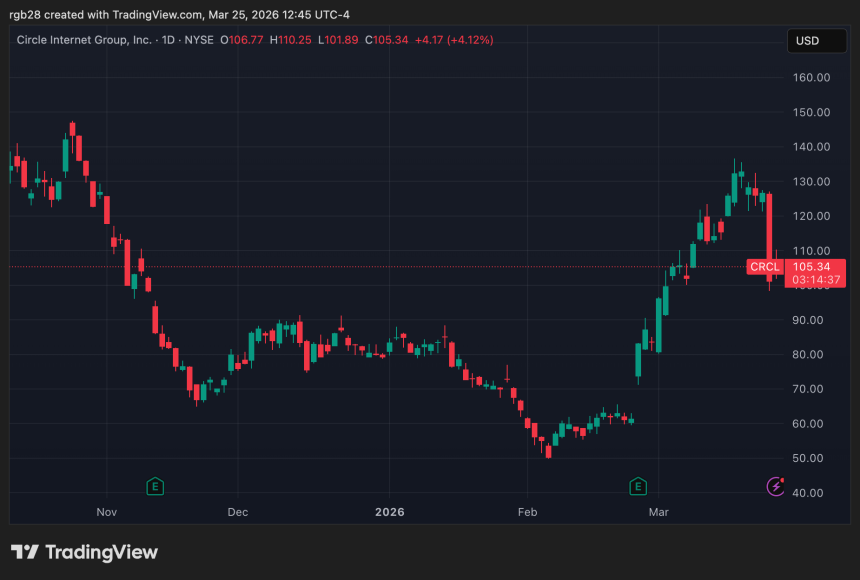
Circle stock, CRCL, experienced a significant decline over the past day following news of a proposed ban on stablecoin yield. Despite this selloff, Bitwise’s CIO maintains that the market reaction was excessive and projects that the company’s valuation will likely double by 2030.

Circle Selloff Was ‘Overblown’ – Bitwise CIO

On Tuesday, Circle Internet Financial, the issuer behind the USDC stablecoin, saw its stock crash 22% to $98 following reports about lawmakers’ decision on the stablecoin yield dispute.

CRCL’s selloff was driven by news that a revised draft of the Senate Banking Committee’s crypto market structure bill, known as the CLARITY Act, would prohibit platforms from offering yield, directly or indirectly, for holding a stablecoin, or in a manner that resembles a bank deposit.

Despite the selloff, some market experts have made the case for Circle, highlighting it as a good opportunity and “the most obvious choice” to invest in the stablecoins sector. In his weekly memo, Bitwise’s CIO, Matt Hougan, called the market’s reaction “overblown.” He asserted that the latest draft of the CLARITY Act doesn’t alter the base case forecast for Circle.

Hougan also emphasized that stablecoins offer convenience, which is “the killer app for money,” pointing out that the average savings account and average checking account yield 0.60% and 0.07%, respectively.

“People aren’t parking their money there for the yield,” he noted, adding that as the global financial system increasingly transitions to blockchain-based rails, stablecoins are expected to assume a more significant role in this shift, irrespective of whether they offer interest.

The Case For Circle’s $75B Valuation

Diving deeper into his outlook for Circle, Hougan shared key projections for the broader stablecoin sector’s market capitalization and the company’s potential market share in the coming years.

Citing Citigroup’s report, he asserted that the “base case” for stablecoin‘s assets under management (AUM)  projects it will reach $1.9 trillion by 2030, while a “bull case” estimates it at $4 trillion.

Bitwise’s CIO also highlighted that Circle’s USDC, the second-largest dollar-pegged token, holds 25% of the overall stablecoin market share, only behind Tether’s USDT, but has a much larger share of the regulated stablecoin market, with an estimated 80%+ share.

Lastly, he addressed what Circle could potentially earn on deposits in four years. As he explained, the company earns roughly 4% interest on $80 billion of its AUM backing USDC, but shares around 60% with distribution partners like Coinbase, netting a 1.6% take rate.

While its sustainability hinges on interest rates and competition from rival stablecoins, Hougan projected that the take rate will be cut in half by 2030, to 0.8%.

Using these “conservative assumptions” on the broader stablecoins market cap, the company’s market share, and margin, Bitwise’s CIO concluded that Circle could hit “$75 billion by 2030—even with the recent CLARITY Act concerns.”

Circle, CRCL
Market Opportunity
The AI Prophecy Logo
The AI Prophecy Price(ACT)
$0.01314
$0.01314$0.01314
-4.29%
USD
The AI Prophecy (ACT) Live Price Chart
Disclaimer: The articles reposted on this site are sourced from public platforms and are provided for informational purposes only. They do not necessarily reflect the views of MEXC. All rights remain with the original authors. If you believe any content infringes on third-party rights, please contact [email protected] for removal. MEXC makes no guarantees regarding the accuracy, completeness, or timeliness of the content and is not responsible for any actions taken based on the information provided. The content does not constitute financial, legal, or other professional advice, nor should it be considered a recommendation or endorsement by MEXC.

You May Also Like

The FDA Is Trying To Make Corporate Free Speech Situational

The FDA Is Trying To Make Corporate Free Speech Situational

The post The FDA Is Trying To Make Corporate Free Speech Situational appeared on BitcoinEthereumNews.com. BENSENVILLE, ILLINOIS – SEPTEMBER 10: Flanked by U.S. Attorney General Pam Bondi (rear), and FDA Commissioner Marty Makary (R), Secretary of Health and Human Services Robert F. Kennedy Jr. speaks to the press outside Midwest Distribution after it was raided by federal agents on September 10, 2025 in Bensenville, Illinois. According to the company, various e-liquids were seized in the raid. (Photo by Scott Olson/Getty Images) Getty Images While running for President in 2008, Barack Obama famously chanted “Yes we can.” Love or hate his political views, Obama’s politics were quite effective. He was asking voters to think big, to envision a much better future. Advertisers no doubt approved. That’s because ads routinely evoke things not as they are, but as they could be. Gyms and exercise equipment companies don’t promote their locations and equipment with flabby, lumbering people, rather their ads show fit, upright, energetic individuals. A look ahead. Restaurants do the same with ads showing happy people enjoying impressively put together plates of food. Conversely, ads meant to convince smokers to quit have not infrequently shown the worst of the worst future downsides of the habit. The nature of advertising comes to mind as FDA commissioner Marty Makary puzzlingly brags that “The Trump Administration Is Taking On Big Pharma” in the New York Times. Makary laments pharmaceutical ads that “are filled with dancing patients, glowing smiles and catch jingles that drown out the fine print.” Not explained is whether Makary would be happier if drug companies placed ads with immobile patients, frowns, and funereal music. Seriously, what does he expect? Does he want drug companies to commit billions to drug development to accompany their achievements with imagery defined by misery? Has Makary stopped to contemplate the myriad shareholders lawsuits drugmakers would face if, upon risking staggering sums meant…
Share
BitcoinEthereumNews2025/09/18 06:29
Bitcoin’s cycle clock points to a final high by late October, will ETFs rewrite history?

Bitcoin’s cycle clock points to a final high by late October, will ETFs rewrite history?

The post Bitcoin’s cycle clock points to a final high by late October, will ETFs rewrite history? appeared on BitcoinEthereumNews.com. Bitcoin price trades near $117,000 after the Federal Reserve decision on interest rates, as the 1,065-day post-halving window approaches. The Fed cut rates by 25bps yesterday, placing Bitcoin’s near-term path at the intersection of policy and a cycle marker Axios says has historically captured a “final high” roughly 1,065 days after a prior cycle low. The test window runs through late September and early October, then the market will trade into Thanksgiving on flow, dollar, and rate dynamics that can either extend the advance or start the topping process that prior cycles paired with drawdowns of 40 to 60 percent, according to Axios. Spot ETF demand is the first lever to watch because it turns the cycle into a flow problem. According to CoinShares’ latest weekly fund-flow update, U.S. spot Bitcoin ETFs saw renewed net inflows in late August and early September, measured in billions of dollars, while SoSoValue tracked a mid-September multi-session inflow streak with a single-day print of around $260 million on September 15. Those figures contrast with the post-halving issuance of about 452 Bitcoin per day, calculated as 3.125 Bitcoin per block times roughly 144 blocks per day. When multi-day ETF demand absorbs several thousand Bitcoin per week, the market’s ability to distribute inventory at the highs narrows, and topping processes can lengthen into a plateau rather than a single peak. Macro conditions set the second lever. This month, the euro touched a four-year high against the dollar as cut expectations increased, while front-end Treasury yields eased into the meeting. A softer dollar lowers global financial conditions and often correlates with higher beta across risk assets. At the same time, domestic inflation has cooled from last year’s pace, with August headline CPI at 2.5 percent year over year and core at 3.0 percent, according to the Bureau of Labor…
Share
BitcoinEthereumNews2025/09/18 20:10
Huawei reveals giant new AI chip cluster as Nvidia’s China issues rise

Huawei reveals giant new AI chip cluster as Nvidia’s China issues rise

The post Huawei reveals giant new AI chip cluster as Nvidia’s China issues rise appeared on BitcoinEthereumNews.com. A person walks past a display of an Atlas 900 AI cluster at the Huawei stand during the World Artificial Intelligence Conference at the Shanghai World Expo and Convention Center in Shanghai on July 28, 2025. Hector Retamal | Afp | Getty Images BEIJING — Chinese telecommunications giant Huawei announced Thursday new computing systems for powering artificial intelligence with its in-house Ascend chips, as it steps up pressure on U.S. rival Nvidia. The company said it plans to launch its new “Atlas 950 SuperCluster” as soon as next year. The U.S. has sought to cut China off from the most advanced semiconductors for training AI models. To cope, Chinese companies have turned more to grouping large numbers of less efficient, often homegrown, chips together to achieve similar computing capabilities. Under Huawei’s AI computing infrastructure, a supercluster is connected to multiple superpods, which, in turn, are built from multiple supernodes. Supernodes, which form the base, are built on Ascend chips, using system design to overcome technical limitations imposed by U.S. sanctions. Huawei said its new Atlas 950 supernode would support 8,192 Ascend chips, and that the Atlas 950 SuperCluster would use more than 500,000 chips. A more advanced Atlas 960 version, slated for launch in 2027, would support 15,488 Ascend chips per node. The full supercluster would have more than 1 million Ascend chips, according to Huawei. It was not immediately clear how the systems compared with those powered by Nvidia chips. Huawei claimed in a press release that the new supernodes would be the world’s most powerful by computing power for several years. “Huawei’s announcement on its computing breakthrough is well timed with recent increasing emphasis by the Chinese government on self-reliance on China’s own chip technologies,” said George Chen, partner and co-chair, digital practice, The Asia Group. While he…
Share
BitcoinEthereumNews2025/09/18 14:02